How to patch test skincare: testing a new face product at home
ROUTINE
To patch test skincare at home, apply the new product twice a day for a week to a coin-sized area on the inside of your forearm near the crook of your elbow, without a plaster. If your skin stays calm, test a small area closer to your face for a few more days, such as the side of your neck or along your jawline. Only then does the product go on your whole face. A 24-hour test is not enough, because allergic reactions often only become visible after several days.
How do you patch test skincare at home?
A home patch test for skincare is essentially a repeated open application test: you apply the product the way you would later use it, just to a small area and several times in a row. In dermatology, this method is called the Repeated Open Application Test, or ROAT for short. In the original study by Hannuksela and Salo in the journal Contact Dermatitis, the substances were applied twice a day for seven days to the inner forearm near the crook of the elbow, unless eczema appeared sooner. You can use exactly this pattern for a new cream or serum. The key word is “open”: covering the area with a plaster would seal the product in and put more strain on your skin than everyday use does. That tends to produce false alarms rather than greater certainty. Wash the test area as usual during that week, but do not apply anything else new to it.
- Choose the spot: the inside of your forearm near the crook of your elbow, marked with a dot of ballpoint pen.
- Amount: as much as you would normally use on a coin-sized area, no more.
- Rhythm: morning and evening, for seven days, on the same spot.
- Second stage: if everything stays calm, a small area on the side of your neck or along your jawline for three to five days.
- Take notes: every evening, jot down whether the area is red, itchy or feels different.
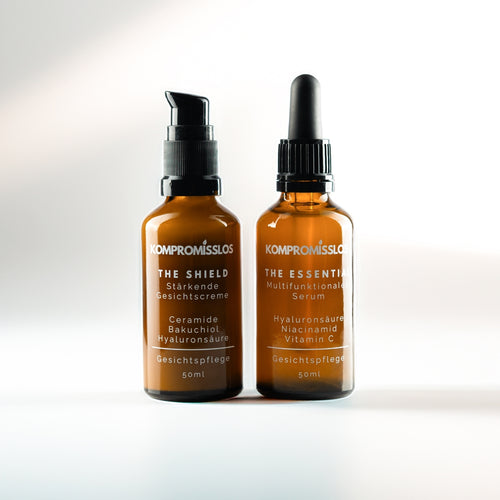
For The Duo of serum and cream, this means testing the two products on two separate, marked areas so that you can clearly tell which one caused any reaction.
Where should you patch test a new face cream?
The best way to test a new face cream is in two stages: first on your forearm, then on a small area closer to the skin of your face. The reason is that skin does not react the same way everywhere. A study in the journal Contact Dermatitis tested a face cream containing a known preservative on sensitised people, first on the upper arm, then on the neck and then on the face. The skin’s reactivity increased from the upper arm to the neck and possibly to the face. The authors considered exactly this sequence, from arm to neck to face, a sensible way of checking for reactions to cosmetics. What this means for you: a calm forearm is a good first sign, but not yet a guarantee for your face. The second stage should therefore be close to where you will actually use the product, such as the side of your neck, along your jawline or just in front of your ear. Your eyelids and the area around your mouth are unsuitable test spots, because the skin there is particularly sensitive and it is the last place you want a reaction.
How long does a patch test take?
A meaningful patch test takes around a week on the forearm, followed by a few more days close to the face – about ten to twelve days in total. A single day is not enough. Irritation from too much acid or alcohol often shows up quickly, whereas an allergic contact reaction is a delayed response of the immune system and takes time. Just how much this matters is shown by an analysis from Groningen in the journal Contact Dermatitis: of 3,292 patients tested with the extended European baseline series at the university hospital’s dermatology department there between 2008 and 2018, 447, or 13.6 per cent, showed new positive reactions at the day-seven reading that had not been there on day three. That was a diagnostic test using patches, not a home test. But the principle is the same: if you give the all-clear after 24 hours, you simply cannot see some reactions yet. How long it then takes for a product your skin tolerates to make a visible difference is a separate question, which we answer in how long skincare takes to work.
Which reactions are a warning sign?
A warning sign is anything that persists at the test site, spreads or gets stronger with each application: lasting redness, itching, swelling, small bumps or blisters, weeping or flaking skin. A brief tingle straight after application that fades within a few minutes, on the other hand, is often a harmless sensory reaction, especially on dry or sensitive skin. Where the line between the two lies is explained in more detail in the article on why a face cream stings. For the test itself, one simple rule applies: if there is a clear warning sign, stop, rinse the area with water and do not apply the product again – not even “just once more to check”.
| What you notice at the test site | What it means | What you do |
|---|---|---|
| Brief tingle, gone within minutes | Usually a harmless sensory reaction | Keep testing and observing |
| Slight redness that has gone by the next day | Unclear, more likely irritation | Take a day’s break, then test again |
| Redness or itching that gets worse from day to day | Warning sign | Stop the test, do not use the product |
| Blisters, swelling, weeping skin or spreading beyond the area | Clear warning sign | Stop and seek medical advice |
What can’t a patch test rule out?
A patch test cannot rule out that your face will still react later. It shows you whether your skin stays calm on a small area over one week, nothing more. Three things remain open. First, a contact allergy can also develop only after longer, repeated use; the test only reflects the first phase. Second, it does not pick up clogged pores: you cannot tell from your forearm whether a product will give you breakouts, and ratings of comedogenic ingredients are of only limited help here. Third, it tests the product on its own. On your face, it meets your cleanser, other active ingredients, sun and dry heated air. New spots in the first few weeks can also have various causes. Whether it is an intolerance or so-called skin purging after new skincare is a separate question that a patch test cannot answer.
Never test on irritated, sunburnt or freshly shaved skin. An area that is already stressed reacts to almost anything and makes the result worthless.
How do you introduce a new product gradually after the test?
After an uneventful test, introduce a new product by adding only one new item to your routine at a time and giving it at least one to two weeks before the next one joins. On your face, start with one application a day, in the evening for example, and only increase to twice a day if your skin stays calm. Keep a short skin diary as you go: date, product, amount and one word on how your skin feels. That may sound pedantic, but it is the only way to link a reaction to a specific product later on. If you start three new products at once and then get redness, you will not know which one it was and will have to stop them all. In her review on Judge.me, Meret S. writes that she tried the products “individually and cautiously at first” (review translated from German). That is exactly the method. For The Duo, this means starting with the serum on its own and adding the cream after one to two weeks. Used twice a day with both products, the Duo lasts around two months, which is a realistic period for properly judging how well your skin tolerates it. And if your skin still does not play along, there is a 100-day return policy.
When does an allergy test at a dermatologist make sense?
An allergy test at a dermatologist makes sense if you react to several products, if eczema keeps coming back even after you stop using something, or if a reaction was severe, for example with swelling of the face or eyelids. At that point, a home test is no longer enough, because it only tells you that a product does not suit you, not which substance is behind it. The standard method here is the epicutaneous patch test. In its guideline, the European Society of Contact Dermatitis describes how this test is carried out and evaluated, and also how specialists test products that patients bring in themselves. So take your skincare products with you to the appointment, including the packaging with the ingredient list. If your face is permanently red without any particular product being the trigger, a skin condition such as rosacea may be behind it, and that also belongs in professional hands. And if your skin has recently started reacting to almost every new product, it is worth looking at the possible causes before your next test: when your skin suddenly reacts to everything.
Both our products are fragrance-free and dermatologically tested. Even so, I recommend a patch test before you use them on your whole face. That is not a contradiction. A dermatological test shows how well a group of test subjects tolerated a product, but it cannot cover every individual skin. Every formula contains substances that someone, somewhere may react to, even one without fragrance. That is why I disclose the full ingredient list, so that you can check it against any intolerances you know about. I do not promise you that The Duo will suit every skin. I would rather tell you how to find out honestly in about two weeks. How to use the two products in your daily routine after that is explained under how to apply the serum and cream.
Frequently asked questions
Is behind the ear the best place for a patch test?
Behind the ear is a reasonable second test spot, but not ideal as the only one. It is close to the face, but it comes into contact with hair, shampoo and styling products, which can skew the result. It is better to use the forearm near the crook of the elbow as the first stage, followed by the side of the neck or the jawline.
Do I need to patch test every new product?
No, not necessarily. A test makes most sense if you have sensitive skin or known intolerances, for products with acids or new active ingredients, and for anything you use on your face every day. A shower gel that is rinsed off straight away is less of a concern than a cream that stays on your skin all day.
Do I test a serum the same way as a cream?
Yes, the method is the same: twice a day, uncovered, on the same small area, for one week. Use only as much as you would normally apply to that area. Test the serum on its own and not with the cream on top, otherwise you cannot tell which product caused a reaction.
Can I patch test several products at the same time?
On your forearm, yes, as long as the test areas are clearly separated and marked, a few centimetres apart. That saves time. On your face, however, introduce the products one after the other, otherwise you will not know which product triggered a reaction.
What is an epicutaneous patch test?
The epicutaneous patch test is the allergy test dermatologists use for contact allergies. Individual test substances are applied to the back under patches and read after a few days, often again around day seven. Unlike a home test, it shows which substance you react to, not just which product.
Can a reaction appear only after several weeks?
Yes, that is possible. A contact allergy can also develop only after longer, repeated use, even with a product you tolerated well at first. If new redness or an itchy rash appears, stop using the product you introduced most recently and, if reactions keep coming back, have it checked by a dermatologist.
How do I patch test The Duo before using it on my whole face?
Apply the serum and the cream twice a day for a week to two separate areas on your forearm, then for a few days to the side of your neck. If everything stays calm, start on your face with the serum on its own and add the cream after one to two weeks. Used twice a day, The Duo lasts around two months – enough time to reach an honest verdict.
Sources
- Hannuksela M, Salo H. The repeated open application test (ROAT). Contact Dermatitis, 1986. Source
- Zachariae C, Hall B, Cottin M, Cupferman S, Andersen KE, Menné T. Experimental elicitation of contact allergy from a diazolidinyl urea-preserved cream in relation to anatomical region, exposure time and concentration. Contact Dermatitis, 2005. Source
- van Amerongen CCA, Ofenloch R, Dittmar D, Schuttelaar MLA. New positive patch test reactions on day 7 – the additional value of the day 7 patch test reading. Contact Dermatitis, 2019. Source
- Johansen JD, Aalto-Korte K, Agner T, Andersen KE, Bircher A, Bruze M et al. European Society of Contact Dermatitis guideline for diagnostic patch testing – recommendations on best practice. Contact Dermatitis, 2015. Source