Rosacea skincare: what cosmetics can do and when to see a dermatologist
SKIN CONDITION
Rosacea skincare can avoid irritants, support the skin barrier and visibly calm the complexion. It cannot treat the condition itself. Rosacea is a chronic inflammatory skin condition, and its diagnosis and treatment belong in the hands of a dermatologist. Cosmetics can accompany that path; they do not replace it.
What is rosacea, and what is it not?
Rosacea is a chronic inflammatory, non-contagious skin condition that mainly affects the centre of the face: the cheeks, nose, forehead and chin. Typical signs are persistent redness, sudden flushing, visible small blood vessels and, in some people, inflammatory papules and pustules. The guideline of the German Dermatological Society classifies the condition by phenotype – that is, by the signs that are actually present – rather than by rigid stages. Not all red skin is rosacea. Skin that feels tight after washing or reacts to the cold describes a skin condition, not a skin type, and a skin condition is not a diagnosis. A few visible blood vessels on their own are not rosacea either. It differs from acne in that there are no blackheads. The condition usually begins in middle age and comes in flare-ups, with calmer phases in between. Many people with rosacea also report burning, stinging or a feeling of dryness, even though the skin need not look dry on the outside.
This distinction is not a detail. It decides whether your skincare is the right tool at all. If you are dealing with facial redness without a diagnosis, cosmetics have plenty of scope. If it is rosacea, that scope narrows and seeing a dermatologist becomes more important.
What can skincare do for rosacea?
Rosacea skincare has three realistic jobs: to cleanse with as little irritation as possible, to give back moisture and barrier building blocks, and to protect the skin from UV. As basic measures, a review in the German medical journal Deutsches Ärzteblatt lists avoiding triggers such as alcohol, spicy food, heat, cold and irritating facial products, together with consistent UV protection and a hydrating base skincare. A review in the Journal of Clinical and Aesthetic Dermatology concludes that mild cleansers and moisturisers are beneficial for people with rosacea. What skincare cannot do: it does not make a diagnosis, it does not replace prescribed treatment and it does not make visible blood vessels disappear. If you know where that line lies, you choose products more calmly and do not expect a cream to do what a treatment has to do. At the same time, skincare contributes more than it sounds: it stops a self-inflicted irritation from being added to what is already happening. With rosacea, that is often a bigger lever than any single active ingredient.
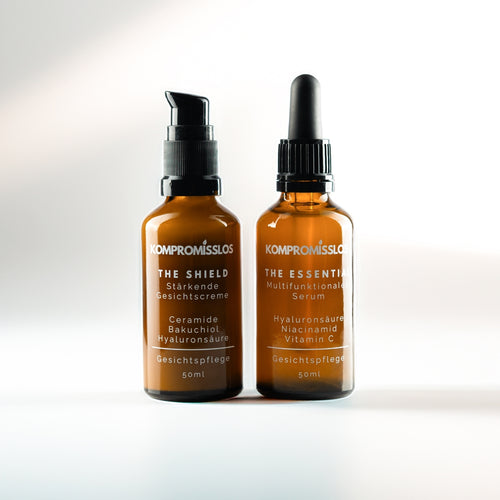
In concrete terms, low-irritation means short ingredient lists, no experiments during a flare-up and a routine that does not challenge your skin afresh every day. The Duo, our serum and cream, contains 5% niacinamide, 2% hyaluronic acid, ceramides, squalane and panthenol, with all values relative to the Duo as a whole. That is barrier care for sensitive skin, not a rosacea treatment. You will find the full list in our overview of all ingredients.
Which products often make rosacea look worse?
Four things most often make the complexion worse: toners high in alcohol, mechanical scrubs, high-strength acids and heavily fragranced products. Then there is how you apply them. Hot water, friction from a brush or flannel and vigorous towel-drying often take more of a toll on the skin than the formula itself. The review on cleansers and moisturisers in rosacea mentioned above describes exactly this interplay between ingredients and application as decisive for how well a product is tolerated. Even well-meant routines can tip over quickly here: if you introduce a new serum during a flare-up, you can no longer tell afterwards what caused the stinging. One pattern comes up again and again in the questions we receive: the routine was not too weak but too full. Four products in the evening are four possible triggers. With irritated skin, one step fewer is almost always the better step, and anything new only comes in once the skin has calmed down.
| What often irritates | Why it is a problem | A gentler approach |
|---|---|---|
| Toners high in alcohol | They strip lipids from the barrier and often sting immediately. | An alcohol-free cleanser, followed directly by a moisturiser. |
| Mechanical scrubs and brushes | Friction and heat can trigger a flare-up. | Fingertips only, lukewarm water, pat dry gently. |
| High-strength acids | They put extra strain on a barrier that is already irritated. | A low concentration, and only after talking to your dermatologist. |
| Heavily fragranced skincare | Fragrances are considered a common cause of burning and stinging. | Short ingredient lists and a patch test on a small area. |
Which acid does what, and which is considered gentler, is explained in our article comparing AHA, BHA and PHA. With diagnosed rosacea, however, that decision lies with your dermatologist, not with a blog post.
When should you see a dermatologist about rosacea?
As soon as redness in the centre of the face stays instead of fading again, it should be looked at. The same applies to inflammatory papules and pustules without blackheads, persistent burning or stinging, irritated eyes and eyelid margins, and any thickening of the skin on the nose. If you have already cut back your skincare and your skin still does not calm down, that is a signal too. A dermatologist makes the diagnosis based on the clinical picture; as a rule, no elaborate tests are needed. Timing matters: the earlier you get a clear assessment, the sooner you know whether skincare is the main path or only an accompaniment to treatment. An appointment costs you little and ends the guesswork. The part most often overlooked is eye involvement, because it does not feel like a skin problem. Burning eyes and red eyelid margins still belong in the same assessment.
One customer wrote to us that the centre of her face was permanently red, stung after washing and that she had already tried several products. Her question was whether The Duo would get rid of it. We replied that we cannot promise that, and that we cannot judge from a distance whether it is rosacea. Our suggestion was to see a dermatologist first and then decide whether, and when, to add a base skincare. Answers like that cost us orders. They are still the only answers we can stand behind. How to use the products, if your dermatologist has no objection, is explained on our page on how to use the serum and cream.
Why we make no claims for The Duo in rosacea
Cosmetics may influence how the skin looks; they may not treat a disease. That is why none of our pages says that The Duo helps with rosacea, and why you will not find any before-and-after pictures on this subject from us. What we can say is this: the formula is designed for sensitive skin with a weakened barrier, and many customers describe it as pleasantly well tolerated. But feedback is not evidence, and certainly not grounds for a conclusion about a disease. To be honest, there is also a contraindication: if your skin is burning in the middle of a flare-up, no new product is the right place to start – ours included. Then what counts is cutting back, not adding. That is why we quote feedback as what it is: individual experiences. We never turn it into a statement about a disease, however good that would read. How to recognise a weakened barrier is described in our article on the disrupted skin barrier.
If you have no diagnosis and your skin simply reacts quickly, that is a different starting point. That is what we made our skincare for, and our article on caring for sensitive skin will suit you much better than this one.
I made a deliberate decision not to mention rosacea on our product page at all. The term would convert well; I can see that from the questions we receive. But I do not sell hope to people who need a diagnosis. For the same reason, The Duo contains no retinol and no high-strength acid, but 0.3% bakuchiol instead. I wanted skincare that still works when your skin tolerates very little, rather than something that looks strong on paper and stings on your face.
Frequently asked questions
Can I use The Duo if I have rosacea?
That is for your dermatologist to decide, not us. If they see no reason against it, test it on a small area first and do not introduce the serum and cream at the same time as a new treatment. During an acute flare-up, we generally advise against starting any new product. Then cutting back makes more sense than adding.
What is the best way to cleanse your face if you have rosacea?
Lukewarm rather than hot water, fingertips rather than a brush or flannel, no toners high in alcohol and no scrubs. Afterwards, pat your skin dry gently and apply your skincare while it is still slightly damp. Twice a day is enough; during a flare-up, a short cleanse in the evening is often sufficient.
Is natural skincare automatically better tolerated with rosacea?
No. Plant-based does not mean low-irritation: essential oils and strongly scented plant extracts are among the common triggers of burning and stinging. What matters is the individual formula, not the label. Look at the length of the ingredient list and whether it contains parfum, rather than at the word natural on the packaging.
Which face cream is suitable for rosacea?
One that does not try to do too much: formulated to be low-irritation, with humectants and barrier building blocks, fragrance-free and without a high concentration of acids. Whether a particular cream suits you depends on your phenotype and on any ongoing treatment. That is why agreeing it with your dermatologist matters more than any best-of list.
Is vitamin C a problem with rosacea?
That depends on the form and concentration. Pure ascorbic acid in high doses is often poorly tolerated by reactive skin. The Duo contains 2% vitamin C as 3-O-ethyl ascorbic acid, a stable form that is considered milder. Even so, with diagnosed rosacea the rule is: get it checked first, then test.
What is the difference between couperose and rosacea?
Couperose describes visibly dilated small blood vessels on the face, usually on the cheeks and the sides of the nose. Rosacea is a chronic inflammatory skin condition that can include such blood vessels, but does not have to. Visible blood vessels on their own are therefore not rosacea. A dermatologist makes the distinction.
Can you exfoliate if you have rosacea?
Mechanical scrubs with grains or brushes are not a good idea for skin with rosacea, because friction and heat can trigger a flare-up. Chemical peels are not ruled out across the board, but they should be agreed with your dermatologist. Without a diagnosis, the rule is: when your skin is irritated, it is better to take a break.
Sources
- Deutsche Dermatologische Gesellschaft, S2k-Leitlinie Rosazea: Phänotypbasierte Einteilung für Diagnostik und Therapie, 2022. Source
- Deutsches Ärzteblatt, Rosazea Teil 2 (Therapie): Neue Aspekte in Diagnostik, Klassifikation und Therapie. Source
- Levin J, Miller R, A Guide to the Ingredients and Potential Benefits of Over-the-Counter Cleansers and Moisturizers for Rosacea Patients, The Journal of Clinical and Aesthetic Dermatology, 2011. Source