Skin condition, not skin type: what really matters for your skincare
SKIN CONDITION
Your skin condition describes how your skin is behaving right now: dry, blemished, red, sensitive or dull. It changes with the seasons, hormones, stress and your skincare. Your skin type, by contrast, is genetically determined and stays largely stable. When you choose products, it is your skin condition rather than your skin type that counts, because you can influence it. Your skin type only tells you where you’re starting from.
What is the difference between skin condition and skin type?
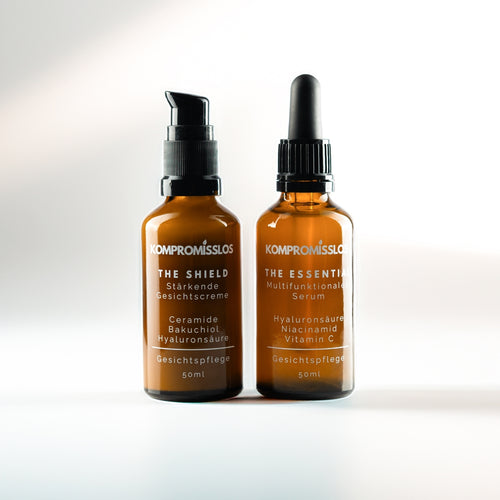
Your skin type is your predisposition; your skin condition is a snapshot. Skin type describes how much sebum your skin naturally produces, and that is something you are born with. It shifts over decades, not weeks. Skin condition, on the other hand, describes how your skin is reacting today. It can tip within a few days, because it depends on the season, central heating, hormones, sleep, stress and your own skincare. That is why oily skin can be dehydrated at the same time, and why skin that gave you no trouble in August suddenly feels tight in January. If you buy products by skin type, you are buying according to a constant that tells you little about what your skin needs right now. If you care for your skin according to its condition, you respond to what is actually happening. That is exactly what our Duo of serum and cream is designed for. So the difference isn’t a play on words: it decides whether you are buying a category or meeting a specific need.
What skin conditions are there?
The common skin conditions are dehydrated, dry, blemished, red and sensitive, dull, and mature with declining elasticity. They rarely occur on their own. Skin can look oily and shiny and be dehydrated at the same time, because sebum and moisture are two different things: sebum is oil, moisture is water. This is precisely the combination that is most often treated wrongly, because the shine tempts you towards oil-stripping products even though your skin is short of water. Redness and sensitivity also often go together, but they don’t necessarily share the same trigger. The order matters: a weakened skin condition makes your skin more susceptible to everything else. As long as the barrier isn’t stable, even well-tolerated active ingredients cause a stronger reaction than usual. So it pays to calm the underlying condition first and only then work on individual concerns such as blemishes or dark spots. The barrier is always the foundation; everything else builds on it.
| Skin condition | How to recognise it | What your skincare needs to do |
|---|---|---|
| Dehydrated | Your skin looks shiny but feels tight at the same time and looks lacklustre. | Bind moisture rather than strip oil. |
| Dry | Your skin flakes slightly, feels rough and soon needs cream again. | Supply lipids and moisture together. |
| Blemished | Clogged pores, the odd inflamed spot, an uneven surface. | Stay gentle and avoid weakening the barrier further. |
| Red and sensitive | Your skin reacts to changes in temperature, active ingredients or fragrance with a burning sensation. | Visibly calm the skin and reduce sources of irritation. |
| Dull | Your complexion looks grey and lacks radiance, especially in the morning. | Help create a more even-looking complexion. |
| Mature with less elasticity | Dehydration lines stay visible for longer, and contours look softer. | Support the skin barrier in the long term. |
How can you tell what condition your skin is in?
Assess your skin twice a day for four weeks, always in the same light and at roughly the same time. The best moment is about twenty minutes after cleansing, before you apply anything. In that window, your skin shows what it does on its own. Note down three things: whether it feels tight, whether it shines, and exactly where. Tightness without shine points to dryness, shine with a feeling of tightness to dehydration, and shine in the T-zone with calm cheeks to a combination picture. Four weeks isn’t an arbitrary period: the top layer of skin renews itself continuously, and individual days tell you little. If you pass judgement after three days, you are assessing the weather and your sleep, not your skin. Do actually write the three observations down, because memory is unreliable at recording how things develop and almost always gives too much weight to the most recent day. How to turn your observations into a fixed routine is explained on our how-to-use page.
A common mistake: changing your skincare at the same time. If you introduce a new product in the middle of your observation period, you won’t know afterwards whether the change came from your skin or from the product. Observe first, then change.
Is dry skin a skin type or a skin condition?
Dry skin can be either, and this ambiguity causes most of the confusion. As a skin type, dry means your skin permanently produces little sebum, often since adolescence, and therefore has less of its own protection against moisture loss. As a skin condition, dry means your skin is currently short of water, regardless of how much sebum it produces. The second case is considerably more common and is correctly called dehydrated. It also affects people with an oily predisposition, which is why oil-stripping products often make the problem worse for them rather than solving it. The distinction is practical, not academic: with a dry predisposition you permanently need more lipids; with a dry condition you mainly need moisture and calm. Confuse the two and you end up buying rich creams for a water problem or mattifying products for a predisposition – and both miss the point. We have openly set out which active ingredients do what in our ingredients overview.
How do you care for your skin by condition rather than type?
You keep the basics constant and only adjust the amount, rather than switching products every time something changes. That is the practical core of it. A routine built on moisture, lipids and barrier support covers almost every skin condition, because those three needs are the same everywhere. What differs is the dose. For us, that means specifically three to six drops of serum and three to six pumps of cream, morning and evening. In a dry phase you go to the top of the range; in a calm phase, the bottom is enough. That range isn’t vague – it is the actual adjustment to your skin condition. If you swap products every few weeks instead, you collect variables rather than insights and end up not knowing what worked. This is exactly the logic behind the composition of the serum and cream in the Duo.
If your current condition is a restless, blemished complexion, you’ll find it explained in our article on blemish-prone skin and its causes. If your skin looks dull, the comparison between vitamin C and niacinamide will help. If redness is the main issue, our article on what gentian root extract does explains what a soothing plant extract can achieve.
When should a skin condition be seen by a dermatologist?
As soon as symptoms persist, spread or come with pain, weeping or severe itching, they belong with a doctor, not in a skincare routine. Cosmetics work on the appearance of the skin. Diagnoses such as rosacea, acne, atopic dermatitis (eczema) or perioral dermatitis are made by dermatologists and treated by dermatologists, and no cream replaces that. The difference can usually be pinned down by three things: duration, spread and accompanying symptoms. An irritated patch after a new product that settles within a few days of stopping that product is a reaction. Redness that has lasted for months and is getting worse is a case for a professional. Cosmetic care can still be a sensible accompaniment during such phases, but it replaces neither diagnosis nor treatment and should then be especially low in irritants. Drawing this line isn’t backing out; it is the most honest point in any skincare article. We make cosmetics, and that is a clear boundary.
I thought for a long time about whether we should sort our products by skin type, as almost everyone does. I deliberately decided against it. The reason is unspectacular: in my own skin and in customer feedback, I kept seeing that the same person’s skin changes more within a year than it differs between two people with supposedly different skin types. A line for dry skin and another for oily skin would have meant buying again every time things shifted. Instead, there are two products whose amount you adjust. Commercially, that is less attractive for us, but it is more honest about what skin actually does.
Dominic Bertschin
Frequently asked questions
Can my skin condition change?
Yes, your skin condition changes constantly, often within a few weeks. The season, central heating, hormonal fluctuations, sleep, stress and your own skincare all affect it. That is exactly what distinguishes it from your skin type, which as a predisposition stays largely stable. So it makes sense to adjust the amount of product you use rather than constantly buying new products.
How many skin conditions can I have at once?
Several – and that is normal. Skin can be dehydrated, red and blemished at the same time. The combination of a shiny T-zone and a feeling of tightness is particularly common and is often mistaken for oily skin. Start with the condition that puts the most strain on the barrier, and only then work on the other concerns.
How long does it take for a skin condition to change visibly?
Allow four to eight weeks before you can reliably judge a change. Short-term effects such as a plumper skin feel from added moisture show sooner, but they say little about the underlying condition. It is important not to change anything else during this time, or you won’t know what the change is down to.
Do I need different products for each skin condition?
No. Almost every skin condition needs moisture, lipids and support for the skin barrier – just in different amounts. That is why two products whose dose you adjust are enough with us: three to six drops of serum and three to six pumps of cream, morning and evening. Switching products frequently makes it harder to judge rather than helping.
Can oily skin be dry?
Yes, and this is more common than many people think. Sebum is oil, moisture is water, and the two are independent of each other. Skin can look visibly shiny and still have too little water in its upper layers. The technical term for this condition is dehydrated. Oil-stripping products usually make it worse rather than resolving it.
Does that make skin type completely irrelevant?
No, it remains the starting point. Your skin type tells you how much natural oil your skin brings with it, and therefore roughly where your baseline lies. For concrete, everyday decisions, though, skin condition is the more useful yardstick, because you can influence it – and you can’t influence your skin type.