Skin age test: what skin analysis devices and apps really measure
SKIN OVER 40
A skin age test does not measure the biological age of your skin. It measures individual characteristics, and software then turns them into an age figure. Selfie apps use AI to estimate how old your face looks in a photo. Measuring devices record values such as the moisture content of the skin’s outermost layer, water loss, sebum or elasticity. These figures fluctuate with lighting, time of day, room climate and the device used. They are only useful as a trend tracked under the same conditions – not as a verdict on your skin and not as a reason to buy anything.
What does a skin age test actually measure?
A skin age test never measures age directly; it measures properties of the skin’s surface and compares them with a reference group. There is no recognised method that determines a “biological skin age” as a fixed quantity. What does exist are two families of methods. The first works with images: a camera or your smartphone photographs your face, and software analyses wrinkles, pigmentation spots, pores, redness and texture. The second works with probes placed directly on the skin to record physical values, such as the moisture in the uppermost layer of skin or how much water evaporates through it. Many services combine the two and convert the result into a single number. “Your skin looks 44” then simply means that your values resemble the average for 44-year-olds in the provider’s dataset. Who is in that dataset, how large it is and under what conditions the photos or measurements were taken is something you are usually not told.
Apps that rate the ingredients in cosmetics, incidentally, do not belong in this category: they measure nothing on your skin, they just read an ingredients list. And if what you really want to know is how to recognise healthy skin in the first place, you will find more on that under the heading of skin longevity than in any score.
| Method | What it records | What it tells you | Typical sources of error |
|---|---|---|---|
| Selfie app with AI | Wrinkles, spots, pores and texture in the photo | How old the face looks in this particular image | Lighting, camera, angle, make-up, filters |
| Camera with UV or polarised light | Pigment below the surface, redness | Distribution of spots and redness | Distance, exposure, software version |
| Corneometer | Moisture in the stratum corneum | How well the outermost layer holds on to water | Freshly applied skincare, room climate |
| TEWL measurement | Water loss through the skin | Condition of the skin barrier | Temperature, humidity, time of day, sweating |
| Sebumeter | Amount of sebum on the surface | How oily the skin is at that moment | Time since cleansing, measuring site |
| Elasticity measurement | Rebound after suction | Firmness at the measuring site | Measuring site, contact pressure |
How do selfie apps calculate your skin age, and how accurate are they?
Selfie apps usually calculate your skin age with a model that has learned to estimate chronological age from photos of faces, and then present that estimate as your “skin age”. Such models are trained on thousands of images of people whose actual age is known. A paper in the journal Aging shows how well this can work under laboratory conditions: a neural network was trained on 8,414 high-resolution images of the outer corners of the eyes and, for people aged between 20 and 80, its estimates were on average 2.3 years away from their chronological age. According to the study, this figure applies to a specific population, and several of the authors work for a skin analysis company or a cosmetics group.
For everyday life, this means two things. First, a selfie taken in bathroom lighting is not a standardised, high-resolution study image. The more the lighting, camera and posture vary, the less the number tells you. Second, a gap of two or three years between the app and your passport is already within the margin of error that even a good model brings with it. That said, perceived age is not meaningless. A cohort study in the BMJ asked nurses, young men and older women to estimate the age of twins aged 70 and over from photographs. Those who looked older had a higher risk of death, even after their chronological age was taken into account. However, this concerned the general health of older people, not the effect of any skincare, and the estimates came from people, not from an app.
What do skin analysis devices in chemists, pharmacies or beauty salons measure?
Skin analysis devices most often measure moisture, sebum and the appearance of the skin, less often barrier function and elasticity – and each of these methods looks at only a small section of your skin. A Corneometer, for example, measures the electrical capacitance of the stratum corneum, which rises with its water content. Other devices measure conductance instead. A comparative study in Skin Research and Technology showed that both methods estimate water content well but look to different depths: the capacitance method down to about 45 micrometres, the conductance-based method down to about 15 micrometres. In the test on living skin, the two sets of measurements correlated closely, yet each device displays its values on its own scale. A reading of 50 on one device is therefore not the same as 50 on another.
These are the methods you are most likely to come across:
- Moisture probe: a value for the stratum corneum, often shown as a number or a percentage, although small handheld devices rarely disclose how it is calculated.
- Sebum measurement: a test strip absorbs sebum, and the device measures how translucent the strip has become.
- Water loss measurement (TEWL): a chamber measures how much water vapour the skin releases, which indicates how well the barrier is working.
- Image analysis with special lighting: reveals pigment and redness that are barely visible in normal light.
- Autofluorescence measurement: some devices use it to estimate so-called advanced glycation end products (AGEs) in the skin – a separate topic that has little to do with skincare.
Why do two tests on the same day show different results?
Two tests on the same day show different results because skin measurements depend heavily on the time of day, the environment and how you prepared. A study in the Journal of Investigative Dermatology measured water loss, hydration, pH and temperature of the skin on the forehead, forearm, upper back and shin of 16 healthy volunteers every two hours over 24 hours. Water loss, pH and skin temperature followed a daily rhythm, whereas the hydration of the stratum corneum did not. The authors concluded that the skin is more permeable in the evening and at night than in the morning. A guidance document from the European expert group EEMCO notes that a large number of factors are known to influence the measurement of water loss, and that reliable, reproducible results can only be obtained under standardised conditions.
In a salon or pharmacy, this kind of standardisation is often missing. You have just come in from the cold or were in a hurry, the air in the room is dry, you put on moisturiser that morning, the probe is pressed on firmly one moment and lightly the next, and the reading is taken on the cheek instead of the forehead. With selfie apps, window light, ceiling lights, camera angle and your smartphone’s own image processing come into play as well. Each of these small details can shift the result by a few points. If, on the other hand, you want to find out whether your skin is short of water rather than oil, knowing how to recognise dehydrated skin will help you more than any single measurement.
What is your result actually useful for, and what is it not?
A test result is useful as a trend value that you compare over weeks under the same conditions, not as a grade for your skin. A single number says little; a series of measurements taken with the same device at the same time of day says rather more. To make this work, stick to a fixed routine:
- Same time of day, same room, same device, or the same app with the same camera.
- Measure without make-up and with the same gap since your last skincare, for example in the morning before you moisturise.
- For photos, always use the same daylight, face the camera straight on, and switch off filters and beauty mode.
- Don’t compare more often than every few weeks – months apart is better – because skin does not change measurably from one day to the next.
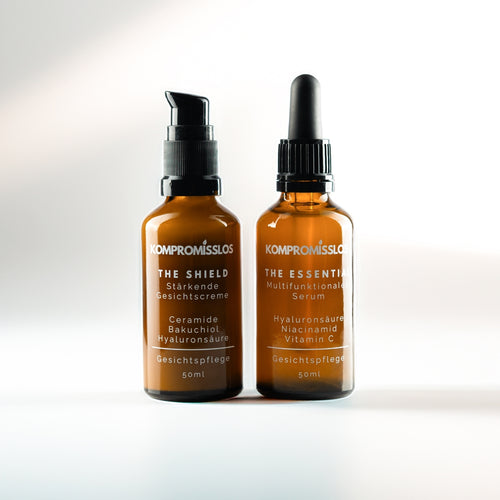
What you should not use it for: comparing yourself with others, justifying a purchase or overhauling your routine on the strength of a single score. You are better off learning to assess your current skin condition and knowing how long skincare takes to work. What a test can reasonably show is moisture, barrier function and irregularities in your complexion – and that is exactly where daily skincare comes in. In The Duo, niacinamide (5% in The Duo) supports a more even-looking complexion, The Essential serum provides moisture with hyaluronic acid in three molecular sizes, and The Shield cream supports the skin barrier with ceramide NP, squalane and jojoba oil. To be honest, none of this lowers your “skin age”. But it can change readings such as moisture that feed into these scores. In her review on Judge.me, Nicole B. writes: “The fine lines don’t go away, which isn’t the point anyway […], but the overall expression becomes softer” (review translated from German). That is a personal impression, not a measurement, and it shows what skincare is really about: how your skin feels, not an age figure.
When should a skin analysis be done by a dermatologist rather than an app?
A skin analysis belongs with a dermatologist as soon as it is no longer about skincare but about a change that is new, conspicuous or bothersome. This includes spots or moles that grow, change shape or colour, itch or bleed, as well as persistent redness, scaling, burning or itching that continues despite gentle skincare. Apps that photograph and assess moles, incidentally, are not skin age tests, and suspicious spots should always be checked by a specialist doctor. A skin age app cannot replace that kind of examination, however medical its analysis may sound.
If, on the other hand, what mainly concerns you is when and how skin ages, it is worth looking at the first signs of skin ageing and at what has been shown to slow down skin ageing. The biggest lever you have in your own hands is not a test, but daily sunscreen for your face.
At Kompromisslos, I won’t promise you “years younger”, and I won’t give you a score. What I can give you are figures you can check for yourself: the page listing all our active ingredients and their concentrations states 5% niacinamide, 2% vitamin C as 3-O-Ethyl Ascorbic Acid and 1% zinc PCA, each for The Duo as a whole. On top of that comes a deliberately simple routine with two products instead of eight. You don’t need a test to get started, and there are no skin-type variants for an app to choose between on your behalf. If your skin is dry, our directions for use say to apply a little more. And because the cream contains no SPF, I’ll say it plainly: in the morning, you need a separate sunscreen as well. I don’t promise more than that, because nothing more can honestly be promised.
Frequently asked questions
Is there a blood test or DNA test for skin age?
There is no established laboratory test that determines a skin age and translates it into a skincare decision. Some services determine gene variants or a so-called epigenetic age from saliva or blood. What that means in concrete terms for the skin on your face and for your skincare has not been established. For everyday purposes, such a number is therefore of little use to you.
How often is a skin age test worth doing?
If at all, then every few months under conditions that are as similar as possible. Skin changes over weeks and months, not days. If you measure every day, you mostly see fluctuations caused by lighting, room climate and time of day, and it is easy to mistake them for real changes. A one-off test with nothing to compare it with provides little useful information.
Can I estimate my skin age at home without an app?
Not as a number, but as an observation, yes. Photograph your face every few months in the same daylight, straight on and without make-up, and compare the pictures. Also pay attention to tightness, shine and redness over the course of the day. That tells you more about your skincare than an age figure from a database whose composition you know nothing about.
What happens to my face photos in a skin analysis app?
That is set out in the app’s privacy policy, and you should read it before you take the first photo. Check whether the images stay on your device or are uploaded, whether they are used to train models, who they are passed on to and how you can have them deleted. Images of your face are highly personal data, so choose an app that answers these questions clearly.
Is a skin analysis at a beauty salon independent?
Not automatically. The analysis is often free or cheap because products from the salon’s own range are recommended afterwards. That need not be a bad thing, but it is not a neutral diagnosis. Ask which device is being used, what exactly was measured and whether you will get the readings yourself rather than just a recommendation.
Can a cream lower my skin age?
No, a cream does not change your age – not even the one in an app. Skincare can provide moisture and support the skin barrier. As a result, individual readings may come out better, and a score that factors in those readings may shift. That is a change in the measurement, not rejuvenation, and it disappears once you stop using the skincare.
Do I need a skin age test before I start using The Duo?
No. The Duo consists of a serum and a cream that you apply morning and evening after cleansing with water – first the serum, then the cream, and a little more if your skin is dry. Measuring beforehand changes nothing about that. If you would still like to keep an eye on your skin, take a photo in the same daylight before you start and, after a few weeks with The Duo from Kompromisslos, compare it with a new one taken under the same conditions.
Sources
- Bobrov E, Georgievskaya A, Kiselev K, Sevastopolsky A, Zhavoronkov A, Gurov S et al. PhotoAgeClock: deep learning algorithms for development of non-invasive visual biomarkers of aging. Aging (Albany NY), 2018. Source
- Christensen K, Thinggaard M, McGue M, Rexbye H, Hjelmborg JV, Aviv A et al. Perceived age as clinically useful biomarker of ageing: cohort study. BMJ, 2009. Source
- Clarys P, Clijsen R, Taeymans J, Barel AO. Hydration measurements of the stratum corneum: comparison between the capacitance method (digital version of the Corneometer CM 825) and the impedance method (Skicon-200EX). Skin Research and Technology, 2012. Source
- Yosipovitch G, Xiong GL, Haus E, Sackett-Lundeen L, Ashkenazi I, Maibach HI. Time-dependent variations of the skin barrier function in humans: transepidermal water loss, stratum corneum hydration, skin surface pH, and skin temperature. Journal of Investigative Dermatology, 1998. Source
- Rogiers V; EEMCO Group. EEMCO guidance for the assessment of transepidermal water loss in cosmetic sciences. Skin Pharmacology and Applied Skin Physiology, 2001. Source