Dehydrated skin: how to recognise it and why it isn’t the same as dry skin
SKIN CONCERNS
The difference between dehydrated and dry skin comes down to what is missing: dry skin lacks lipids, while dehydrated skin lacks water in its outermost layer. Dryness is usually a lasting trait of your skin; dehydration is a temporary condition that can affect any skin type, oily skin included. Typical signs of dehydrated skin are tightness despite shine, a dull complexion and fine, crinkly lines. It needs humectants that bind water and a layer on top that holds it in.
How can you tell if your skin is dehydrated, and how does the self-test work?
You can recognise dehydrated skin above all by how it feels: it feels tight even though it is not flaky, and it can be shiny at the same time. Add to that a dull, tired complexion, make-up that turns patchy more quickly and fine lines that change depending on how much moisture your skin has at that moment. The most important clue is that it fluctuates: dehydrated skin feels different after a night in heated air than after a damp autumn day. A simple self-test takes half an hour. Cleanse your face with water or a mild cleanser, pat it dry gently and deliberately apply nothing. Then watch for two things: how your skin feels and what the surface looks like. The test is one part of the broader check that helps you determine your skin condition rather than a fixed skin type.
- Your skin feels tight after 20 to 30 minutes but is shiny on your forehead or nose at the same time: a sign of a lack of water alongside normal to high oil production.
- It feels tight and looks matte, rough or flaky: a sign of a lack of lipids, in other words dry skin, often combined with a lack of water.
- When you gently push the skin on your cheek together, lots of fine, crinkly lines form and disappear again straight away: a possible sign of a surface that is short of moisture.
- Your skin feels comfortable after cleansing and is only slightly shiny in the T-zone: a lack of water is probably not an issue for you.
A test like this is no substitute for a diagnosis, but it does point your skincare in the right direction.
What is the difference between dehydrated and dry skin?
Dehydrated skin has too little water in the stratum corneum, the outermost layer of the skin, while dry skin has too little oil to hold on to water. The two are linked, but they are not the same thing. A review in the Journal of Cosmetic Dermatology describes two components that determine how well the stratum corneum binds water: the natural moisturising factors inside its cells, which attract water, and the ordered lipids between the cells, which act as a barrier against water loss. In dehydrated skin, the problem lies with the first component, or with external conditions that draw out more water than can be replaced. In dry skin, the second component is permanently lacking. That is why dehydrated skin is sometimes shiny despite feeling tight, whereas dry skin tends to look matte and rough. With very dry skin on the face, the missing lipids are therefore the main issue; with dehydrated skin, it is the water.
| Feature | Dehydrated skin | Dry skin |
|---|---|---|
| What is missing | Water in the stratum corneum | Lipids and sebum |
| Skin type | Can affect any skin type, including oily skin | Usually a drier skin type |
| How it typically feels | Tight, but shiny in places | Tight, rough, often flaky, matte |
| Pattern over time | Fluctuates with the weather, heating and your routine | Fairly constant, often more pronounced with age |
| What your skincare needs to do | Bind water and hold it in | Replace lipids and bind water as well |
Often, both are present at the same time. If the lipid layer is permanently lacking, the skin also loses more water. The distinction is still useful, because it shows you where your skincare needs to focus.
Can oily skin be dehydrated at the same time?
Yes, oily skin can be dehydrated at the same time, because sebum and water are two different things. Sebum comes from the sebaceous glands and forms a film on the surface. Water sits in the stratum corneum, where it is bound by moisturising factors. A lot of sebum therefore says little about how much water your skin is holding. The typical picture: your forehead is shiny by midday, your cheeks feel tight after washing and your make-up settles into fine lines. This condition often comes from a routine aimed mainly at fighting shine: harsh, oil-stripping cleansers, products containing alcohol and exfoliating too often. The surface turns matte for a while, but loses water in the process. If you find yourself thinking ‘my skin is shiny but dry’, you are describing exactly this combination. You can find out whether sebum is more likely the real issue in the article on oily skin. If the tightness comes after every cleanse and your skin also burns, it is worth looking into a damaged skin barrier.
Why isn’t drinking plenty of water enough for dehydrated skin?
Drinking plenty of water is not enough on its own for dehydrated skin, because the outermost layer of the skin loses its water mainly to the surrounding air, and that loss has to be slowed down from the outside. A systematic review from Charité in Berlin, published in Skin Research and Technology, brought together the studies on fluid intake and skin. Of 216 papers identified, six met the criteria. The result: the evidence is weak, and additional water can slightly increase hydration of the stratum corneum, especially in people who previously drank little. Individual studies did also see fewer signs of dryness, but according to the authors, whether drinking more actually reduces them still needs to be established. The mechanism behind it is unknown.
So drinking enough is sensible, especially if you have not been drinking much so far. What studies show about fluid intake and skin overall, and when drinking more stops helping, is covered in our article on drinking water for your skin. But drinking does not replace what happens on the outside. A review in the Journal of the European Academy of Dermatology and Venereology concludes that low humidity and low temperatures generally weaken the skin’s barrier function and make it more susceptible to mechanical stress. That is exactly what everyday life looks like in a Swiss winter: cold outside, dry heated air indoors. How to adapt your skincare then is covered in the article on winter face cream.
Which ingredients bind moisture in the skin?
Moisture is bound above all by humectants: hyaluronic acid, glycerin, panthenol, aloe vera and plant polysaccharides such as tamarind seed polysaccharide. They attract water and hold it in the stratum corneum. Glycerin even occurs naturally in the stratum corneum as one of the body’s own humectants, as the review in the Journal of Cosmetic Dermatology notes. Hyaluronic acid is the best-known example, and with it, molecule size plays a role. In a study in the Journal of Drugs in Dermatology, 76 women aged between 30 and 60 applied a hyaluronic acid cream around one eye twice a day over a 60-day treatment period, and a comparison cream without hyaluronic acid around the other. Five molecule sizes were tested. All of them improved skin hydration and elasticity compared with the comparison cream, but wrinkle depth was only significantly reduced with the two smallest molecule sizes. What humectants cannot do is keep the bound water in. That takes lipids such as ceramides, squalane or plant oils in a cream on top. You can read more about what hyaluronic acid really does and where its limits lie in a separate article.
Fine lines that almost disappear once you have applied cream are often dehydration lines rather than true wrinkles. The article on dehydration lines vs wrinkles explains the difference.
How do you care for dehydrated skin without overloading it?
The best way to care for dehydrated skin is in two light layers: first a serum with humectants, then a cream that holds the water in. A very heavy cream on its own is rarely the answer, because it mainly supplies oil, whereas dehydrated skin is more likely to be short of water. Conversely, the water bound by a hydrating serum can evaporate again in dry indoor air if there is no cream on top. The texture your cream should have depends on whether your skin is also short of lipids. The comparison rich vs light moisturiser helps you decide. Just as important is what you leave out: hot water on your face, heavily foaming cleansers twice a day, several acids or exfoliants a week. Apply your skincare straight after cleansing so that your skin is not left unprotected for long.
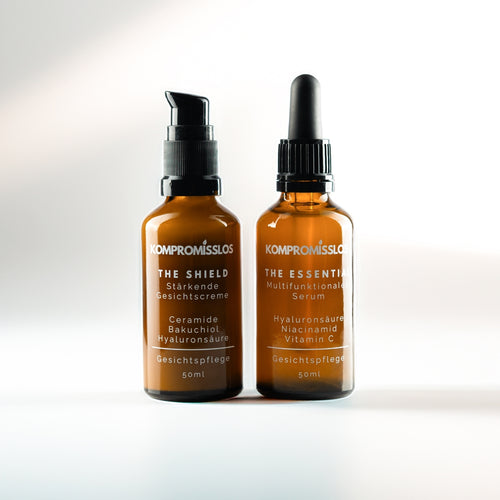
That is also how The Duo of serum and cream is built: in the serum, hyaluronic acid in three molecule sizes binds water, and the Duo as a whole adds aloe vera juice as its base, plus tamarind seed and glycerin. The cream layers ceramides, squalane and jojoba oil on top. How to use it: morning and evening, after cleansing with water, apply 3 to 6 drops of serum, then 3 to 6 pumps of cream, each massaged in from the centre of the face outwards and down over the neck. In her review on Judge.me, Nicole L. writes: ‘Great for my mature skin too, not shiny or greasy, just right, doesn’t feel tight, but still nourishing […]’ (review translated from German). For very oily skin, however, this cream with several oils is probably not the right choice.
When I finalised the formula, one thing mattered to me: moisture should come from the skincare layer, not from the promise that you just need to drink enough. That is why the serum contains hyaluronic acid in three molecule sizes rather than just one. And that is why aloe vera juice comes first on the ingredient list, even before water. So the base of both products is a plant juice, not simply water. What the Duo cannot do is make up for dry heated air, very hot showers or a cleanser that is too harsh. That is something you have to change yourself. And you do not need a third moisturising product for it – the two layers cover both binding and holding water. You can see exactly which active ingredients are in it on the page listing our active ingredients with disclosed concentrations.
Frequently asked questions
How long does it take for dehydrated skin to hold moisture again?
With humectants and a cream on top, your skin often feels more comfortable within a few days. For it to stay stable without constant reapplying, expect it to take a few weeks of a consistent routine. What matters is that you cut back on the triggers at the same time, meaning hot water, harsh cleansers and too many active products. Otherwise your skincare is working against a daily loss.
Does central heating dehydrate your skin?
Yes, heated air is a typical trigger. Dry indoor air constantly draws water out of the stratum corneum, and a review in the Journal of the European Academy of Dermatology and Venereology shows that low humidity and cold weaken the skin’s barrier function. In winter, a cream that holds water in therefore helps more than frequent spritzing. Airing your rooms regularly and not turning the heating up too high help as well.
Is hyaluronic acid good for dehydrated skin?
Yes, hyaluronic acid makes sense for dehydrated skin because it binds water in the stratum corneum. On its own, though, it is not enough: without a cream on top, the bound water can evaporate again in dry air. It works best as a serum straight after cleansing, followed by a cream with lipids such as ceramides or squalane.
Can dehydrated skin cause spots?
Dehydrated skin does not directly cause spots, but it often leads to a routine that encourages breakouts. Applying very heavy creams to tackle tightness, or stripping away more and more oil to tackle shine, throws the skin off balance. Persistent or inflamed spots should be checked by a dermatologist.
Does a facial mist help dehydrated skin?
A spray of pure water does very little, because the water evaporates quickly and does not stay in the skin without humectants and a cream. A mist only makes sense if it contains humectants and you apply a cream afterwards. When you are out and about, it is a quick refresher, not skincare. What a thermal water face mist contains and when you can skip it is covered in a separate article.
Does dehydrated skin need a rich cream?
Not necessarily. What dehydrated skin lacks above all is water, and oil does not supply that. The combination of humectants and a cream that holds the water in matters more. You only need a richer texture if your skin is also rough, flaky or matte – in other words, if it is short of lipids too.
Is The Duo suitable for dehydrated skin?
For dehydrated skin that is otherwise normal, dry, sensitive or mature, the logic fits well: the serum binds water with hyaluronic acid in three molecule sizes, and the cream holds it in with ceramides and squalane. For very oily skin, a cream with several oils is probably not the right choice. The Duo with serum and cream comes with a 100-day return policy.
Sources
- Verdier-Sévrain S, Bonté F. Skin hydration: a review on its molecular mechanisms. Journal of Cosmetic Dermatology, 2007. Source
- Akdeniz M, Tomova-Simitchieva T, Dobos G, Blume-Peytavi U, Kottner J. Does dietary fluid intake affect skin hydration in healthy humans? A systematic literature review. Skin Research and Technology, 2018. Source
- Engebretsen KA, Johansen JD, Kezic S, Linneberg A, Thyssen JP. The effect of environmental humidity and temperature on skin barrier function and dermatitis. Journal of the European Academy of Dermatology and Venereology, 2016. Source
- Pavicic T, Gauglitz GG, Lersch P, Schwach-Abdellaoui K, Malle B, Korting HC, et al. Efficacy of cream-based novel formulations of hyaluronic acid of different molecular weights in anti-wrinkle treatment. Journal of Drugs in Dermatology, 2011. Source