Oily skin: causes, the right skincare and what makes the shine worse
SKIN CONDITION
Oily skin develops when the sebaceous glands produce more sebum than the skin’s surface needs. The cause is usually genetics, hormones and climate, and less often the skincare itself. What makes sense is gentle cleansing twice a day, a light moisturiser and active ingredients such as niacinamide. In the long run, aggressively stripping away oil tends to increase shine rather than reduce it.
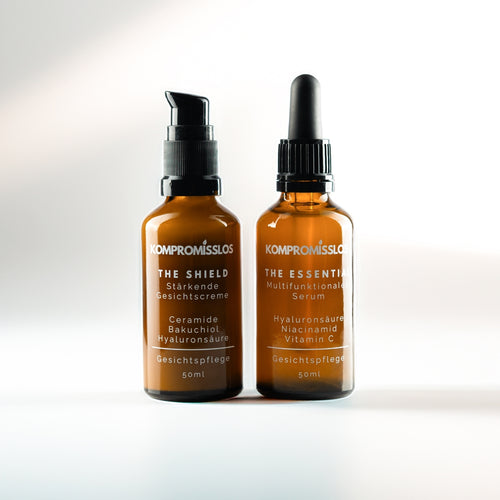
Light skincare with niacinamide and zinc PCA in the serum, and a matte finish from the cream: The Duo – Serum & Face Cream.
What causes oily skin?
Oily skin is caused by sebaceous glands that are set, genetically or hormonally, to produce more. Genetics are the biggest single factor and cannot be rewritten with skincare. Then there are androgens, which activate the sebaceous glands – which is why shine increases during puberty, around your cycle, in pregnancy and when you stop hormonal contraception. Because this shifts over the years, it is worth thinking in terms of skin condition rather than skin type. Warmth and humidity increase sebum output further, which is why the same skin shines more in summer than in February. Stress and lack of sleep are often described as triggers, but the evidence for this is thinner than often suggested. And skincare plays its part: cleansing too often and too harshly removes oil from the surface but does not change production underneath. Shine and blemish-prone skin often occur together, but they are not the same thing.
What skincare does oily skin need?
Oily skin needs gentle cleansing morning and evening, a light moisturiser and patience with active ingredients. More steps rarely achieve more. Cleanse with a product containing mild surfactants and lukewarm water, not hot, and avoid brushes and grainy scrubs in everyday use. This is followed by a water-based serum that binds moisture without adding oil. On top goes a cream that holds this moisture in and seals the surface without weighing it down. This is exactly where many people give up, because they equate cream with greasiness. That is a mix-up: moisture is water, shine is sebum, and the two have less to do with each other than it seems. If you are unsure whether you really need both serum and cream, the deciding factor is how tight your skin feels after cleansing, not the shine in the afternoon. How to combine the two steps in daily life is shown in the step-by-step how-to-use guide.
Which active ingredients suit oily skin?
For oily skin, the most obvious active ingredients are niacinamide, zinc, humectants such as hyaluronic acid and light lipids such as squalane. Niacinamide has the most concrete evidence on this topic: in a placebo-controlled study in the Journal of Cosmetic and Laser Therapy, a 2% preparation was associated with a lower sebum excretion rate. Hyaluronic acid binds water without adding oil, which is why it often feels more comfortable on shiny skin than an oil. Squalane resembles the skin’s own squalene and rarely weighs down the surface, which is why it is usually well tolerated even with heavy sebum output. Zinc is used in skincare to soften the look of an unsettled complexion. What you don’t need, on the other hand, are rich butter textures and heavy plant oils, which quickly feel unpleasant on a surface that is already oily. The Duo of serum and cream contains 5% niacinamide, 1% zinc and 2% hyaluronic acid, with all percentages referring to the two products together. You can see what else it contains in the full ingredients list.
Why stripping away oil often makes shine worse
Stripping away oil often makes shine worse because it puts strain on the skin’s surface without changing sebum production. Sebum is produced in the gland, not on the skin. A toner containing alcohol or a heavily foaming face wash removes the oil on top, but it also attacks the lipids between the skin cells of the outer layer. The result is skin that feels clean shortly after washing, then feels tight and shines again a few hours later. Many people respond with even more cleansing, an extra scrub or a stronger formulation, and the cycle starts again. A weakened skin barrier shows up differently in oily skin than in dry skin: not as flaking, but as tightness combined with shine, often with redness on the cheeks. If that sounds familiar, leaving things out is the quicker route than piling more on.
Oily skin can be dehydrated at the same time
Oily skin can lack moisture at the same time, because sebum and water content are two separate things. Sebum is oil from the gland; moisture is water in the upper part of the outer layer of skin. Skin can have a lot of one and little of the other. Typical signs are a shiny forehead combined with tight cheeks, make-up settling into fine lines and a face that feels tight after cleansing. If, in this situation, you consistently skip moisture because your skin looks oily anyway, you make the problem worse. A lighter build-up makes more sense: bind water, cover thinly, don’t add extra weight. A simple test is the quarter of an hour after cleansing, which shows whether your skin stays calm or feels tight. The overview below shows what generally works for oily skin and what mainly has a short-term effect.
| Measure | What it does | Verdict |
|---|---|---|
| Gentle cleansing twice a day | Removes excess sebum without putting much strain on the surface | A sensible basis |
| Light moisturiser | Supplies the skin with water without adding extra lipids | Sensible, even with shine |
| Niacinamide | At 2%, was associated with a lower sebum excretion rate in one study | An active ingredient with evidence |
| Toners containing alcohol | Remove oil immediately but can dry out the surface | Better left out |
| Skipping skincare altogether | Does not change the amount of sebum but deprives the skin of moisture | Not recommended |
| Mattifying powder | Visually removes shine without affecting the amount of sebum | Cosmetic, not caring |
When to see a professional about oily skin
See a professional if the shine is accompanied by inflammation, pain or a sudden change for no obvious reason. Skincare cares for the appearance of your skin; it does not replace a medical assessment. Specifically, deep, painful lumps, scarring, very red or weeping patches, and shine that increases markedly within a few weeks belong in the hands of a dermatologist or doctor. The same applies to accompanying signs such as heavy hair loss or a marked change in your cycle, because there may be hormonal causes behind them that no cream addresses. A review in the Journal of Clinical and Aesthetic Dermatology sets out a broad range of options for oily skin, from cosmetic active ingredients to prescription treatments and device-based procedures. And if you have been caring for your skin carefully for months and nothing has changed, a professional assessment makes more sense than the next product. In all these cases, cosmetic skincare can still be useful alongside, but it does not answer the actual question.
During development, I deliberately chose not to build a mattifying product. Alcohol and absorbent powders would have removed the shine instantly, and that is exactly what I didn’t want: the effect lasts two hours, after which your skin is worse off than before. Instead, it contains 5% niacinamide and 1% zinc, plus squalane rather than heavy oils. That is the slower decision, and it looks worse in an advert than instant mattness. Our Duo is therefore not an anti-shine solution but basic skincare that doesn’t sit heavily on the skin, even when your skin is shiny. If all you want is an instantly matte look for one evening, a powder is the more honest choice.
Frequently asked questions
Is oily skin a skin type or a skin condition?
Oily skin is both at once. The underlying tendency to produce sebum is genetic and therefore a feature of your skin type. How strongly it shows, however, varies with your hormones, the season, the climate and your skincare, which makes it a condition. For your routine, the condition is the more useful measure, because you can influence it.
How often should I wash my face if I have oily skin?
For oily skin, twice a day – morning and evening – is usually enough. Washing more often removes oil from the surface but does not reduce sebum production in the gland, and it can irritate the skin further. In between, a dry tissue or blotting paper removes shine without putting strain on the skin.
Does oily skin even need a moisturiser?
Yes, oily skin needs moisture too. Sebum is oil, moisture is water, and skin that looks oily can still have too little water in its outer layer. What matters is the texture: light rather than rich. If your skin feels tight after cleansing, that is a clearer signal than the shine in the afternoon.
Does niacinamide help with shiny skin?
Niacinamide is the active ingredient with the most concrete evidence on this topic. In a placebo-controlled study, a 2% preparation was associated with a lower sebum excretion rate. Applied to a finished skincare product, that is no guarantee: whether and how clearly your complexion changes depends on your skin and how long you use it.
Does oily skin go away with age?
Sebum production usually decreases over the years, but it rarely disappears completely. From around the mid-forties, many people notice a mixed picture: the T-zone keeps shining while the cheeks and eye area become drier. That is a good time to review your routine instead of carrying on unchanged.
Is oily skin the same as blemish-prone skin?
No. Oily skin describes increased sebum output; blemish-prone skin describes visible blockages and inflammation. The two often occur together, because sebum combined with skin cells can clog pores. But there is shiny skin without a single blemish, and blemish-prone skin that isn’t oily.
Can a serum be too rich for oily skin?
Yes, that is possible. An oil-based serum can be too heavy with high sebum output and leave an unpleasant feeling. Water-based serums with humectants such as hyaluronic acid usually sit better on shiny skin. The amount matters: 3 to 6 drops are enough for the whole face.