Salicylic acid: what it does, who it suits and when it is too much
SINGLE INGREDIENT
Salicylic acid is an oil-soluble beta hydroxy acid that mixes with the sebum in the pore and loosens the bonds between dead skin cells. Up to 2 per cent is permitted in facial products, and 0.5 to 2 per cent is typical. It suits oily skin that is prone to blemishes and is often too much for dry or irritated skin.
How does salicylic acid work in the pore?
Salicylic acid works in the pore because it is oil-soluble. It mixes with the sebum in the hair follicle instead of staying on the surface, and there it loosens the bonds between dead skin cells, so that the mixture of sebum and cell debris comes away more easily. According to a review in Clinical, Cosmetic and Investigational Dermatology, it is precisely this oil solubility that sets this beta hydroxy acid apart from water-soluble fruit acids such as glycolic acid, which mainly work on the surface of the skin. So the effect is not the removal of a whole layer but a loosening of the adhesion between cells. You usually see it as a slightly smoother surface and fewer dark dots on the nose and chin. How this compares with AHA and PHA is explained in our overview of AHA, BHA and PHA. In practical terms, salicylic acid targets clogged pores and blemish-prone skin, not dehydration lines, tightness or declining elasticity.
What concentration of salicylic acid is typical, and what is permitted?
In facial skincare, 0.5 to 2 per cent salicylic acid is typical, and more than 2 per cent is not permitted for such products in either Switzerland or the EU. Outside its use as a preservative, the EU Cosmetics Regulation limits salicylic acid to 2.0 per cent in most products, to 0.5 per cent in exceptions such as body lotion, eyeshadow or lipstick, and to 3.0 per cent in rinse-off hair products. As a pure preservative, 0.5 per cent is the maximum. The substance is not permitted for children under three and is classed as an eye irritant. The same limits apply here, because Swiss food legislation refers directly to the annexes of the EU regulation for regulated substances, as the Federal Food Safety and Veterinary Office (FSVO) points out. If a pack shows a higher figure, the product is not a regular cosmetic for this market. Many manufacturers give no figure at all. In that case you will only find Salicylic Acid in the ingredient list, and a position far down the list suggests a small amount.
| Product type | Typical concentration | Upper limit | Assessment |
|---|---|---|---|
| Facial cleanser or face wash | 0.5 to 2 per cent | 2.0 per cent | Brief contact, gentlest way to start |
| Leave-on toner or serum | 0.5 to 2 per cent | 2.0 per cent | Too much for many skin types if used daily |
| Declared as a preservative | up to 0.5 per cent | 0.5 per cent | No exfoliating effect intended |
| Rinse-off hair product | up to 3 per cent | 3.0 per cent | For the scalp, not for the face |
Which skin types find salicylic acid too much?
Salicylic acid is too much for dry, sensitive or already irritated skin, and for any skin with a weakened barrier. The ingredient specifically loosens the bonds between cells. If those bonds are already loose, because your skin feels tight, flakes or stings quickly with new products, an acid makes the problem worse instead of solving it. Typical warning signs are stinging when you apply your usual cream, fine flakes around the sides of the nose, and redness that lingers longer than usual after washing. In these cases, the sensible step is to leave out the acid and first stabilise the skin barrier. Oily skin usually tolerates it better, while with sensitive skin going without is more often worthwhile than trying it. More mature skin, which naturally produces less sebum, also rarely has a reason for an additional acid. And if you already use retinol or bakuchiol, the exfoliating stimulus is usually covered already.
One customer wrote to us that she had been using a toner with salicylic acid for some time because of blackheads on her nose, and had also ordered the Duo because her cheeks were feeling tight and flaking at the same time. That combination was exactly the point: the acid was going over her whole face, even though the concern was limited to a small area. Our suggestion was to use the toner on the T-zone only and to leave out the cheeks completely.
What should you not combine with salicylic acid?
It is best not to combine salicylic acid with retinol, a second acid or a mechanical scrub in the same application. Not because the substances react with each other chemically, but because the irritation adds up: each of these steps challenges the stratum corneum, and the skin can only cope with a limited amount. For the same reason, vitamin C at a low pH does not belong in the same layer; here, separating them into morning and evening is usually enough. Niacinamide, on the other hand, is no problem and sits well alongside an acid. For a broader look at which active ingredients go together, see our overview of which active ingredients can be combined. As a rule of thumb: one acid per evening, and nothing else afterwards that also exfoliates. What comes straight after can happily be boring – moisture, lipids and a cream that simply seals everything in.
Do you need salicylic acid in your routine at all?
You do not need salicylic acid if your pores do not bother you, your skin is more dry than oily and your concern is moisture, redness or elasticity. The ingredient has a narrow purpose: sebum and dead skin cells in the pore. For everything else there are better-suited approaches, and an acid without a reason only costs you barrier. It makes sense if you have recurring blackheads on your nose, chin or forehead, your skin tolerates acids well and you are prepared to use it sparingly. A good test is to ask yourself what has genuinely bothered you over the past few months. If the answer is not pores or blackheads, salicylic acid is the wrong place to start. What is in our own formula and what is deliberately left out is set out transparently in our ingredients. If you are looking for an acid-free daily base, you will find it in our serum and cream as the Duo.
When a professional is the better choice
A professional is the better choice as soon as a cosmetic concern becomes a medical one. Cosmetics may improve how the skin looks, nothing more. If inflamed lumps keep coming back, scars are left behind, large areas of the face are permanently red or a skin condition may be involved, that belongs with a dermatologist, not in a serum off the shelf. The same applies if an acid stings every time despite careful use, or if your skin visibly gets worse. Drawing this line honestly is not excessive caution; it is the only way to avoid losing months. Good skincare accompanies medical treatment; it does not replace it. In practice, that means writing down before your appointment what you have used, for how long, and how you noticed things getting worse. That information is worth more than any extra product off the shelf.
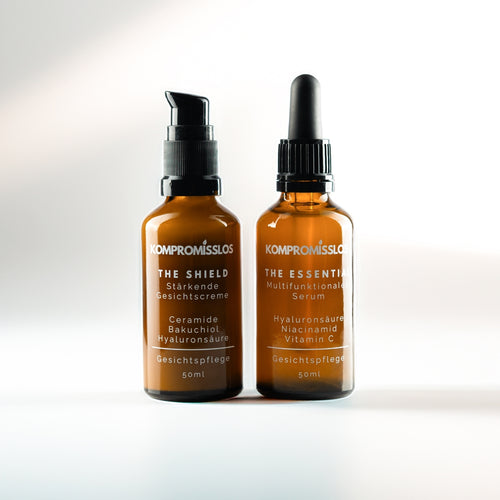
I deliberately left salicylic acid out of the Duo. The Duo is designed for two steps in the morning and two in the evening, every day, even for sensitive skin. An acid that, depending on your skin, only makes sense two or three times a week does not fit into a product that is applied daily. Either I dose it so low that it does nothing, or I build a source of irritation into a routine that is meant to calm. For sebum and the look of pores, I rely instead on 1 per cent zinc and 5 per cent niacinamide in the Duo of The Essential serum and The Shield cream. If you also want a BHA, you are better off buying it separately and managing it yourself.
Frequently asked questions
What does BHA on a pack mean?
BHA stands for beta hydroxy acid, and in cosmetics it almost always means salicylic acid. The difference from AHA lies in solubility: BHA is oil-soluble and therefore gets into the sebum-filled follicle, while AHA is water-soluble and stays on the surface. If BHA is on the front, it is worth checking the ingredient list for Salicylic Acid.
Is a salicylic acid exfoliant better than a scrub?
A salicylic acid exfoliant works differently from a mechanical scrub, not automatically better. The acid loosens the bonds between cells and also reaches the inside of the pore, while a grainy scrub only rubs over the surface. For blackheads, the acid is the more logical route. For sensitive skin, both are often too much.
How often should you use salicylic acid on your face?
For most people, salicylic acid on the face two or three times a week is enough, in the evening and only on the areas that need it. Start once a week and only increase once your skin stays calm. Tightness, flaking or new redness are the signal to cut back straight away rather than carrying on.
Does The Duo contain salicylic acid?
No, The Duo does not contain salicylic acid. The Duo is intended as a daily base for morning and evening, and in our view an acid does not belong in a product that is applied all over the face every day. For sebum and the look of pores, the Duo relies instead on 1 per cent zinc and 5 per cent niacinamide.
Can you use salicylic acid and niacinamide together?
Yes, salicylic acid and niacinamide can be combined. The two work in different ways, and niacinamide supports the skin barrier that an acid puts under strain. If your skin is very reactive, apply them at different times, for example the acid in the evening and niacinamide in the morning. For calm skin, there is nothing against using them in the same routine.
Is salicylic acid an issue during pregnancy or breastfeeding?
That is a medical question that a doctor or pharmacist should answer, not a guide. It makes sense to take the actual product with you and be able to state the concentration. Until you hear back, skincare without acids is the simpler choice, because it leaves no questions open.
Sources
- Arif T., Salicylic acid as a peeling agent: a comprehensive review, Clinical, Cosmetic and Investigational Dermatology, 2015. Source
- European Commission, Commission Regulation (EU) 2019/1966 amending the Annexes to Regulation (EC) No 1223/2009, 2019. Source
- Federal Food Safety and Veterinary Office (FSVO), Geregelte Stoffe in kosmetischen Mitteln. Source