Combining hyaluronic acid: what goes with it and which layer is missing
INGREDIENT COMBINATION
Combining hyaluronic acid works with almost every common skincare ingredient. Niacinamide, vitamin C, ceramides, squalane, panthenol, retinol and bakuchiol can all be used in the same routine without hyaluronic acid losing its effect. None of these pairings causes a genuine conflict. Only one thing matters: hyaluronic acid needs a layer on top that keeps the moisture it has bound in the skin.
Combining hyaluronic acid: why almost nothing goes wrong
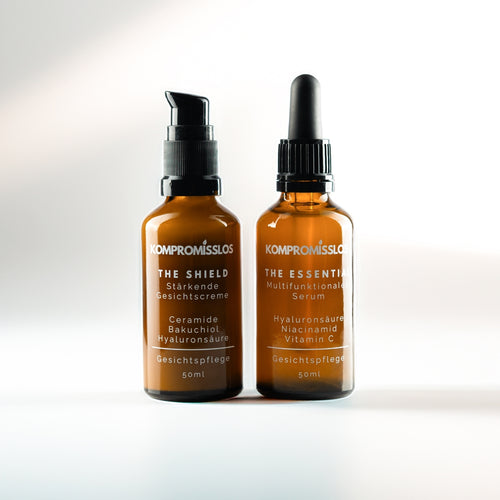
Hyaluronic acid is chemically unremarkable, doesn’t need a particular pH and doesn’t compete with any other skincare ingredient for the same job. That is why combining it practically never causes a conflict, and why most of the warning lists online, for good reason, don’t even mention it. Hyaluronic acid is a humectant: it binds water in the upper layers of the skin and swells there. Niacinamide, vitamin C, bakuchiol or retinol work in entirely different places and don’t get in its way. The only rule you really need concerns the order and the layer that follows: water-based hyaluronic acid serum first, lipid-rich skincare on top. That is exactly how The Duo of serum and cream is built, with 2% hyaluronic acid alongside 5% niacinamide, 2% vitamin C as 3-O-ethyl ascorbic acid and 0.3% bakuchiol. All percentages refer to the Duo as a whole. For the bigger picture across all ingredient pairings, see our overview of ingredient combinations.
| Combined with hyaluronic acid | In the same routine | What to watch |
|---|---|---|
| Niacinamide | Yes | No waiting time needed, texture decides |
| Vitamin C | Yes | Stable forms are less sensitive |
| Ceramides | Yes | Ceramides belong in the layer on top |
| Squalane and jojoba oil | Yes | Always apply after the hyaluronic acid |
| Retinol | Yes | Hyaluronic acid softens the dry phase |
| Bakuchiol | Yes | No need to separate them in time |
| AHA and BHA | Yes, one after the other | Acid first, then the hyaluronic acid |
Can you use vitamin C and hyaluronic acid together?
Yes, vitamin C and hyaluronic acid can be used in the same routine without restriction, and in a great many serums they sit side by side anyway. There is no known interaction between the two, no mutual deactivation and no reason to separate them in time. The widespread concern comes from elsewhere: pure L-ascorbic acid needs a low pH to stay stable and is sensitive to water, light and air. That is a formulation issue, not a conflict with hyaluronic acid. Stabilised forms such as 3-O-ethyl ascorbic acid are considerably more robust here, because they don’t need an extreme pH. In practice: apply the serum to slightly damp skin, don’t wait, and finish with a cream. If you want to go through the pairing in detail, the order is broken down step by step in our article on using vitamin C with hyaluronic acid.
Do niacinamide and hyaluronic acid belong in the same routine?
Yes, niacinamide and hyaluronic acid are one of the most straightforward pairings in skincare and need neither a waiting time nor a fixed order between them. Niacinamide is a form of vitamin B3 and water-soluble; hyaluronic acid is a water-binding sugar. Both therefore sit in the same water phase of a formulation, which is why they so often turn up in the same serum. In terms of what they do, they complement rather than duplicate each other: hyaluronic acid brings water into the upper layers of the skin, while niacinamide targets evenness and supports the skin barrier. There is no need to wait between the two steps, and no mutual deactivation is known. If both are in the same product anyway, the question of order doesn’t arise at all. If you want to choose between the two rather than use both, our comparison of hyaluronic acid or niacinamide will help you decide. If you are interested in how to apply them one after the other, the order for niacinamide and hyaluronic acid is described separately, including which concentrations make sense.
Why hyaluronic acid on its own is often not enough
Hyaluronic acid almost always needs a partner to hold on to the moisture it has bound; otherwise part of the effect is wasted. A humectant attracts water and holds it in the outer layer of the skin. What it can’t do is stop that water from evaporating back out. That is precisely the job of lipids: ceramides, squalane, jojoba oil or a cream with enough fat content. Without this second layer, less is left in dry, centrally heated air or in the wind on the ski slopes than the serum promises, and some skin even feels tighter afterwards than before. The consequence is not a more complicated routine but a complete one: serum first, cream on top, done. For the same reason, we don’t sell a hyaluronic acid serum on its own, only a set of both. If you only want to buy a single product, you are usually better off with a good cream than with a pure hyaluronic acid serum. Which partners are suitable for this final layer is covered in our article on which active ingredients go with ceramides.
If your skin feels tight or burns after application, hyaluronic acid is rarely to blame; it is usually an overwhelmed barrier. How to recognise a damaged skin barrier is described there in detail.
Which amount and which molecular size of hyaluronic acid matter
With hyaluronic acid, it is not the highest percentage that counts, but the molecular size and a layer on top. According to a review in the journal Molecules, hyaluronic acid is typically used in cosmetics at 0.2 to 1%, with a maximum of 2% given for sodium hyaluronate. More of it mainly makes a serum stickier, not more effective. Molecular size is more interesting: a study in the journal Skin Research and Technology tracked the uptake of hyaluronic acid using Raman spectroscopy, with three size ranges of 1000 to 1400 kDa, 100 to 300 kDa and 20 to 50 kDa. Large molecules stay on the surface and form a film there, while smaller ones get further into the outer layer of the skin. That is why many formulations use a mix of several size ranges rather than just one. This information rarely appears on the label, however, which is why a percentage on its own says little about quality. You can see which ingredients we use in the full list of active ingredients.
For context: these figures come from ingredient research, not from a test of our product. The Duo contains 2% hyaluronic acid, calculated across both products together, which puts it at the upper end of what is usual in cosmetics.
When hyaluronic acid isn’t the answer, and when a professional can help
You don’t need hyaluronic acid if your skin doesn’t feel tight after washing, doesn’t feel rough and looks even throughout the day. An extra hyaluronic acid serum does little for well-cared-for skin, and a third product doing the same job does nothing at all. Hyaluronic acid also makes little sense as the sole answer to dry skin, because what is usually missing there is lipids, not water. And there is a clear line where dermatology takes over: persistent redness, weeping or heavily flaking patches, itching that disturbs your sleep, and skin changes that alter in shape or colour need to be checked by a doctor rather than handled with a skincare routine. The same applies if you suspect a contact allergy or already have a skin condition under medical care, in which case a professional decides what else can go on your skin. Cosmetics care for the appearance of your skin and support the skin barrier, but they replace neither diagnosis nor treatment.
I am regularly asked why we don’t offer a pure hyaluronic acid serum – it would be cheaper and easier to explain. The reason is in this article: hyaluronic acid on its own binds water but doesn’t hold on to it. A serum without a suitable cream on top therefore delivers half a result, and produces exactly the feedback I hear most often from new customers: that hyaluronic acid has never done anything for them. I deliberately built the 2% hyaluronic acid into a Duo in which the second layer is already included. How that works day to day is explained in the guide to using our products.
Frequently asked questions
Can you use hyaluronic acid and vitamin C together?
Yes, without restriction and without waiting in between. There is no known interaction between hyaluronic acid and vitamin C. The widespread warning refers to pure L-ascorbic acid, which needs a low pH and is generally sensitive. Stabilised forms such as 3-O-ethyl ascorbic acid are considerably more robust in everyday use.
Can you use hyaluronic acid and retinol together?
Yes, and the combination is actually an obvious one. In the first few weeks, retinol often causes dryness and a feeling of tightness. Hyaluronic acid before it and a lipid-rich cream after it cushion exactly that. Apply the retinol according to the manufacturer’s instructions and finish your routine with a caring layer.
In what order do you apply hyaluronic acid?
Hyaluronic acid goes on early in your routine, straight after cleansing, on slightly damp skin. It is followed by the cream, which seals in the moisture that has been bound. The other way round, the water-based serum can barely get through a layer of fat. In the morning, finish with sun protection.
Do you need to keep hyaluronic acid and acids apart?
No, there is no need to separate them. AHA and BHA work through a low pH, to which hyaluronic acid is insensitive. Apply the acid first and the hyaluronic acid afterwards. If your skin reacts quickly to the acid anyway, less acid is a better answer than a different order.
Can hyaluronic acid draw moisture out of your skin?
In very dry air without a final caring layer, your skin can indeed feel drier after a pure hyaluronic acid serum. The humectant binds water, but without lipids on top it can’t keep it in the skin. The solution is not less hyaluronic acid, but a cream on top.
What percentage of hyaluronic acid makes sense?
Typical amounts used in cosmetics are 0.2 to 1%, with up to 2% given for sodium hyaluronate. Higher values mainly make a formulation stickier. The Duo contains 2% hyaluronic acid, based on the serum and cream together, not on a single product.
Do you need a separate serum for hyaluronic acid?
No. Hyaluronic acid is an ingredient in many serums and creams, and an extra stand-alone product rarely adds much. The more useful question is whether your routine contains a layer that keeps moisture in the skin at all. If it doesn’t, a suitable cream will help far more than another hyaluronic acid product on the shelf.
Sources
- Juncan AM et al., Advantages of Hyaluronic Acid and Its Combination with Other Bioactive Ingredients in Cosmeceuticals, Molecules, 2021. Source
- Essendoubi M et al., Human skin penetration of hyaluronic acid of different molecular weights as probed by Raman spectroscopy, Skin Research and Technology, 2016. Source