What to mix with ceramides: which active ingredients suit them and why order matters
INGREDIENT COMBINATION
The short answer to what you can mix with ceramides is: almost any common skincare ingredient. Niacinamide, hyaluronic acid, retinol, bakuchiol, vitamin C and vitamin E can all be used in the same routine, because ceramides are chemically inert and do not need a particular pH. What matters is almost always just the order: light, watery textures first, the lipid-rich ceramide product last.
Mixing ceramides with other ingredients: why so little goes wrong
Ceramides are chemically inert, do not need a particular pH and do not compete with any common skincare ingredient for the same mechanism. That is why combining them almost never leads to a genuine conflict. Ceramides work in the lipid matrix of the stratum corneum, the skin’s outermost layer, and according to a review in the Journal of Lipid Research this matrix consists of around 50 per cent ceramides, 25 per cent cholesterol and 15 per cent free fatty acids. Niacinamide, hyaluronic acid or bakuchiol act in other places and so do not get in the ceramides’ way. The only rule you really need concerns the order: watery textures first, the lipid-rich ceramide product last, because a layer of lipids barely lets products underneath it through. What ceramides actually do for your skin is explained in our article on ceramide benefits and how to use them. For the broader picture across all ingredient pairings, see our overview of ingredient combinations.
| Combining with ceramides | In the same routine | What to watch |
|---|---|---|
| Niacinamide | Yes | Serum first, ceramide cream on top |
| Hyaluronic acid | Yes | On slightly damp skin, lipids afterwards |
| Retinol | Yes | Retinol first, ceramides as the caring layer |
| Bakuchiol | Yes | No need to use at different times |
| Vitamin C | Yes | Light serum before the lipid-rich layer |
| Vitamin E | Yes | Often already in the same formula |
| AHAs and BHAs | Yes, one after the other | The acid first, then the ceramides |
Can you use niacinamide and ceramides together?
Yes, niacinamide and ceramides can be used in the same routine without restriction, and in terms of what they do, they complement each other particularly well. Niacinamide is a form of vitamin B3; ceramides are lipids the skin makes itself. There is no known interaction between the two and no pH conflict. The second point is more interesting: in a study in the British Journal of Dermatology, ceramide synthesis in keratinocyte cultures rose 4.1- to 5.5-fold with nicotinamide, depending on the dose, and topical application increased the levels of ceramides and free fatty acids in the stratum corneum, while water loss through the skin’s surface decreased in dry skin. An honest assessment has to add that this was a study of the ingredient, not a test of a finished product. In practice, the combination means you tackle the same issue from two sides: supplying lipids from outside and encouraging the skin to make new ones.
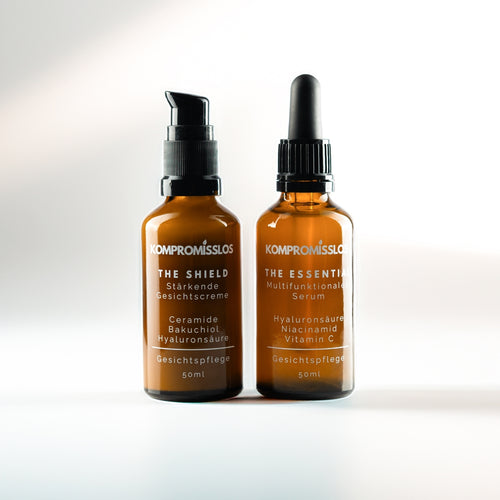
The order follows the texture: niacinamide serum first, ceramide product on top. In The Duo of serum and cream, 5% niacinamide and ceramides already sit side by side, so you don’t need to layer anything extra. All percentages apply to the Duo as a whole, not to an individual product. You can see what else it contains in the full ingredient list.
Can you use hyaluronic acid and ceramides together?
Yes, hyaluronic acid and ceramides are one of the most sensible combinations there is, because they do two different jobs. Hyaluronic acid is a humectant and binds water in the upper layers of the skin. Ceramides are lipids and slow down how quickly that water evaporates again. Together they form a chain that works: bring water in and keep it there. Without the second step, little is left of the first. In dry, centrally heated air, a hyaluronic serum without a lipid-rich layer on top can even leave your skin feeling tight, because the moisture it has bound escapes unchecked. So the order is not a minor detail: apply the hyaluronic serum to slightly damp skin, let it absorb briefly, then apply the ceramide product. The other way round, the light serum can barely get through the layer of lipids. You don’t need to use them at different times, however, because chemically the two groups of ingredients do not interfere with each other. In the Duo, 2% hyaluronic acid and ceramides are already combined in the same routine, so the order is automatically right.
Two combinations come up so often that they have their own articles: vitamin C alongside ceramides and ceramides together with vitamin E. Both work, but each follows its own logic when it comes to order.
Can you use ceramides and retinol together?
Yes, ceramides and retinol are one of the most sensible combinations, and the order is clear: retinol first on dry skin, the ceramide product afterwards. Retinol speeds up cell renewal and makes the stratum corneum more permeable in the first few weeks. Dryness, a feeling of tightness and fine flaking are typical during this phase. Ceramides replenish exactly this lost lipid, which is why a cream containing ceramides over your retinol is not a stopgap but part of the routine. There is no chemical conflict between the two, so you don’t need to use them at different times. Two tips from practice: apply the ceramide product on the evenings when you skip the retinol too, because the barrier needs support throughout the build-up phase. And don’t introduce both products at the same time, otherwise you won’t be able to attribute a reaction to either of them later. How retinol gets on with other active ingredients is covered separately.
Can you use bakuchiol and ceramides together?
Yes, bakuchiol and ceramides go together without any restriction and do not need to be used at different times. Neither is sensitive to pH, they work in different places, and there is no known way in which one deactivates the other. Bakuchiol is considered a gentle partner; it does not make the skin as sensitive to light as retinol does, so it can be used both morning and evening. Ceramides alongside it take the edge off the adjustment period if some tightness does appear. The order is again based on texture: light bakuchiol serum first, lipid-rich ceramide product on top. You don’t need to rebuild your routine for this combination; it simply adds one layer. In the Duo, 0.3% bakuchiol and ceramides are already part of the same routine, so the question of layering does not arise. Which other active ingredients get on with bakuchiol is covered in our article on which partners suit bakuchiol and which are better kept apart.
When ceramides are not the answer and when a professional can help
You don’t need ceramides if your skin does not feel tight after washing, is not rough and takes new products in its stride. A barrier that works well does not get better if you offer it more lipids than it can use. It also makes little sense to add a third product containing ceramides if your serum and cream already contain them. Then you are paying twice for the same job. And there is a clear line where dermatology takes over: persistent redness, weeping or heavily flaking patches, itching that keeps you awake at night, and skin changes that alter in shape or colour need to be checked by a doctor rather than treated with a skincare routine. The same applies if you suspect a contact allergy or have a skin condition that is already under medical care, where a professional decides what else can go on your skin. Skincare looks after the appearance of your skin and supports the skin barrier, but it replaces neither diagnosis nor treatment.
The question I am asked most often about ceramides is not whether they go with niacinamide, but in which order to apply two products. That is exactly why I limited us to two products rather than five. The more layers a routine has, the more decisions about order you have to make, and each of them is a point where something can go wrong. With a serum and a cream, only one rule is left: the lighter one first, then the richer one. You can see how that looks day to day in our guide to how to use the products.
Frequently asked questions
Can you use ceramides and vitamin C together?
Yes, ceramides and vitamin C get on without any restriction. Vitamin C is usually applied as a light serum and therefore goes first, with the lipid-rich ceramide product afterwards. There is no need to use them at different times. Stabilised forms such as 3-O-ethyl ascorbic acid are also less sensitive to their surroundings than pure ascorbic acid.
In what order should ceramides go in your routine?
Ceramides go last, because they are usually found in the richest texture. The order is: cleanse, watery serum, then the cream containing ceramides. The other way round, light products could barely get through the layer of lipids. In the morning, sun protection follows at the very end.
Can you layer two products containing ceramides?
You can, but it is usually unnecessary. Ceramides do not work in a dose-dependent way, like an active ingredient that does more the more of it you apply. If your serum and cream already contain them, a third product rarely adds anything. A second product only makes sense for targeted use, for example on very dry patches.
Can you use ceramides and squalane together?
Yes, and the two complement each other well. Squalane is a light lipid that spreads over the surface of the skin, while ceramides work within the stratum corneum. So they are not competing for the same job. Many formulas contain both anyway, because they support the barrier from two sides.
What should you do if your skin still feels tight despite ceramides?
Check your cleanser first, because strongly stripping products remove more lipids from the skin than any product applied afterwards can give back. Second, the amount: if you apply too little, the layer does nothing. Third, time, because a weakened barrier needs weeks. If the tightness lasts for months, have it checked by a dermatologist.
Does The Duo contain ceramides?
Yes, ceramides are part of The Duo of The Essential serum and The Shield cream, together with squalane, panthenol and jojoba oil. We deliberately do not state a percentage for ceramides, because in this group of ingredients the ratio to the other lipids says more than a single figure. The percentages we do state always apply to the Duo as a whole.
Sources
- Feingold KR, Thematic review series: Skin Lipids. The role of epidermal lipids in cutaneous permeability barrier homeostasis, Journal of Lipid Research, 2007. Source
- Tanno O, Ota Y, Kitamura N, Katsube T, Inoue S, Nicotinamide increases biosynthesis of ceramides as well as other stratum corneum lipids to improve the epidermal permeability barrier, British Journal of Dermatology, 2000. Source