Combining skincare ingredients: what works together and what doesn’t
COMBINING ACTIVE INGREDIENTS
Combining skincare ingredients works without any problem for the vast majority of pairings: niacinamide, hyaluronic acid, vitamin C, ceramides, panthenol, squalane and vitamin E can all be used together in one routine. The main thing to be careful with is using several strongly exfoliating products at the same time. What matters most is layering from thin to thick and introducing new active ingredients slowly.
Which active ingredients can you use together without problems?
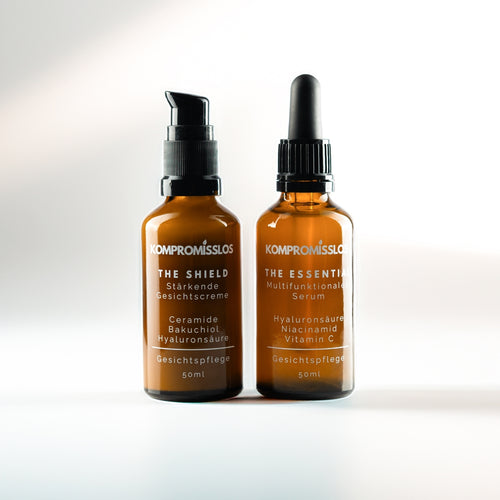
Most skincare active ingredients can be combined without restriction. Niacinamide, hyaluronic acid, panthenol, ceramides, squalane and vitamin E work side by side in a routine without getting in each other’s way. Vitamin C belongs in this group too, as long as it comes in a stable form such as 3-O-ethyl ascorbic acid. The reason is simple: these ingredients act at different levels. Hyaluronic acid binds moisture in the upper layers of the skin, ceramides and squalane replenish the lipid layer, while niacinamide and vitamin C target evenness and the overall look of your skin. The Duo, our serum and cream, is an example of this logic: it contains 5% niacinamide, 2% vitamin C as 3-O-ethyl ascorbic acid, 2% hyaluronic acid and 0.3% bakuchiol side by side, because they don’t get in each other’s way in a routine. So the better question when combining isn’t what is forbidden, but whether your skin actually needs another active ingredient at all.
Some active ingredients even work in the same direction. According to a study in the British Journal of Dermatology, nicotinamide – in other words niacinamide – increases ceramide biosynthesis in skin cells. Using niacinamide alongside ceramides is therefore not duplication but support by two different routes.
| Combination | Can be used together | What to watch out for |
|---|---|---|
| Niacinamide and hyaluronic acid | Yes, without restriction | Apply hyaluronic acid to slightly damp skin. |
| Niacinamide and vitamin C | Yes, in modern formulations | With pure L-ascorbic acid, separate the two steps briefly. |
| Vitamin C and vitamin E | Yes, often formulated together | Makes sense in the morning, as both work as antioxidants. |
| Ceramides and everything else | Yes | Ceramides belong in the last step of your routine. |
| Bakuchiol and niacinamide | Yes | Start in the evening and introduce gradually. |
| Retinol and AHAs | Only at different times | Use on different evenings. |
| Several exfoliants at once | No | Limit yourself to one exfoliating product. |
Which combinations really call for caution?
It gets tricky in exactly three situations: several exfoliating products on the same evening, retinoids alongside strong AHAs, and starting two or three new active ingredients on the same day. In all three cases, the problem isn’t chemical incompatibility but the sum of irritants on a skin barrier that can only cushion so much. If you use an acid peel in the morning, apply retinol in the evening and add an enzyme peel in between, you will overwhelm your skin no matter how well each individual product is formulated. Bakuchiol as a gentler alternative to retinol is far more relaxed, because it gets on well with niacinamide and vitamin C in the same routine. And the most widespread warning of all – about niacinamide and vitamin C in one routine – doesn’t stand up to scrutiny: a review in the journal Antioxidants concludes that topical niacinamide is well tolerated on its own or combined with other active ingredients.
In what order should you apply active ingredients?
The order follows one single rule: from thin to thick. Watery, light textures go first, oily and rich ones last, because otherwise a cream forms a layer that a serum struggles to get through. Within the watery layer, the order of individual active ingredients matters less than is often claimed, as long as the products are designed to be used together. Whether niacinamide alongside hyaluronic acid goes on first or second is less important than whether both actually reach your skin regularly. Waiting ten or twenty minutes between steps isn’t necessary in a normal routine. What this looks like in practice is shown on our page on how to use the products step by step. With two products – 3 to 6 drops of serum and 3 to 6 pumps of cream – the whole routine takes under two minutes.
- Cleanse and only gently pat your skin, don’t rub it dry.
- Apply the serum while your skin is still slightly damp.
- Follow with cream to lock in moisture and active ingredients.
- In the morning, finish with sun protection, which no serum or cream can replace.
How many active ingredients can your skin handle at once?
Healthy skin can tolerate quite a number of active ingredients at the same time, provided they are added gradually rather than all on the same day. The practical limit is rarely the number of active ingredients but the number of irritants: one product with eight well-tolerated substances is less of a problem than three products that each contain a strongly exfoliating component. The signal that it’s getting too much is always the same: tightness, stinging on application, redness, a sudden sensitivity to products that used to work well. Knowing how to recognise a weakened skin barrier is therefore more important than any combination chart. If these signs appear, the right response is less, not more: go back to cleansing, a gentle moisturiser and two to three weeks of rest before adding anything again. Introduce new active ingredients one at a time and leave at least two weeks in between. A routine of two products designed to work together, such as the serum and cream in the Duo, keeps the number of these variables small from the outset.
Which active ingredients belong in the morning, and which in the evening?
Antioxidants tend to suit your morning routine, while regenerating ingredients and those you introduce gradually are better in the evening. In the morning your skin is exposed to external factors such as UV radiation, fine dust and temperature changes, which is why vitamin C and vitamin E logically belong there. In the evening, repair and renewal processes are under way, which is why retinoids and bakuchiol are traditionally applied at night. For niacinamide, hyaluronic acid, ceramides, panthenol and squalane there is no such split: they work at either time of day and can be used twice daily. These ingredients don’t need a particular time of day; they need consistency over weeks. If you use vitamin C together with vitamin E, it makes sense to do so in the morning, whereas ceramides and vitamin E in the same step are a particularly natural fit in the evening. In practice, for most routines that means the same two products morning and evening, with the only difference being that sun protection is added during the day.
When a specialist is a better bet than a new combination
Cosmetics care for the look of your skin, but they replace neither a medical diagnosis nor a medical examination. If you are dealing with persistent redness, weeping or flaking patches, sudden marked changes in a mole or painful inflammation, the right next step is a dermatology practice, not another active ingredient in your bathroom cabinet. The same applies if a skin condition has already been diagnosed or you are using prescription treatments: in that case, the specialist treating you decides what else can go on your skin, not a general combination rule. And if a combination has caused a reaction three times in a row, trying again with other products won’t get you much further. A professional assessment of whether a contact allergy or an underlying skin condition is behind it is more helpful. You can check which substances we use in our full list of active ingredients and, if needed, take it along to a dermatology appointment.
I’m often asked why we don’t use pure L-ascorbic acid, which sounds stronger on paper. The reason is exactly this topic: pure L-ascorbic acid needs a low pH, oxidises quickly and complicates a routine, because it doesn’t get on as well with other steps. I chose 3-O-ethyl ascorbic acid because it is more stable and easy to use alongside niacinamide and bakuchiol. For the same reason, we have two products rather than seven. The more steps a routine has, the more opportunities there are to overwhelm your skin. For me, combining means leaving out whatever doesn’t contribute.
Frequently asked questions
Which active ingredients shouldn’t I use at the same time?
The main problem is combining several strongly exfoliating products on the same day, such as an AHA peel together with retinol or a second peel. Most of the other common warnings relate to laboratory conditions rather than use on the skin. Introduce new active ingredients one at a time, and you will also be able to tell what your skin is actually reacting to.
Can I use niacinamide and vitamin C together?
Yes. Niacinamide and vitamin C can be used in the same routine, and it is particularly straightforward with stable forms of vitamin C such as 3-O-ethyl ascorbic acid. That is exactly why the Duo contains 5% niacinamide and 2% vitamin C as 3-O-ethyl ascorbic acid side by side. With pure L-ascorbic acid, you can separate the two steps briefly, though it usually isn’t necessary.
How long should I wait between two active ingredients?
In a normal skincare routine you don’t need to wait at all. Apply the serum, then the cream, with no pause in between. Long waiting times only matter for strongly acidic products that need a specific pH. More important than waiting is applying to slightly damp skin.
Can I combine bakuchiol with other active ingredients?
Yes. Bakuchiol is considered easy to combine and gets on well with niacinamide, hyaluronic acid, ceramides and stable forms of vitamin C. In the Duo, 0.3% bakuchiol is deliberately formulated alongside these active ingredients. If you are introducing bakuchiol for the first time, start in the evening and build up slowly rather than using it daily straight away.
What should I do if my skin reacts to a combination?
Cut back to the minimum straight away: gentle cleansing and a simple moisturiser, nothing else. Wait two to three weeks until tightness and redness have settled, then reintroduce a single active ingredient. If the reaction persists despite the break, seeing a dermatologist is the more sensible next step.
Do I need a separate product for each active ingredient?
No. Several active ingredients in one well-balanced product are generally easier on your skin than lots of individual products applied one after another. Every extra product brings its own emulsifiers, preservatives and fragrances. Fewer steps mean fewer variables when you are trying to work out what works.
In what order do serum and cream go on?
Serum first, then cream. The rule is thin to thick: the lighter, watery product goes on your skin first and the richer one seals it in. The other way round, the cream forms a layer that the serum struggles to get through. This order applies morning and evening alike.
Sources
- Boo YC, Mechanistic Basis and Clinical Evidence for the Applications of Nicotinamide (Niacinamide) to Control Skin Aging and Pigmentation, Antioxidants, 2021. Source
- Tanno O et al., Nicotinamide increases biosynthesis of ceramides as well as other stratum corneum lipids to improve the epidermal permeability barrier, British Journal of Dermatology, 2000. Source