Niacinamide and hyaluronic acid: order, concentration and when it’s worth it
INGREDIENT COMBINATIONS
You can combine niacinamide and hyaluronic acid without any restrictions. When it comes to order, texture decides, not the ingredient: the lighter product goes on first – usually the hyaluronic acid serum – followed by the richer cream with niacinamide. Hyaluronic acid binds moisture straight away, while niacinamide supports the skin barrier over a period of weeks. There is no evidence of any conflict between the two.
Can you use niacinamide and hyaluronic acid together?
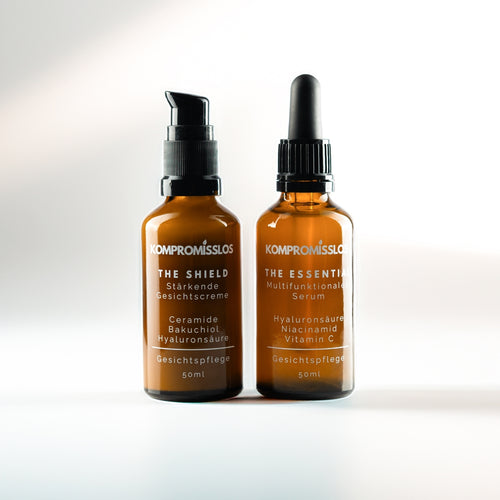
Yes, niacinamide and hyaluronic acid can be combined without restriction, because there is no conflict between them – neither chemically nor in terms of how your skin tolerates them. The idea that active ingredients cancel each other out on the skin usually comes from laboratory conditions that have little to do with a finished formulation. Niacinamide is a form of vitamin B3; hyaluronic acid is a humectant. They work in completely different places and therefore do not get in each other’s way. In practice, you will rarely find them apart anyway, because most serums contain several active ingredients at once and a good formulation already takes the combination into account. That is exactly how we built The Duo, a serum and a cream, rather than selling you two single ingredients that you then have to balance against each other yourself. So the real question is not whether, but in what order and in what amounts you apply them.
What do niacinamide and hyaluronic acid each do?
Hyaluronic acid provides instant moisture at the surface, while niacinamide works slowly on the skin barrier. Hyaluronic acid is a sugar molecule that binds many times its own weight in water. When you apply it, your skin looks plumper within minutes and fine dehydration lines are less noticeable. The effect lasts exactly as long as you keep renewing it. Niacinamide takes a different route and acts on lipid production in the stratum corneum, the skin’s outermost layer. According to a study in the British Journal of Dermatology, topically applied nicotinamide increases the ceramide and fatty acid content of the stratum corneum and reduces water loss in dry skin. This is not an instant effect but a gradual build-up over several weeks. For you, that means hyaluronic acid disguises, niacinamide changes. With an unsettled complexion and blemishes, it is therefore niacinamide that makes the difference over time, not moisture alone.
| Feature | Hyaluronic acid | Niacinamide |
|---|---|---|
| Where it works | In the uppermost layers of the stratum corneum. | In the stratum corneum and the lipid metabolism beneath it. |
| When it goes on | First, because the texture is lighter. | Afterwards, usually in the richer cream. |
| Visible after | Minutes to hours. | Four to twelve weeks. |
| Aim | Binding water and smoothing the surface. | Supporting the skin barrier and making the complexion look more even. |
| Needs | A cream on top, otherwise the moisture evaporates. | Patience and daily use. |
Hyaluronic acid or niacinamide first: which order is right?
Hyaluronic acid first, then niacinamide – provided the two are in separate products. With niacinamide and hyaluronic acid, the order is decided not by the ingredient but by the texture: the thin serum first, then the richer cream. A serum absorbs quickly; a cream contains lipids and settles on top. If you apply the cream first, the serum will barely get through. If the hyaluronic acid is in the serum, this sequence has an added advantage: it attracts water, and the cream on top stops the moisture evaporating again. Without anything sealing it in, hyaluronic acid can, in dry indoor air, even draw moisture up from deeper layers of the skin, which makes tightness worse rather than relieving it. You do not need to wait between steps until everything has fully absorbed. In fact, the cream spreads better on slightly damp skin. You can see how this works with our products in the step-by-step guide to using them.
If both ingredients are in both products, the question does not arise. The same order applies morning and evening. If you are wondering whether you need both at all, see which of the two ingredients suits your skin.
Which concentrations of niacinamide and hyaluronic acid make sense?
For niacinamide, the usual cosmetic range is between 2 and 10%; for hyaluronic acid, between 0.5 and 2%. More is not better here. Above around 10% niacinamide, many people report tingling or redness without any documented additional benefit, and we have worked out separately the point at which high percentages tip over. With hyaluronic acid, the limit is a practical one: above 2%, the texture becomes sticky, and your skin cannot bind more water just because there is more humectant sitting on it. What matters more than the number itself is whether a brand states the concentration at all. A great many do not, and simply put the ingredient’s name on the front. Our Duo for CHF 109.90 contains 5% niacinamide and 2% hyaluronic acid, and these figures always refer to the serum and cream together. We have disclosed all other figures on our page about ingredients and their concentrations.
What else can you combine them with?
With almost everything found in a normal routine, including vitamin C, bakuchiol and ceramides. The old warning that niacinamide and vitamin C neutralise each other goes back to experiments with pure ascorbic acid under heat and cannot be applied to modern formulations. We deliberately use 3-O-ethyl ascorbic acid, a more stable form of vitamin C that works in the same pH range as niacinamide. If you are interested in the order of these two, you will find it here: whether vitamin C or niacinamide goes on first. Caution is only called for with strong acids and high-strength retinol – not because of a conflict with niacinamide or hyaluronic acid, but because they already put your skin under strain on their own. Plant extracts can also sit alongside without any problem, for example gentian root extract and what it does in a formula, which is in the Duo at 2%.
It is best to introduce a new product on its own and give it two to three weeks. If you start three things at once and your skin reacts, you will not know which one caused it.
When is the combination not the answer?
If your skin is acutely irritated, an extra active ingredient will not help – what helps first is less. Skin that burns, flakes or reacts to every product with redness usually has an overloaded skin barrier. In that state, a simple moisturiser with few actives is a better choice than a combination of two active substances. Give your skin two to three weeks’ rest, then reintroduce the active ingredients one at a time. To be equally honest: if your skin is happy at the moment and there is nothing specific you want to address, you need neither extra niacinamide nor extra hyaluronic acid. A good moisturiser is then perfectly sufficient. And if there is a medical condition behind the way your skin looks – persistent inflammation, severe acne or redness that will not go away – that is one for a dermatologist. Skincare cares for and stabilises the skin; it is no substitute for a medical assessment.
With the Duo, I deliberately chose not to split niacinamide and hyaluronic acid into two separate products, even though that would have meant more sales. Two ingredients, two bottles, twice the basket – that is the usual pattern. But for me the question was not how to sell more; it was why anyone should buy two products they are going to apply straight after one another anyway. That is why both ingredients are spread across the Duo, and why I state the concentrations rather than just naming the ingredients. If you see no difference after two months, you have 100 days to return it. I prefer that to a promise I cannot keep.
Frequently asked questions
Should you apply hyaluronic acid or niacinamide first?
Hyaluronic acid first, then niacinamide – if the hyaluronic acid product is the lighter one. It is not the ingredient that decides the order but the texture: thin serum before rich cream. If both ingredients are in both products, the question does not arise and you simply follow the order of textures.
Does the order matter morning and evening?
No, the same order applies morning and evening: light product first, rich product second. Neither niacinamide nor hyaluronic acid makes your skin more sensitive to light, so there is no reason to reverse the order in the evening. What matters more than the time of day is that you use both twice a day, consistently.
Do I need to wait between serum and cream?
No, you do not need to wait until the serum has fully absorbed. The cream actually spreads better on slightly damp skin and seals in the moisture the serum has bound. On current evidence, waiting several minutes between steps brings no additional benefit.
Do I need two separate products for niacinamide and hyaluronic acid?
No. The two ingredients can be combined in one formulation, and most serums do exactly that. Two separate products only help if you want to control one particular concentration. For daily care, a ready-balanced combination is the simpler route.
Can niacinamide and hyaluronic acid together irritate the skin?
The combination itself is considered well tolerated. Irritation is more likely to come from niacinamide concentrations above 10%, from additional acids in the same routine, or from a barrier that is already weakened. If your skin reacts, cut down the number of products rather than switching ingredients.
How long does it take to see results?
With hyaluronic acid, you see the moisturising effect immediately; with niacinamide, you need four to twelve weeks. That is because niacinamide acts on processes that take time. So never judge a routine after a week – and it is a good idea to photograph your skin at the start.
Does hyaluronic acid work in dry indoor air?
Only with a cream on top. Hyaluronic acid attracts water, and if there is hardly any in the surrounding air, it partly draws it from deeper layers of the skin. Finishing with a lipid-rich cream prevents this and keeps the moisture where it belongs.
Can I combine niacinamide and hyaluronic acid with vitamin C?
Yes. The widespread warning about niacinamide and vitamin C comes from experiments with pure ascorbic acid under heat and cannot be applied to modern formulations. More stable forms of vitamin C such as 3-O-ethyl ascorbic acid work in the same pH range as niacinamide and can be used alongside it without any problem.
Sources
- Tanno O, Ota Y, Kitamura N, Katsube T, Inoue S. Nicotinamide increases biosynthesis of ceramides as well as other stratum corneum lipids to improve the epidermal permeability barrier. British Journal of Dermatology, 2000. Source