Hyaluronic acid or niacinamide: what does your skin actually need?
INGREDIENTS COMPARED
Hyaluronic acid or niacinamide is not an either-or question. Hyaluronic acid binds moisture in the upper layers of the skin and makes it look plumper within minutes. Niacinamide supports the skin barrier over a period of weeks and helps give you a more even complexion. If your skin feels tight and dry, start with hyaluronic acid; if your complexion is unsettled, start with niacinamide.
Hyaluronic acid or niacinamide: which ingredient solves which problem?
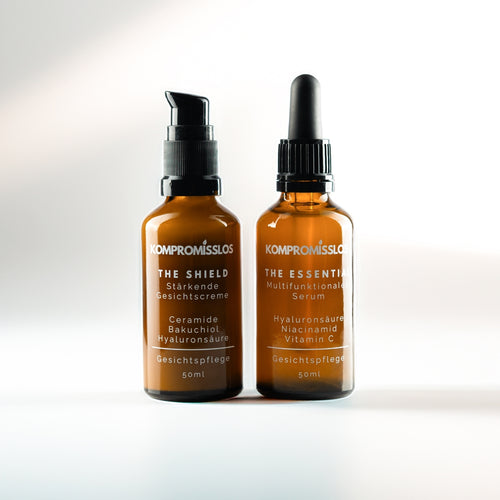
Hyaluronic acid and niacinamide solve two completely different problems, which is why they do not rule each other out. Hyaluronic acid is a humectant: it binds water in the upper layers of the skin, so that fine dehydration lines become less visible in the short term and the surface looks smoother. The effect shows quickly and lasts as long as you keep applying it regularly. Niacinamide works more slowly: it is a form of vitamin B3 that is used in skincare to support the skin barrier and give a more even appearance. That is exactly why our Duo of serum and cream contains both ingredients rather than us choosing one. With niacinamide, visible changes usually take four to eight weeks. If you want a smoother surface tonight, hyaluronic acid is your ingredient. If what bothers you is how your skin generally looks and how it reacts to central heating, weather or stress, niacinamide is the more patient route.
| Criterion | Hyaluronic acid | Niacinamide |
|---|---|---|
| Main job | Binds moisture in the stratum corneum | Supports the skin barrier |
| Visible after | A few minutes to hours | About four to eight weeks |
| Suits | Tightness and dehydration lines | Redness, large pores and an unsettled complexion |
| In the Duo | 2% | 5% |
When is hyaluronic acid the better choice?
Hyaluronic acid is the better choice if your skin is mainly losing water and is not generally irritated. Typical signs: your skin feels tight after washing, make-up settles into fine lines, and by the evening your face looks more tired than it did in the morning, even though nothing is inflamed or flaking. That is dehydrated skin – a condition, not a skin type – and it can affect any skin, including oily skin. Hyaluronic acid targets exactly this, because it holds water in the stratum corneum rather than adding oil. The order in your daily routine matters here: on completely dry skin in dry indoor air, a pure hyaluronic acid product can even feel uncomfortably tight if you do not follow it with something that holds in the moisture. That is why a hyaluronic acid serum should always be followed by a cream. You can see which active ingredients work together in our products in the full overview of active ingredients.
When will niacinamide do more for you?
Niacinamide will do more for you if what bothers you is not dryness but the overall look of your skin. That means redness that lingers long after a shower, an uneven skin tone, visible pores or skin that reacts sensitively to every change. Niacinamide is used in skincare to support barrier function, and that is precisely the difference: it changes not only how your skin looks today, but how stable it stays over the weeks. That takes patience. In the first two weeks, little happens visibly, and if you give up after ten days, you will never see the part that counts. A second point hardly anyone mentions: niacinamide does not replace a moisturiser. It makes the skin more resilient over time, but it does not top up its water reserves, which is why a cream on top remains essential. You can read what customers report after several weeks in other people’s reviews.
Do you have to choose between hyaluronic acid and niacinamide?
No, you do not have to choose, because hyaluronic acid and niacinamide work together in the same routine without any problem. The old warning that niacinamide does not get on with other active ingredients comes from combinations with pure ascorbic acid at a very low pH and has nothing at all to do with hyaluronic acid. In practice, that means you can use both morning and evening in the same application, without separating them in time or spreading them across different days. For the order, the simple rule is to work from thin to thick. First the serum on skin that is still slightly damp, then the cream. With our products, that is three to six drops of serum and three to six pumps of cream, morning and evening. If you already have both ingredients in two products designed to work together, the question does not arise, because the formulation has already taken care of it.
If your skin is reacting to everything right now, do not introduce both ingredients at the same time. Start with the moisture side and give your skin two weeks before you add anything else.
How much hyaluronic acid and niacinamide should a product contain?
For niacinamide, around 4 to 5% makes sense, and for hyaluronic acid, levels in the low single digits – anything above that rarely brings more. With niacinamide, from everything we see, higher concentrations of 10% or more are more often poorly tolerated by sensitive skin, without the visible benefit increasing accordingly. With hyaluronic acid, the figure matters less anyway than the molecular size and, above all, what you apply on top to hold in the moisture. In The Duo, we therefore chose 5% niacinamide and 2% hyaluronic acid, each relative to both products together. When comparing different brands, check what a percentage refers to, because the same figure can stand for a single serum or for a whole routine. A figure without a reference tells you little about what actually ends up on your skin.
When do you need neither hyaluronic acid nor niacinamide?
If your skin is calm, does not feel tight and you are happy with your complexion, you do not need either ingredient in addition. That is the sentence you rarely read in product copy, and it is true all the same. Skincare does not solve a problem that is not there, and a routine that works well does not get better because you add another serum to it. The most common mistake we see in feedback is not the wrong ingredient, but too many at once and switching before anything has had time to work. Equally important is knowing where skincare stops: heavily flaking patches, persistent redness, painful inflammation or sudden changes mean your skin belongs with a dermatologist, not with a new skincare product. Skincare cares for and supports the complexion. It is no substitute for an assessment when something needs to be looked at medically.
When developing the formula, I deliberately decided against the highest possible niacinamide concentration, even though 10% looks more impressive on a label. Our customers often have sensitive skin, and for them what counts is not the number but whether they are still applying a product after eight weeks. Skin can tolerate 5% more reliably. The same logic applies to hyaluronic acid: in our products, it works through the interplay of serum and cream, because hyaluronic acid on its own cannot hold anything on dry skin. Two products designed to work together, instead of five that get in each other’s way.
Dominic Bertschin
Frequently asked questions
Which is better, hyaluronic acid or niacinamide?
Neither is better in principle; they solve different problems. Hyaluronic acid helps with a lack of moisture, tightness and dehydration lines, and its effect is visible straight away. Niacinamide supports the skin barrier and the look of redness and pores, but it takes four to eight weeks to do so. For most skin conditions, combining them makes more sense than choosing.
Can I use hyaluronic acid and niacinamide together?
Yes, hyaluronic acid and niacinamide can be used in the same routine without restriction, morning and evening alike. There is no known incompatibility between the two ingredients. The widespread warning about niacinamide combinations relates to pure ascorbic acid at a very low pH, not to hyaluronic acid.
Which goes first, hyaluronic acid or niacinamide?
Apply the thinner product first and the richer one afterwards. In practice, that usually means serum on skin that is still slightly damp, followed by cream. If both ingredients are in a set designed to work together, there is nothing else to consider, because the formulations are matched to each other.
How long does it take for niacinamide to make a visible difference?
Expect four to eight weeks with daily use, morning and evening. In the first two weeks you usually will not see a difference yet – that is normal and not a sign that the product does not suit you. If you switch before then, you never judge the result, only the beginning.
How much niacinamide should a product contain?
Around 4 to 5% is considered a good compromise between effect and tolerance. Higher concentrations of 10% and above are more often poorly tolerated by sensitive skin, without bringing correspondingly more. The Duo contains 5% niacinamide, relative to the serum and cream together.
Does dry skin need hyaluronic acid or niacinamide more?
Dry skin needs moisture and lipids first – so hyaluronic acid plus a cream on top. Niacinamide is a sensible addition, because a well-supported skin barrier loses less moisture. On dry skin, hyaluronic acid on its own is not enough; it always needs to be sealed in with a moisturiser that holds the water.
Can niacinamide irritate the skin?
At high concentrations and on very sensitive skin, redness or tingling is possible, especially at the beginning. At moderate concentrations of around 5%, on the other hand, most people tolerate niacinamide well. Introduce it slowly and do not combine it with other new active ingredients at first.