Niacinamide side effects: what’s behind redness, stinging and breakouts
ACTIVE INGREDIENTS
The most common niacinamide side effects are redness, a feeling of warmth, burning or tingling and, less often, small spots. In studies, the ingredient itself is considered well tolerated, and genuine allergies are rare. Something else is usually behind the reaction: a weakened skin barrier, too much niacinamide from several products, combining it with acids or retinol, or the base of the product. Once you know which factor applies to you, you can respond in a targeted way instead of dropping niacinamide for good.
What side effects can niacinamide have?
On the skin, niacinamide can cause redness, warmth, burning, stinging, itching, a feeling of dryness and occasionally blemishes, mostly mild and temporary. Serious reactions are rare. In its safety assessment in the International Journal of Toxicology, the Cosmetic Ingredient Review Expert Panel concluded that niacinamide and niacin are not significant skin irritants, sensitisers or photosensitisers. A study in Dermatologic Surgery also notes that topical niacinamide was well tolerated in several long-term clinical studies. That does not mean every skin type tolerates it, though. Studies usually test a single product on largely healthy skin. In everyday life, by contrast, niacinamide meets cheeks that are irritated after the winter, an exfoliant from the night before or two other serums containing the same ingredient. That is exactly where most of the reactions described as niacinamide intolerance arise. What the ingredient can achieve at its best is covered in the article on what niacinamide can do. This article looks at the other side: how to tell what is happening to your skin right now.
| Reaction | When it appears | Common cause | What to do |
|---|---|---|---|
| Warmth, redness, mild burning | Minutes after applying | Stressed barrier, a lot of niacinamide, acid or retinol in the same routine | Wash it off, take a break, reintroduce it more slowly later |
| Stinging around the nostrils or the corners of the mouth | Immediately, on thin or cracked areas | Small breaks in the skin barrier | Leave out these areas, calm the barrier first |
| Small spots or red bumps | After a few days to a few weeks | The product’s base, a rich texture, irritation | Test products one at a time, check the base |
| Itchy, scaly patches, swelling | After hours to days, even beyond the area where you applied it | Possible contact allergy to an ingredient | Stop using it and have it checked by a dermatologist |
Why does skin go red or warm after niacinamide?
Redness and warmth after niacinamide usually occur because the ingredient meets skin that is already stressed or is applied in large amounts. Niacinamide is a small, water-soluble molecule, and a weakened barrier lets substances like this through more easily. A review in Skin Pharmacology and Physiology lists vasoactive effects among niacinamide’s actions – in other words, an influence on the blood vessels – and stresses that the effects depend on the concentration. That matches what many people describe: a warm, flushed face shortly after applying it, which settles again after a while. It has also been suggested that traces of nicotinic acid in the product may play a part, as nicotinic acid is known for causing flushing. For cosmetics, however, this has hardly been studied, and as a customer you have no way of checking it anyway. Concentration is a factor, but it is rarely the only reason. Where a higher percentage does more harm than good is covered in the article on when high-strength niacinamide backfires.
If the redness lasts for hours, spreads or every product now stings, it is no longer a harmless reaction of the blood vessels. Whether a brief tingle is still within normal limits is explained in the article on why a face cream stings. If, regardless of niacinamide, you often have persistent redness, visible small veins or bumps on your face, that is a matter for a dermatologist, as described in the article on rosacea and skincare.
Can niacinamide cause breakouts?
Niacinamide itself is not a typical trigger of spots; if blemishes appear after you start a new niacinamide product, the cause more often lies in the base or in irritation. The review in Skin Pharmacology and Physiology even lists a sebum-regulating effect among niacinamide’s actions. But a serum or cream never consists of the active ingredient alone. Rich oils and waxes, a very dense texture or simply too much product can clog pores in some skin types. On top of that, there is a second form that is often mistaken for breakouts: irritated skin forms small red bumps that look like spots but are really an inflammatory response to too much irritation. They often appear where the skin is thin, such as around the mouth and nose. Purging is mainly associated with active ingredients that speed up cell turnover, such as retinoids and acids. With niacinamide alone, it is therefore not an obvious explanation. How to tell purging apart from a reaction is explained in a separate article. One clear warning sign is blemishes in places where you never otherwise get them.
Is the reaction caused by combining niacinamide with other active ingredients?
Often, yes, because niacinamide triggers reactions less often on its own than in combination with products that put extra strain on the skin barrier. People who go red after starting a new niacinamide serum have often changed something else in the same week. Typical contributors are:
- Acids such as AHA or BHA, whether as a toner, exfoliant or serum.
- Retinol and other retinoids, especially in the first few weeks.
- Several products containing niacinamide at the same time, whose amounts add up without you noticing.
- Toners with a lot of alcohol, fragrances and essential oils.
- Mechanical irritation such as brushes, exfoliating pads or frequent rubbing with a cloth.
The best-known warning, on the other hand, hardly applies to everyday life: the claim that niacinamide and vitamin C together form a reddening mixture goes back to old laboratory experiments under conditions that do not occur on the skin. The details are in the article on combining niacinamide and vitamin C. So if you want to find the cause, do not just ask yourself which product is new, but what has changed in your routine as a whole over the past two weeks.
What should you do if niacinamide does not agree with your skin?
If niacinamide does not agree with your skin, wash the product off with lukewarm water, stop using it and let your skin settle before you try anything new. During this time, it is best to pause acids, retinol and exfoliants as well and stick to a few fragrance-free products you have tolerated for a long time. Only once your skin is calm again is it worth looking for the cause – one product at a time rather than everything at once. It helps to know how much niacinamide a product actually contains. Many products only name the ingredient, not the amount. The Duo, for example, discloses that it contains 5% niacinamide. That lets you judge whether you end up well above that when you add a second niacinamide product. And if a product you have just bought does not suit you, you do not have to use it up just because you have paid for it. That is what our 100-day return policy is for.
You should have the reaction checked by a doctor if your skin swells, weeps or blisters, if your eyes are affected or if your skin does not calm down within a few days of stopping.
How do you introduce niacinamide if your skin is sensitive?
If your skin is sensitive, introduce niacinamide slowly, on its own and on calm skin, so that you can clearly attribute any reaction. That sounds laborious, but it saves you weeks of guesswork. This order has proven useful:
- Only one new product at a time, and not during the same period as an acid or retinol.
- Apply it once a day for the first one to two weeks, then increase to twice a day if everything stays calm.
- Do not start straight after an exfoliation, sunburn or shaving.
- Use a small amount and leave out cracked areas around the nostrils and the corners of the mouth at first.
- Keep only one product with niacinamide in your routine.
The product itself matters just as much as the approach. A short ingredient list without fragrance makes it easier to interpret a reaction. How to recognise a product your skin will tolerate is explained in the article on choosing a serum for sensitive skin.
If you have a reaction, make a quick note of which products you used in the three days before. A photo taken in daylight also helps if you later talk to a professional about it.
I decided to disclose the concentrations in The Duo, including the 5% niacinamide. That ties in directly with this topic: if your skin reacts, you should be able to tell what you are dealing with instead of guessing. But I will also tell you what disclosure cannot do. A concentration of 5% niacinamide is a well-studied range, and yet some skin still reacts to it. No formulation can rule that out for everyone, mine included. What I could do was make The Duo fragrance-free and leave out essential oils, so that at least the typical sources of irritation that have nothing to do with niacinamide are gone. If it still does not suit you, then it does not suit you, and that is exactly what the return policy is for. You will find all the amounts on the page with all active ingredients and their concentrations.
Frequently asked questions
How long does a reaction to niacinamide last?
A feeling of warmth or slight redness straight after applying it usually disappears again after a short time. Irritation caused by repeated use generally settles within a few days of stopping. If it lasts longer, gets worse or is accompanied by swelling and blisters, it needs medical attention.
Can niacinamide cause darkening of the skin?
There is no solid evidence for this; if anything, studies show the opposite. In a study in the British Journal of Dermatology, a moisturiser containing niacinamide reduced hyperpigmentation after 4 weeks compared with the same base without the active ingredient. Darker patches after irritation are more likely to be caused by the inflammation itself or by sun exposure without protection.
Does niacinamide with vitamin C make your skin red?
In a normal routine, generally not. The old warning about redness comes from laboratory experiments that have little to do with applying products to the skin. If your skin does react, it is more likely due to a very acidic vitamin C product or to the sum of all the active ingredients.
Is niacinamide intolerance an allergy?
Usually not. Most reactions are irritation that depends on the amount, the combination and the condition of your skin, and that disappears after you stop. A genuine contact allergy to niacinamide is rare. Whether you have an allergy, and to which ingredient, can be established with a patch test at a dermatologist’s.
Does red, reactive skin react more strongly to niacinamide?
It often reacts more quickly, because red, reactive skin frequently has a weakened barrier and responds more sensitively to any new active ingredient. That does not mean it cannot tolerate niacinamide in principle: in a study in Dermatologic Surgery, red blotchiness on ageing facial skin became visibly less pronounced with niacinamide. So introduce it especially slowly. Have persistent redness without a clear trigger checked by a dermatologist.
Is niacin in tablet form the same thing?
No. Niacin tablets are swallowed, and in amounts that are not comparable with skincare. A review in the journal Eye lists gastrointestinal complaints, flushing and skin rash among the side effects of oral supplements, with nicotinamide causing fewer side effects than niacin. High-dose supplements should be taken under medical supervision.
What should I do if I react to the niacinamide in The Duo?
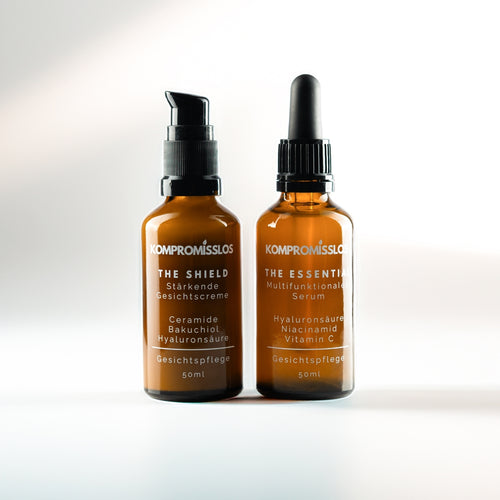
Stop using both products until your skin is calm again. The niacinamide is in The Essential serum. Afterwards, test the cream on its own first and the serum only later, so you can see which product triggers the reaction. This cannot tell you for certain whether niacinamide is the cause. If The Duo does not suit your skin, you can return it within 100 days.
Sources
- Cosmetic Ingredient Review Expert Panel. Final report of the safety assessment of niacinamide and niacin. International Journal of Toxicology, 2005. Source
- Bissett DL, Oblong JE, Berge CA. Niacinamide: A B vitamin that improves aging facial skin appearance. Dermatologic Surgery, 2005. Source
- Wohlrab J, Kreft D. Niacinamide – mechanisms of action and its topical use in dermatology. Skin Pharmacology and Physiology, 2014. Source
- Hakozaki T, Minwalla L, Zhuang J, Chhoa M, Matsubara A, Miyamoto K, et al. The effect of niacinamide on reducing cutaneous pigmentation and suppression of melanosome transfer. British Journal of Dermatology, 2002. Source
- Young SL, Gazzard G. The adverse effects of oral niacin/nicotinamide – an overview of reviews. Eye, 2025. Source