Serum for sensitive skin: how to spot one your skin will tolerate
SKIN CONCERNS
To choose a serum for sensitive skin, look at the formula rather than the label: no fragrance or essential oils, no ethanol near the top of the ingredient list, a small number of active ingredients in moderate, openly declared concentrations and no strongly acidic pH. Claims such as ‘for sensitive skin’ or ‘dermatologically tested’ help you narrow down the choice, but they guarantee nothing. Whether a serum really suits your skin only becomes clear with a careful test over a few days.
How can you tell whether a serum will suit sensitive skin?
A serum that suits sensitive skin has a short, transparent formula without the usual sources of irritation, and you can check this on the ingredient list before you buy. That is worth doing, because skincare products are often the very thing that sets sensitive skin off: in a meta-analysis in the Journal of the European Academy of Dermatology and Venereology, which evaluated surveys of people with sensitive skin, cosmetics were the most important trigger of symptoms, with an odds ratio of 7.12. Why your skin reacts so quickly in the first place is explained in our article on the causes of sensitive skin. Here, the only question is which serum to choose. Five points separate the calm candidates from the risky ones:
- No parfum, no aroma and no essential oils on the ingredient list.
- No Alcohol denat. or ethanol among the first ingredients.
- A manageable number of active ingredients whose concentrations the manufacturer discloses.
- No strongly acidic pH, which means no pure ascorbic acid and no exfoliating acids such as AHA or BHA in a serum for daily use.
- A base that holds on to moisture rather than stripping oil from the skin.
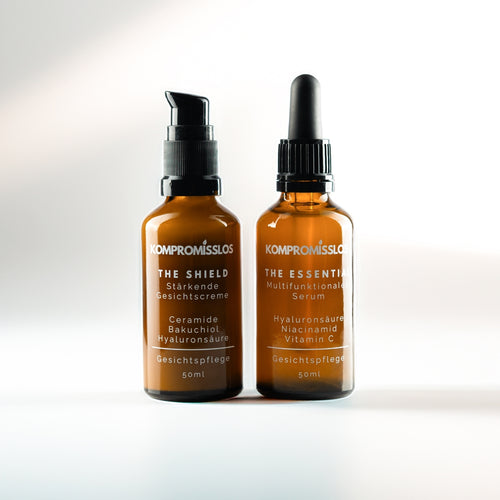
One example of these criteria is our serum The Essential: fragrance-free, with vitamin C as stable 3-O-Ethyl Ascorbic Acid instead of pure L-ascorbic acid, with niacinamide and with hyaluronic acid in three molecular sizes. For The Duo of serum and cream as a whole, the figures are 5% niacinamide, 2% vitamin C as 3-O-Ethyl Ascorbic Acid and 1% zinc PCA. In her review on Judge.me, Carmen writes: ‘I tolerate the serum very well, even though I am very sensitive’ (review translated from German). That is one person’s experience, not a promise for your skin. So the rule for any new serum is: test it on a small area for a few days first, then gradually extend it to your whole face. How to do this properly is explained in the guide on how to patch test skincare at home.
Why do concentration, base and the number of active ingredients matter more than individual ingredient names?
Concentration, base and the number of active ingredients matter more because the same ingredient can be gentle or irritating depending on its dose and what surrounds it. Niacinamide is the best example: in moderate amounts it is considered well tolerated, but at very high percentages the risk of redness and burning goes up without the benefit growing to the same extent. You can read more about when a higher percentage of niacinamide backfires in a separate article. The base plays its part too: a serum built on water, glycerin or aloe vera behaves differently on the skin from one with a lot of ethanol, which sinks in faster but can dry out the surface. And every additional active ingredient is one more chance for your skin to react. If you layer five serums with three active ingredients each, you end up with no idea what is actually bothering your skin.
This is in line with the experts’ assessment. A position paper by the special interest group on sensitive skin of the International Forum for the Study of Itch names avoiding triggers and using well-tolerated cosmetics as a possible approach. However, it also states that the data published so far are not sufficient to reach a consensus on caring for sensitive skin. For you, that means criteria rather than advertising promises – and, if in doubt, one product fewer.
| Feature | Usually calm for sensitive skin | Riskier |
|---|---|---|
| Fragrance | Fragrance-free, no essential oils | Parfum, aroma, essential oils |
| Alcohol | No ethanol, at most conditioning fatty alcohols | Alcohol denat. among the first ingredients |
| Vitamin C | A stable form such as 3-O-Ethyl Ascorbic Acid | High-strength pure ascorbic acid with a low pH |
| Acids | No exfoliating acids in a daily serum | AHA or BHA in a serum for everyday use |
| Active ingredients | A few, with disclosed concentrations | A long list with no quantities given |
Which serum ingredients irritate sensitive skin most often?
The serum ingredients that most often irritate sensitive skin are fragrances and essential oils, large amounts of ethanol, acids and strongly acidic vitamin C formulas, and high-strength active ingredients. With fragrances, the problem lies in the sheer number of individual substances: according to a review in the journal Dermatitis, essential oils usually consist of 100 to 250 identified components, including substances such as limonene and linalool that occur in many oils. A ‘natural’ scent is therefore no advantage for sensitive skin. A lot of ethanol can sting on skin that is already irritated and feel drying, especially when it appears near the top of the list. With vitamin C, the form is what counts: according to a study on pig skin in Dermatologic Surgery, pure L-ascorbic acid has to be formulated at a pH below 3.5 to get into the skin. This acidic range is a common reason for stinging on sensitive skin. More stable forms do not need such a low pH. Whether a vitamin C serum is worth it for you at all is covered in the article on which skin types a vitamin C serum is really worth it for.
The ingredient list is sorted by quantity in descending order, so the first few ingredients make up most of the product. If Alcohol denat. is right at the top, you can usually give the serum a miss. Parfum, on the other hand, often sits far down the list, so it pays to read all the way to the end.
Can sensitive skin tolerate a hyaluronic acid serum?
Usually yes, because hyaluronic acid is a humectant that the body produces itself and is not considered a typical irritant in its own right. If a hyaluronic acid serum stings, the cause is usually the formula around it: fragrance, alcohol, added acids or a long list of other active ingredients. So do not just check whether hyaluronic acid is in it, but what else is. The second point concerns how you use it: a serum with humectants binds water but does little to seal it in. Without a cream on top, dry, sensitive skin often still feels tight. For dry sensitive skin, pairing a serum with a cream that contains lipids therefore usually makes more sense than adding a second serum. Claims about several molecular sizes are a formulation detail, not proof of tolerability. Which further checkpoints apply to mature skin, such as the share of barrier ingredients, is covered in the article on the best serum for mature skin.
What do ‘for sensitive skin’ and ‘dermatologically tested’ mean on a serum?
Both claims say less than they seem to promise: ‘for sensitive skin’ is a manufacturer’s statement with no uniform testing standard behind it, and ‘dermatologically tested’ only means that the product was tested on volunteers under dermatological supervision. How many people took part, how long the test lasted and whether any of them had sensitive skin is almost never stated on the packaging. Passing the test also means that the test group tolerated the product, not that your skin will. Our products are dermatologically tested as well, and the same limitation applies to them. What is behind the label and what it does not cover is explained in the article on what ‘dermatologically tested’ means and what it doesn’t guarantee. The ingredient list remains more useful than any claim on the pack: it shows whether parfum, ethanol or acids are included, and that is something you can judge for yourself.
Are oil-based serums better for sensitive skin than water-based ones?
No, oil-based serums are not inherently better for sensitive skin – what matters is the composition, not the texture. Water-based serums are light and carry water-soluble active ingredients such as niacinamide, vitamin C or hyaluronic acid. Their risks lie in alcohol, acids and long lists of additives. Oil-based serums supply lipids that protect against water loss, but quite often contain essential oils for scent, and some oils can cause problems if you are prone to blemishes. Emulsions combine both and are often a calm middle ground, as long as the formula stays short. For sensitive skin, the order is therefore: first rule out fragrance, alcohol and acids, then choose the texture by how it feels on your skin. Dry skin usually copes better with a few more lipids, oily skin with a light, water-based formula. Whether you should use an oil instead of a serum is a separate question, answered in the comparison serum or face oil.
With the serum, I made two deliberate decisions, even though they make less of an impression at first. First, it is fragrance-free, even though a scent feels nicer when you first apply it. Second, it contains vitamin C as stable 3-O-Ethyl Ascorbic Acid rather than pure ascorbic acid, because pure ascorbic acid needs a very acidic pH – and that is exactly what sensitive skin often does not like. To be honest, though, that does not mean every skin will tolerate the formula. Our serum also contains niacinamide, the Duo contains plant extracts as well, and very reactive skin can respond to either. That is why I disclose what is in it instead of promising that it suits ‘all skin types’. You can check which active ingredients the Duo contains and in what concentrations before you buy.
Frequently asked questions
Is a serum without a cream enough for very sensitive skin?
In most cases, no. A serum mainly supplies moisture and water-soluble active ingredients; the lipids for the skin barrier come from the cream. For very sensitive skin, it is therefore the serum rather than the cream that you can more easily do without. If you want to cut back, keep a mild cream and leave out extra serums, not the other way round.
Are serums with lots of plant extracts riskier?
They tend to be, because every plant extract is a mixture of many individual substances, and any one of them can be a source of irritation. That does not mean plant extracts are bad. But the more different extracts a serum contains, the harder it is to work out what is bothering your skin. A short list is easier to check when your skin is sensitive.
Is a fragrance-free serum automatically well tolerated?
No. Fragrance-free rules out added fragrance, but not alcohol, acids, high-strength active ingredients or plant extracts with a scent of their own. It removes one of the most common sources of irritation, nothing more. So check what else is on the ingredient list all the same. What the claim actually guarantees is explained in the article on what fragrance-free really guarantees.
Are serums with centella asiatica a good idea for sensitive skin?
Centella asiatica is often used in skincare for irritated skin and is well tolerated by many people, but as a plant extract it is no guarantee of calm skin. What the plant can do and when a simpler ingredient such as panthenol is enough is explained in the article on centella asiatica for irritated skin.
What should you do if a new serum tingles?
A slight tingle that fades after a few minutes is usually harmless. If the burning persists, your skin turns red or starts to itch, wash the serum off with lukewarm water and stop using it for now. According to the meta-analysis mentioned above, sensitive skin symptoms usually appear within an hour of exposure to the trigger. How to tell a harmless tingle from a genuine intolerance is explained in the article on face cream stinging.
Is The Duo suitable for sensitive skin?
The Duo is designed with sensitive skin in mind as well: fragrance-free, without ethanol and with vitamin C as 3-O-Ethyl Ascorbic Acid. That is no guarantee for every skin, because niacinamide and plant extracts can still irritate very reactive skin. Test it on a small area first. If it does not suit you, our 100-day return policy applies, so you can try The Duo without any pressure.
Sources
- Brenaut E, Barnetche T, Le Gall-Ianotto C, Roudot AC, Misery L, Ficheux AS. Triggering factors in sensitive skin from the worldwide patients' point of view: a systematic literature review and meta-analysis. Journal of the European Academy of Dermatology and Venereology, 2020. Source
- Misery L, Weisshaar E, Brenaut E, Evers AWM, Huet F, Ständer S, et al. Pathophysiology and management of sensitive skin: position paper from the special interest group on sensitive skin of the International Forum for the Study of Itch (IFSI). Journal of the European Academy of Dermatology and Venereology, 2020. Source
- de Groot AC, Schmidt E. Essential Oils, Part III: Chemical Composition. Dermatitis, 2016. Source
- Pinnell SR, Yang H, Omar M, Monteiro-Riviere N, DeBuys HV, Walker LC, et al. Topical L-ascorbic acid: percutaneous absorption studies. Dermatologic Surgery, 2001. Source