Best serum for mature skin: how to recognise it and what you can skip
COMPARISON
The best serum for mature skin isn’t one from a ranking, but the one whose active ingredients suit your skin’s current condition. Five criteria decide: a declared active-ingredient concentration, a moisture binder, a barrier-supporting component, a short, low-irritation formula and packaging that keeps out light and air. The price per month tells you more than the shelf price.
The counterpart for cream: the best face cream for mature skin.
What makes a serum the best for mature skin?
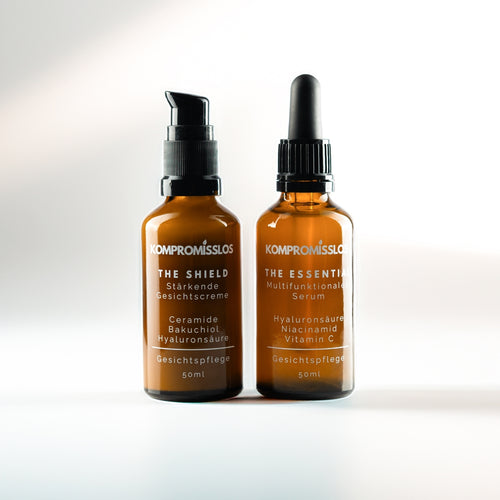
What makes a product the best serum for mature skin is how well it matches your skin’s condition, not a place in a list. Mature skin is not one uniform condition: one person’s skin feels tight after cleansing and shows dehydration lines in the morning, another’s looks dull with uneven pigmentation, and a third has been reacting to almost every new product since the hormonal transition. All three starting points lead to the same search, even though they need different priorities. That is why asking for the best serum is misleading until you have named what specifically bothers you. Note down two or three observations from the past few weeks and check whether a serum addresses them at all. How a complete routine is put together is shown in our article on caring for mature skin step by step. We deliberately only offer the serum together with the cream, as The Duo of The Essential serum and The Shield cream.
Which active ingredients should a serum for mature skin deliver?
A serum for mature skin needs to cover three jobs: binding water, making your complexion look more even and supporting the barrier. For the first job, hyaluronic acid is the standard. In a randomised study in the Journal of Drugs in Dermatology, 76 women aged between 30 and 60 applied a preparation containing 0.1 per cent hyaluronic acid in different molecular sizes around the eyes twice a day. After 30 and 60 days, all versions showed a clear improvement in skin hydration and elasticity compared with the placebo side. The second job is most reliably done by niacinamide, while ceramides, squalane and panthenol take care of the third. The Duo contains 2% hyaluronic acid, 5% niacinamide, 2% vitamin C as 3-O-ethyl ascorbic acid, 1% zinc and 0.3% bakuchiol, plus 2% edelweiss extract and 2% gentian root extract. All percentages refer to the Duo as a whole and never to either product on its own.
For niacinamide, there is a double-blind split-face study in Dermatologic Surgery: 50 women applied 5% niacinamide to one half of their face twice a day for twelve weeks. Fine lines, dark spots and redness improved compared with the ingredient-free base. Why 3-O-ethyl ascorbic acid is considered a stable form of vitamin C is explained in a separate article, and the full formula is under ingredients in detail.
How can you tell from the ingredient list whether a serum is any good?
You can tell whether a serum lives up to what the product page promises in about two minutes, by looking at four points in the ingredient list. First, the percentage: if a brand doesn’t give one, the advertised active ingredient often sits far down the list and is therefore present only in a very small amount. Second, the first five positions: alongside water, there should be at least one humectant there, not just thickeners and emulsifiers. Third, alcohol and fragrance: if Alcohol Denat. is near the top or Parfum appears, that is rarely the better choice for mature, thinning skin. Fourth, length: for sensitive skin, a list of more than forty ingredients generally brings more potential for irritation than extra benefit. These four points cost you nothing and tell you more than any ranking. Where the difference between bakuchiol and retinol lies is explained in our article on bakuchiol or retinol for sensitive skin.
| What to check | What to look for in the list | Why it matters for mature skin |
|---|---|---|
| Concentration | A percentage stated by the brand | Without an amount, no claim about an active ingredient can be checked |
| Moisture binders | Hyaluronic acid, glycerin, panthenol | Skin binds water less well over the years |
| Lipids and barrier | Ceramides, squalane, jojoba oil | Sebum production slows down and building blocks go missing |
| Irritants | Alcohol Denat. and Parfum near the top | The irritation threshold drops and redness lingers longer |
| Packaging | Pump dispenser or dark glass | Vitamin C and bakuchiol react to light and air |
How much does a good serum for mature skin cost per month?
What a serum for mature skin costs you isn’t the price on the label but what a bottle costs per month. This calculation is missing from almost every comparison, even though it is the only one that affects your day-to-day life. Two serums with an identical price can differ in how long they last by a factor of two, depending on pack size, dispenser and how much you apply. So always do the sums yourself: price divided by the number of months a bottle lasts at your rate of use. With us, our two-step routine for CHF 109.90 costs between around CHF 27 and CHF 55 a month, because a bottle lasts two to four months depending on how often you use it, and the price includes both products. Whether that amount is right for you is your decision. What matters is that you compare two offers on the same basis, not shelf price against monthly price.
Is a serum enough on its own, or does mature skin need a cream as well?
A serum on its own is rarely enough for mature skin, because serum and cream do two different jobs. The serum is a light, low-oil formula that carries water-soluble active ingredients into the upper layers of the skin. The cream supplies lipids and forms the final layer that keeps the moisture there. Without that final layer, some of what the serum has just delivered evaporates – and that weighs more heavily with mature skin than it does at 25. Conversely, a cream on its own covers moisture and protection but carries hardly any active ingredients in amounts that change how your skin looks. If you look for both in one product, you usually get a little less of each. Why the two steps belong together, and when one of them is enough, is explained in our article on whether you really need both. Order and quantities are set out on our page on how to use the serum and cream.
When a serum isn’t the right choice, and when to see a specialist
You don’t need a new serum if your skin is calm at the moment, doesn’t feel tight after cleansing and nothing bothers you. An extra product with no reason makes your routine more complicated, not better. Nor does it make sense to start in the middle of an irritated phase: if your skin is stinging, flaking or itching, calm it first with two to four weeks of moisture and barrier care before adding new active ingredients. And there is a line beyond which cosmetics are the wrong tool. Persistent redness with visible thread veins, weeping or itchy patches, a spot that won’t heal, and a mole that changes in colour, size or the shape of its edge all need to be checked by a dermatologist. The same applies if dryness coincides with starting a new medication. Skincare can change how your skin looks. It replaces neither diagnosis nor treatment, and no online ranking can make that distinction for you.
The most common message I get on this topic goes something like this: I’ve already been through four serums – which one is the best? My reply is always the same question: how long did you use each one? In most cases, it’s two to three weeks. That’s why I don’t sell The Essential serum on its own. Two products, morning and evening, three to six drops of serum and three to six pumps of cream, followed by eight to twelve weeks of patience. I deliberately chose 0.3% bakuchiol instead of retinol, because thinning skin often pays the price for retinol with flaking – and then people give up on it.
Frequently asked questions
What is the best serum for mature skin?
The best serum for mature skin is the one whose active ingredients suit your skin’s current condition. Look for a declared percentage, a moisture binder such as hyaluronic acid, a barrier-supporting component such as ceramides and squalane, and a short, low-irritation formula. A ranking is no substitute for these four checks.
Which active ingredients should a serum for mature skin contain?
A moisture binder, an active ingredient for your complexion and barrier-supporting building blocks make sense. In The Duo, that means 2% hyaluronic acid, 5% niacinamide, 2% vitamin C as 3-O-ethyl ascorbic acid and 0.3% bakuchiol, plus ceramides, squalane and panthenol. All values refer to both products together.
Is a serum without a cream enough for mature skin?
Very rarely. The serum delivers water-soluble active ingredients to the upper layers of the skin; the cream provides lipids and keeps the moisture there. Without that final layer, some of what the serum has delivered evaporates. Two products are enough for this; a longer routine rarely brings more.
How long does it take for a serum to work on mature skin?
Allow eight to twelve weeks before judging the result. The study on 5% niacinamide cited above ran for twelve weeks; the hyaluronic acid study took measurements after 30 and 60 days. Skin feel and tightness often improve sooner; fine lines and uneven pigmentation take considerably longer.
Is there a test winner among serums for mature skin?
What comes up as a test winner for this search almost always comes from comparison sites that rank products based on manufacturer information, price and customer reviews. There is usually no measurement of concentration or stability behind it. So check the percentage, supporting ingredients, packaging and how your skin tolerates the product yourself.
How much does a good serum for mature skin cost?
What tells you something is not the shelf price but the price per month. The Duo costs CHF 109.90 for the serum and cream together, and a bottle lasts two to four months depending on how often you use it. That works out at around CHF 27 to CHF 55 a month for both products together.
Is an expensive serum better for mature skin?
The price tells you little about whether a serum suits you; the ingredient list and how long it lasts tell you a lot. An expensive serum without a stated percentage can’t be checked, while an inexpensive one with declared active ingredients and a short formula may suit you. In the end, what matters is whether you use it twice a day for several months.
Sources
- Pavicic T, Gauglitz GG, Lersch P et al. Efficacy of cream-based novel formulations of hyaluronic acid of different molecular weights in anti-wrinkle treatment. Journal of Drugs in Dermatology, 2011. Source
- Bissett DL, Oblong JE, Berge CA. Niacinamide: A B Vitamin that Improves Aging Facial Skin Appearance. Dermatologic Surgery, 2005. Source