Best face cream for mature skin: the criteria, not the ranking
COMPARISON
The best face cream for mature skin is the one that suits your skin’s current condition, not the one with the highest test ranking. Five points you can check are what count: traceable active-ingredient concentrations, barrier-strengthening lipids, good tolerance, a fully visible ingredient list and a texture you enjoy using morning and evening. There is no universal best-of list, because mature skin reacts in very different ways.
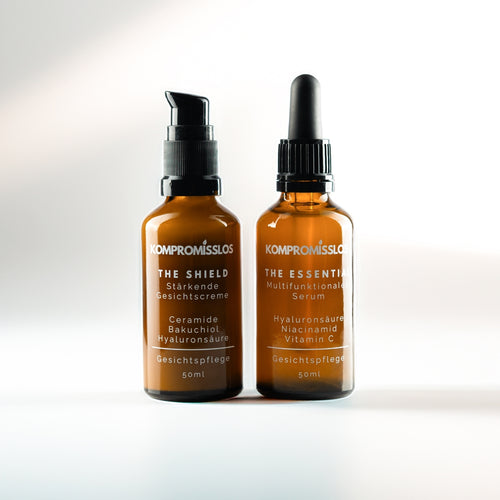
Want to compare straight away? The Duo – serum & face cream for mature skin, from Switzerland, fragrance-free and with ceramides.
What makes the best face cream for mature skin?
The best face cream for mature skin meets five criteria that you can check on the product itself, rather than taking them from a ranking. First, it states active-ingredient concentrations as percentages, not just ingredient names. Second, it contains barrier-strengthening lipids such as ceramides or squalane, because the lipid content of the outermost layer of skin decreases with age. Third, it avoids unnecessary sources of irritation if your skin is quick to react with tightness or redness. Fourth, the full ingredient list is available before you buy, not only on the packaging on the shelf. Fifth, the texture suits the season and your routine, because even the most carefully designed formula is of little use if it is hard to spread. The Duo, our serum and cream, is built on exactly this logic. You can check these five points in a few minutes. A place in a best-of list, on the other hand, tells you nothing about whether the product suits your skin’s condition.
| Criterion | How to check it | What tells you nothing on its own |
|---|---|---|
| Amount of active ingredients | Percentages are given on the product page or packaging. | An ingredient name in the product title. |
| Barrier care | Ceramides, squalane or plant oils are declared. | Being described as “rich”. |
| Tolerance | A short list, clear information on fragrance. | The term hypoallergenic without explanation. |
| Transparency | Full INCI list visible before you buy. | A nature image on the packaging. |
Which ingredients belong in a cream for mature skin?
Mature skin benefits above all from three building blocks: moisture binders, barrier lipids and a well-researched active ingredient for the look of lines and dark spots. Moisture binders such as hyaluronic acid and panthenol hold water in the outermost layer of skin. Barrier lipids such as ceramides, squalane and jojoba oil make up for what your skin loses over the years: an analysis of stratum corneum lipids in Archives of Dermatological Research showed that all the major lipid classes – and ceramides in particular – decrease markedly with age. As the third building block, niacinamide is the most widely researched. On top of that come gentle additions such as bakuchiol and a stable form of vitamin C. In The Duo, taken as a whole system, that means 2% hyaluronic acid, 5% niacinamide, 0.3% bakuchiol and 2% vitamin C as 3-O-ethyl ascorbic acid. All percentages refer to the serum and cream together, never to a single product. You can go through the full overview of active ingredients before you buy.
For niacinamide, there is an evidence-based order of magnitude: in a split-face study with 50 women over twelve weeks, a 5% preparation was compared with its base, with visible improvements in fine lines, dark spots and redness. A higher percentage doesn’t automatically mean more effect – it more often means tingling on sensitive skin.
Why does a test winner tell you nothing about your skin?
A test win describes how a product performed in a defined test set-up, not how your skin will respond to it. Comparative tests usually assess criteria such as freedom from harmful substances, quality of labelling, preservation, packaging and a user rating from a test panel. These are sensible criteria, but they don’t answer your real question: whether this texture works for your skin’s condition, in your climate and alongside your other products. On top of that, rankings are almost always a snapshot of a limited field of products. A product that wasn’t tested is therefore not worse; it simply wasn’t included. So use tests as a filter for hard exclusion criteria such as poor labelling, and then make the actual choice yourself, based on your skin. It makes sense to ask what a test actually checked before you rely on its result. What these tests check in practice, and where their limits lie, is covered in the next section.
What face cream tests in Switzerland measure – and what they don’t
The Swiss TV consumer programme Kassensturz and the consumer magazines K-Tipp and saldo regularly test face creams, and their results come top in every search for a test winner. What gets tested is whatever can be measured in the same way for every product: whether the ingredient list matches the product and its advertising, whether problematic substances are present, how much the moisture content of the outer layer of skin rises shortly after application, and how testers rate texture, scent and spreadability. These are sensible criteria, and a good result shows that a manufacturer works carefully. What is missing from this framework is precisely what makes the difference for mature skin over months: the level of active-ingredient concentrations, how several active ingredients work together, tolerance over weeks, and whether the cream fits the rest of your routine. A short-term test can’t distinguish a cream that makes skin look smoother instantly from one that supports your skin barrier over months. Then there is timing: a test reflects a formula as it stood on the test date, and formulas are adjusted regularly. That is why there is no official, recurring face cream test winner in Switzerland – only snapshots with different criteria. How one of these tests is set up is shown in our article on the K-Tipp face cream test.
| What the test checks | What is behind it | What it tells you about mature skin |
|---|---|---|
| Labelling | Whether the ingredient list matches the product and its advertising. | A good indication that the manufacturer works carefully. |
| Problematic substances | Laboratory testing for contaminants and substances rated as problematic. | Relevant, but says nothing about effectiveness. |
| Moisture delivery | Measurement of the moisture content of the outer layer of skin after application. | Shows short-term effects, not change over weeks. |
| User verdict | Testers rate texture, scent and spreadability. | A matter of taste – and you are allowed your own. |
| Not tested | Active-ingredient concentration, lipid content, tolerance over weeks. | Exactly the points that count for mature skin. |
Where a cream is sold doesn’t tell you much either: on the chemist’s shelf, carefully formulated creams sit next to ones whose formula consists mainly of water, emulsifiers and fragrance. Price is a weak indicator, because it depends as much on packaging, marketing and retail margin as on the active ingredients. What counts is how far up the list the active components appear and whether the manufacturer states concentrations. Most don’t, because they don’t have to.
Is a face cream enough on its own, or do you need a serum too?
A good cream on its own is enough as long as your skin feels soft, isn’t tight and has no visible concerns you want to target. A serum makes sense when you want a higher density of active ingredients without making the texture heavier. The division of labour is simple: the serum carries water-soluble active ingredients into the outermost layer of skin, and the cream seals them in with lipids and reduces water loss. With mature skin, this combination pays off more often than with younger skin, because the barrier has fewer reserves. Two products are the upper limit, not the start of a longer routine. More layers mean more possible sources of irritation and rarely better results. How to apply both morning and evening is explained in our how-to-use guide. The role each product plays is broken down in our article comparing serum and cream, and you will find the right order in our routine for mature skin.
When you don’t need to change your face cream at all
A switch isn’t worth it if your current cream looks after your skin well and you have been using it for months without tightness, redness or flaking. A birthday is no reason to replace a product that works. A switch makes sense when there are specific signs: your skin feels tight despite moisturising, it looks shiny shortly after application and feels dry two hours later, make-up settles into lines, or you have recently started reacting to products that were fine for years. That last sign points more to a weakened barrier than to a cream that is too weak, and in that case changing products alone won’t achieve much. Timing matters too: don’t judge a cream in the middle of a cold or after a week of central heating. How to tell the difference is explained in our article on the compromised skin barrier. And if only your cheeks get dry in winter, a thin extra layer in the evening often helps, rather than a completely new product.
When to see a specialist about your skin
Cosmetics care for the look of your skin, but they are no substitute for a dermatological assessment. See a dermatologist if redness persists for weeks, if weeping, flaking or itchy patches appear, if a pigmented spot changes shape, colour or size, or if your skin suddenly reacts to almost everything. Severe dryness that doesn’t improve with skincare also needs its cause investigated, because medication or metabolic issues, among other things, can be behind it. In these cases, a face cream is neither the solution nor the diagnosis, and the longer you wait, the more involved the investigation usually becomes. It can accompany medical treatment if your specialist has no objection. For everything below that threshold – the everyday care of healthy, ageing skin – the five criteria above are a more useful yardstick than any ranking.
I deliberately chose not to advertise a test win for Kompromisslos, even though it would help sales. It matters more to me that you can check the figures yourself. That’s why we state everywhere how much is inside: 5% niacinamide, 2% hyaluronic acid, 0.3% bakuchiol, each relative to the serum and cream together. For niacinamide, I decided against the higher percentages that look good in marketing. In the feedback I receive, tingling is the most common reason someone stops using a product. A cream left on the shelf because it stings doesn’t help anyone.
Frequently asked questions
What is the best face cream for mature skin?
The best face cream for mature skin is the one that matches your skin’s current condition. Check five points: stated active-ingredient concentrations, barrier lipids such as ceramides or squalane, few sources of irritation, an ingredient list you can see before you buy, and a texture you enjoy applying twice a day. There is no universal best-of list.
At what age is skin considered mature?
Mature skin is a skin condition, not an age. Typical features are slower regeneration, less moisture in the outermost layer, fine dehydration lines and a loss of firmness. In some people this shows from their mid-thirties, in others much later. What matters is how your skin behaves, not the year you were born.
Does a good face cream for mature skin have to be expensive?
No. The price says little about the formula, because it also covers packaging, advertising and distribution. Stated concentrations and the price per application are more telling. The Duo costs CHF 109.90 and lasts two to four months depending on how often you use it, which makes the sums comparable.
Is natural skincare enough for mature skin?
Yes, provided the active ingredients are specifically stated. What matters is not where a raw material comes from, but its concentration and formulation. Plant oils on their own provide lipids, but not a targeted density of active ingredients. Good natural skincare therefore combines both and states the amounts, rather than relying on pictures of plants.
How long does it take for a new cream to make a difference?
Moisture and skin feel often improve within a few days. For the look of lines, redness or dark spots, allow eight to twelve weeks of regular use. Studies on niacinamide typically run for twelve weeks. So don’t judge a product after one week, but after a full pack.
Do I need two different creams for day and night?
No, two separate creams aren’t necessary. The distinction only makes sense if your day product contains sun protection, which has no job to do at night. Otherwise, the same cream is fine morning and evening. For The Duo, we recommend three to six drops of serum and three to six pumps of cream, twice a day.
How can I tell a cream doesn’t suit my skin?
Persistent stinging, redness that doesn’t fade within minutes, itching, flaking or new blemishes after two to three weeks all count against the product. A slight tingling in the first few days can settle. If in doubt, stop everything except your cleanser and a simple cream, then reintroduce the products one at a time.
Is there an official face cream test winner in Switzerland?
No. There is no official body that names the best face creams in Switzerland. The well-known results come from consumer media such as Kassensturz, K-Tipp or saldo, which test according to their own criteria and at a specific point in time. The same product can come out on top in one test and mid-table in the next without anything about the cream having changed.
Which face cream is the test winner for over-60s?
There is no official test winner for this either. From 60, the criteria shift further towards lipids: ceramides, squalane and a texture that doesn’t leave your skin feeling tight count for more than any ranking. What changes in the criteria from decade to decade is covered in our article on face cream over 60.
Are expensive face creams better than cheap ones from the chemist?
Not necessarily. Besides the formula, the price depends on packaging, marketing and distribution. What matters is which active ingredients are included in what amounts and whether the texture suits your skin’s condition. There are very good inexpensive creams, and expensive products whose active-ingredient content remains modest.
What does it mean if a cream is marked down in a test because of fragrance?
The formula contains fragrance allergens that must be declared and can trigger reactions in sensitive skin. For many people that isn’t a problem, but for skin that is both mature and reactive it is a sensible reason to rule a product out. Whether it matters for you depends on whether you have ever reacted to fragrance before.
Sources