What dermatologists look for in a moisturiser: the criteria no label can replace
SWISS BUYING GUIDE
Which face cream dermatologists recommend can rarely be pinned down to a brand: what dermatologists look for in a moisturiser is a set of criteria. That means a fragrance-free moisturiser that suits your skin type, with humectants such as glycerin or hyaluronic acid and lipids such as ceramides or jojoba oil. Add to that a separate sunscreen with SPF 30 or higher every morning. For visible signs of ageing, retinoids are the best-studied ingredients. Whether a cream ticks these boxes is something its ingredient list tells you – not a seal, and not its price.
Which face cream do dermatologists recommend?
Dermatologists do not primarily recommend a specific face cream but a basic framework of moisturiser and sunscreen. The American Academy of Dermatology (AAD), the professional body for dermatologists in the United States, states in its guide to choosing anti-ageing skincare that dermatologists agree: sunscreen and moisturiser are the two most effective anti-ageing products you can buy. That sounds unspectacular, but it is at the heart of almost every consultation in practice. Which brand does the job is secondary. What matters is that the cream suits your skin type, contains no unnecessary irritants and that you actually use it every day. An expensive cream that ends up in a drawer after two weeks does less for you than a simple one you apply every morning and evening.
So if you are looking for a name, the honest answer is that there is no single face cream that dermatologists recommend. There is a short list of properties you can check yourself – and it is exactly the list a dermatologist applies when looking at the products on a shelf or at your ingredient list.
What do dermatologists look for in a moisturiser?
Above all, dermatologists look at whether a moisturiser suits your skin type, whether it is free of fragrance, whether it supports the skin barrier with humectants and lipids, and whether the ingredient list is complete. The AAD advises choosing skincare formulated for your own skin type and, if your skin is sensitive, looking for products labelled accordingly. In its tips for dry skin, it names glycerin, hyaluronic acid and jojoba oil, among others, as useful ingredients and recommends products labelled ‘fragrance-free’. Ceramides and niacinamide are also regarded as barrier-friendly building blocks. Sunscreen is part of the recommendation, but as a separate product.
| Criterion | Why it matters | How to spot it |
|---|---|---|
| Suits your skin type | Too rich or too light is a typical bad buy | Skin type stated on the pack, how your skin feels after a few days |
| Fragrance-free | Fragrance is an avoidable source of irritation for sensitive skin | No ‘Parfum’ or ‘Fragrance’ and no essential oils in the INCI list |
| Humectants and lipids | They bind water and replace missing lipids in the barrier | Glycerin, Sodium Hyaluronate, ceramides, squalane, jojoba oil |
| One active ingredient for your concern | More targeted than lots of extracts in trace amounts | A retinoid, bakuchiol or niacinamide, ideally with the concentration stated |
| Separate sunscreen | According to the AAD, the most effective anti-ageing product alongside moisturiser | SPF 30 or higher with broad-spectrum protection |
| Full disclosure | Only then can a professional assess the cream | INCI list publicly available, concentrations stated |
For visible signs of ageing, retinoids are the best-researched option: a review in Clinical Interventions in Aging describes tretinoin as probably the most potent and most widely studied retinoid, but points out irritation such as burning and scaling, which is considerably milder with retinol and retinaldehyde. For niacinamide, a split-face study in Dermatologic Surgery with 50 women found fewer fine lines, pigment spots and red blotches after twelve weeks of 5% niacinamide than on the comparison side. How solid the evidence is for these and other active ingredients is covered in the article on whether anti-wrinkle creams actually work.
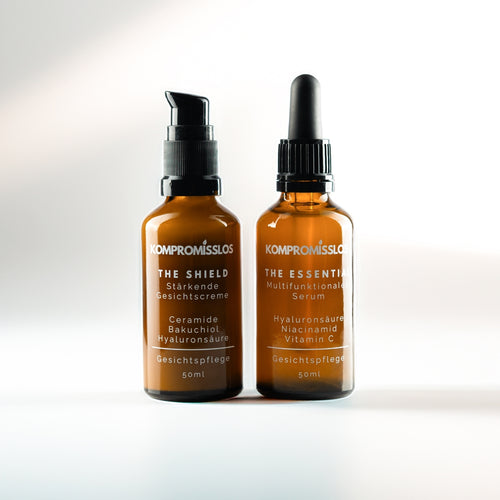
If you hold this list up against The Duo of serum and cream, you can check most of the points yourself: fragrance-free, ceramide NP and squalane in the cream, 5% niacinamide in the Duo, and bakuchiol instead of retinol. It does not contain sunscreen, so you need one in addition in the morning. And we do not claim any endorsement by dermatologists for it.
Why do dermatologists rarely recommend specific brands?
Dermatologists rarely recommend specific brands because the same criteria are met by many products across all price ranges, and because the right cream depends on your skin, not on the logo. The AAD states explicitly that effective anti-ageing products come in all price ranges. On top of that, a professional can see your skin, knows your history and knows what you have already tried. A blanket brand recommendation without this information would be of little professional value. If a dermatologist does name a product, it is usually as an example of a category, such as a simple fragrance-free cream, rather than as the only right choice.
Formulas also get revised. A recommendation from five years ago does not automatically apply to today’s ingredient list. Claims printed on the packaging do not replace this judgement either: what ‘dermatologically tested’ really means is a separate question, but it is certainly not a recommendation by dermatologists. The same goes for where you buy. Whether pharmacy skincare is better than drugstore products is also decided by the formula, not by the shelf.
Which packaging claims do dermatologists consider untrustworthy?
The claims dermatologists trust least are those that promise fast and complete rejuvenation. The AAD gives examples such as ‘look ten years younger overnight’ or ‘quickly reduces all signs of ageing’ and calls promises like these too good to be true. The reason lies in the time skin needs. According to the AAD, a moisturiser can plump up fine lines within a few days, but most products take at least six weeks to work, sometimes up to three months. Anything that promises to deal with deep wrinkles much faster is, as a rule, describing the short-term moisturising effect. Five warning signs can be drawn from the AAD’s recommendations:
- Instant or overnight effects that promise more than skin that feels smoother.
- Wording such as ‘all signs of ageing’ instead of one clearly named concern.
- Results promised within a few days, when six weeks to three months is realistic.
- Price presented as proof of quality, even though effective products exist in every price range.
- Routines that call for several anti-ageing products at once, even though that is exactly what can irritate the skin.
What do dermatologists actually advise for dry or mature skin?
For dry skin, dermatologists advise a cream rather than a light lotion, humectants and lipids, and fragrance-free products. In its tips for dry skin, the AAD writes that ointments and creams provide more moisture and are more effective than lotions. For the face, that does not automatically mean heavy or greasy. A good cream for dry skin can sink in easily and still deliver enough lipids to stop your skin feeling tight during the day.
For mature skin, an active ingredient for visible signs of ageing usually comes on top, classically a retinoid. Because retinoids can irritate the skin, starting slowly is the usual advice. The AAD generally recommends beginning with a single anti-ageing product, because several at once can irritate the skin, and irritated skin shows signs of ageing more clearly. If your skin reacts easily, gentler ingredients such as niacinamide or bakuchiol are a common alternative. Which points really matter in a face cream for mature skin, and why topping a product test says little about your skin, is covered in a separate article. Here, one rule of thumb is enough: first a well-tolerated base of cream and sunscreen, then one active ingredient, then at least six weeks of patience before you judge the result.
Take your current products, or photos of their ingredient lists, to your next appointment. A dermatologist can assess a specific INCI list far better than a description from memory.
When should you see a dermatologist instead of buying another cream?
You should see a dermatologist as soon as your skin no longer just looks dry or tired but shows symptoms that go beyond what skincare can address. In its tips for dry skin, the AAD writes that persistent dryness despite good skincare can point to an underlying medical condition. In these situations, an appointment makes more sense than the next cream:
- Redness, burning, visible small blood vessels or bumps on your face that no longer go away. What skincare can do in this case is explained in the article on rosacea skincare.
- Dry, itchy or flaky patches that persist for weeks despite fragrance-free skincare.
- Inflamed spots or lumps that leave scars or dark marks.
- Moles or marks that newly appear, grow, change colour or bleed.
- No visible change after three months of consistent skincare, even though something clearly bothers you.
Until your appointment, less is more: mild, fragrance-free skincare and sunscreen, no new active ingredients and no exfoliation. You can read what a pared-back routine for sensitive skin looks like in a separate article.
Our products do not carry any dermatologist endorsement. I think it is more honest to give you the information a professional needs to judge for themselves. That is why we disclose the concentrations that apply to the Duo as a whole: 5% niacinamide, 2% vitamin C as stable 3-O-Ethyl Ascorbic Acid and 1% zinc PCA. You can print out the complete list of all ingredients from A to Z and take it to your appointment. I deliberately left out fragrance and used bakuchiol instead of retinol in the cream. Neither product contains a sun protection factor, and your dermatologist should know that too. And if your dermatologist advises something different for your skin, their word counts, not mine.
Frequently asked questions
Is a cream from the pharmacy always recommended by dermatologists?
No, being sold in a pharmacy says nothing about whether dermatologists recommend a cream. Pharmacies also stock cosmetic products whose quality depends entirely on the formula. Check the same criteria as anywhere else: suited to your skin type, fragrance-free, with humectants and lipids, and with a complete ingredient list.
Do dermatologists recommend natural skincare?
Dermatologists neither recommend natural skincare across the board nor advise against it across the board, because what counts is the formula. One point deserves attention: essential oils and plant-based scents are still fragrances, even in natural form, and a possible source of irritation for sensitive skin. Fragrance-free natural skincare meets the criterion; scented products do not automatically.
What do dermatologists recommend for wrinkles?
For wrinkles, dermatologists mainly recommend daily sunscreen and a retinoid, and for sensitive skin also gentler ingredients such as niacinamide or bakuchiol. What these ingredients can achieve, and where skincare reaches its limits, is covered in the article on which anti-wrinkle ingredients are actually proven.
What do dermatologists recommend for sensitive skin?
For sensitive skin, dermatologists mainly recommend cutting back: few products, no fragrance, and new products introduced only one at a time. A mild cleanser, a barrier-supporting cream and a sunscreen are often enough. If your skin still reacts with burning or persistent redness, it should be checked by a dermatologist.
Why do dermatologists recommend sunscreen?
Dermatologists recommend sunscreen because, according to the AAD, it is one of the two most effective anti-ageing products, together with a moisturiser. The recommendation is broad-spectrum protection with SPF 30 or higher. How to combine sunscreen for your face with serum and cream when your skincare has no SPF is covered in a separate article.
Do I need a cream from a dermatologist?
For healthy skin, you do not need a cream from a dermatologist. Well-chosen cosmetic skincare and sunscreen cover the basics. A prescription is needed mainly for skin conditions or for potent retinoids such as tretinoin, which can be more irritating and should therefore be used under medical supervision.
Can I show my dermatologist the INCI list of The Duo?
Yes – that is exactly why it is public. The page with all the Duo’s ingredients shows the complete INCI list, and you will find the concentrations of niacinamide, vitamin C and zinc PCA on the page about the active ingredients. This allows your dermatologist to judge for themselves whether The Duo suits your skin. The verdict on your skin remains theirs.
Sources
- American Academy of Dermatology. How to select anti-aging skin care products. AAD, patient information. Source
- American Academy of Dermatology. How to maximize results from anti-aging skin care products. AAD, patient information. Source
- American Academy of Dermatology. Dermatologists' top tips for relieving dry skin. AAD, patient information. Source
- Mukherjee S, Date A, Patravale V, Korting HC, Roeder A, Weindl G. Retinoids in the treatment of skin aging: an overview of clinical efficacy and safety. Clinical Interventions in Aging, 2006. Source
- Bissett DL, Oblong JE, Berge CA. Niacinamide: A B vitamin that improves aging facial skin appearance. Dermatologic Surgery, 2005. Source