Pharmacy skincare: is it really better than drugstore products?
SWISS BUYING GUIDE
Pharmacy skincare is not automatically better than drugstore skincare. In Switzerland, face creams from both channels are, as a rule, cosmetic products subject to the same rules – where they are sold makes no difference. The differences lie in the range and the advice: pharmacies often focus more on lines for sensitive skin. Whether a cream is any good, however, comes down to the formula, fragrance, disclosed concentrations and your skin. You can check all of these anywhere, including online.
Is pharmacy skincare really better than drugstore skincare?
No, pharmacy skincare is not fundamentally better – it is simply a different selection. A face cream does not become gentler or more effective because it sits on a shelf next to medicines. What it does depends on the formula: which active ingredients it contains and in what amounts, whether it contains fragrance and how well the base suits your skin. The real difference lies elsewhere. Pharmacies often stock brands aimed specifically at sensitive, very dry or blemish-prone skin, and you can ask a trained professional. There is also a point that gets lost in comparisons from Germany: in Switzerland, a drugstore is not necessarily a drugstore chain. Alongside the large chains, there are specialist drugstores with trained druggists who also give advice. The question “pharmacy or drugstore?” is therefore usually a question of range and advice, not of quality. You will find good and mediocre products on both sets of shelves.
Many people who have searched for a long time know that simply moving to a different shelf achieves little. In her review on Judge.me, Meret S. writes: “[…] I tried a lot, from cheap to expensive, from natural cosmetics to medical cosmetics, until I finally gave up” (review translated from German). What usually gets you further is a close look at the ingredient list.
What is dermocosmetics and how does it differ legally?
Dermocosmetics is a marketing term, not a legal category. It describes skincare for skin with particular needs, often sold through pharmacies. Legally, what counts in Switzerland is the distinction between cosmetic products and therapeutic products. A joint guidance document from the Federal Food Safety and Veterinary Office (FSVO), the Federal Office of Public Health (FOPH) and Swissmedic on the criteria for telling them apart classifies cosmetic products as consumer goods under food law. They are intended to cleanse the skin, protect it, keep it in good condition or change its appearance. They do not need authorisation from cantonal or federal authorities; whoever places them on the market is responsible for meeting the requirements through self-monitoring. Medicinal products, by contrast, are intended to have a medical effect, for example in diagnosing, preventing or treating diseases, and may generally only be sold with Swissmedic authorisation. What decides the classification is a product’s intended purpose and how it is advertised. The place of sale does not feature in these definitions. A face cream from the pharmacy therefore remains a cosmetic product, just like a cream from the supermarket.
| Feature | Cosmetic product | Medicinal product |
|---|---|---|
| Legal basis | Food law, classed as a consumer good | Therapeutic Products Act |
| Purpose | Cleansing, protecting, keeping in good condition, changing appearance | Medical effect, for example preventing or treating diseases |
| Market access | No official authorisation, self-monitoring by the manufacturer | Generally requires authorisation by Swissmedic |
| Place of sale | Pharmacy, drugstore, supermarket chain or online | Depends on the dispensing category, some only in pharmacies or drugstores |
What this means for you: the word pharmacy on a website or in advertising copy is no proof of quality. On pharmacy shelves, cosmetic products and medicines often sit side by side, and only medicines have been checked by an authority before going on sale.
How can you recognise good skincare wherever it is sold?
You can recognise good skincare by its ingredient list and by information you can verify, not by the shelf, the logo or advertising promises. An analysis in JAMA Dermatology shows how little the claims on the pack guarantee on their own. The researchers examined the best-selling body moisturisers at three large US online retailers. Of the products labelled “hypoallergenic”, 83 per cent contained at least one substance from a common allergen patch test series. Of the products labelled “fragrance free”, 45 per cent contained at least one ingredient that can cross-react with fragrances, or a botanical ingredient. These were body lotions from the US, not Swiss pharmacy brands. The lesson still applies to every shelf: whatever the front of the pack says, you check on the back in the INCI list. You can check these four points anywhere:
- Fragrance: if Parfum, Fragrance or Aroma appears in the INCI list, the product contains fragrance. Individually listed fragrance substances such as Linalool or Limonene usually appear further down.
- Concentrations: does the brand state how much of an active ingredient the product contains, or only that it contains it?
- Choice of active ingredients: do the active ingredients match your goal, such as hydration, barrier support or a more even-looking complexion, rather than lots of trendy ingredients in small amounts?
- Full disclosure: can you see the complete ingredient list before you buy, in the shop as well as online?
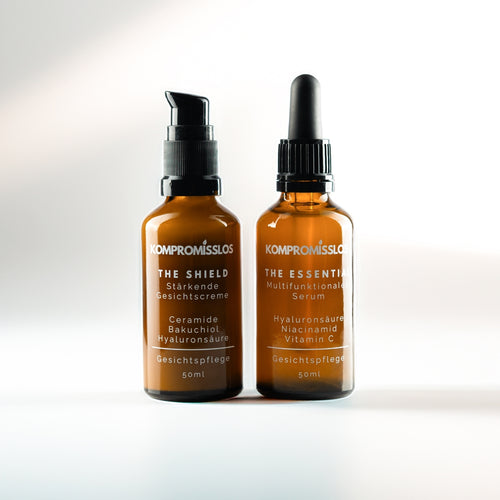
By these criteria, The Duo sits between the channels: based on active ingredients like many pharmacy lines, fragrance-free, vegan, developed and made in Switzerland, but bought online rather than off a shelf. The best way to check whether it suits you is to look at the disclosed formula of The Duo of serum and face cream.
Is pharmacy skincare worth it for mature or sensitive skin?
For sensitive skin, a trip to the pharmacy can be worth it, because you will find fragrance-free, pared-back formulas and advice in one place. For mature skin, there is no advantage that depends on where you buy. With sensitive skin, what matters most is what is left out. In a study in the British Journal of Dermatology, 3,119 randomly selected adults from five European countries were patch tested. Of these, 27.0 per cent reacted to at least one allergen in the European baseline series. At 1.9 and 1.8 per cent, the two fragrance mixes were among the most common allergens, after nickel, thiomersal and cobalt. If you react to fragrance, consistently fragrance-free skincare is the calmest option, whether it comes from a pharmacy, a drugstore or online. You can read more about what to leave out with sensitive skin in a separate article.
Mature skin needs above all moisture, barrier lipids and active ingredients in amounts you can actually check. You will find these in every channel, and the word pharmacy does not guarantee them. You can apply the criteria for the best face cream for mature skin to any product, wherever it is sold. If redness, flaking or burning persists for weeks, that is a matter for a dermatologist. Skincare, from whichever shelf, can then only play a supporting role.
Try new products one at a time, and start by using them for a few days on a small patch of skin, for example behind the ear. If you switch three products at once and your skin reacts, you will not know which one caused it.
How useful is the advice at a pharmacy or drugstore?
Advice at a pharmacy or specialist drugstore is most useful when you bring specific questions and judge the answers by your skin rather than by what is on the shelves. A good professional recognises when a skin condition is more of a medical matter and refers you on. They can show you which products are free from fragrance and sometimes give you a sample to take home. That is a real advantage over the self-service shelf, especially if you are unsure whether your skin is just dry or already irritated. The limit is just as clear: the advice is based on the range that is in the shop. No one at the counter knows the formulas of every brand, and two pharmacies can stock completely different lines. So take your current product, or a photo of its ingredient list, with you. These questions help in any conversation:
- Does the product contain fragrance or essential oils?
- Which active ingredients does it contain, and is the amount stated?
- Is there a sample so that I can try it first?
- At what point is my skin problem a matter for a dermatologist?
Online, pharmacy or drugstore: where is the best place to buy in Switzerland?
Where you buy in Switzerland is secondary; what matters is where you get the information you need to make your choice. Pharmacies score with advice and a quick assessment when something looks like a medical issue. Specialist drugstores also offer personal advice. Drugstore chains and supermarkets have a wide selection across many price points, but offer hardly any advice. A separate article explains when a face cream from Migros, Coop or dm is good enough. Online, on the other hand, you have time: you can read the INCI list at your leisure, compare concentrations and look at other customers’ reviews. What is missing is a person to talk to, and you cannot feel the texture on your hand beforehand. So look for fair return conditions and make sure the full ingredient list is visible before you buy. What specifically matters with a Swiss shop is covered in the article on what to look for when buying natural skincare in Switzerland. For most people, the best solution is a combination: get your questions answered where someone listens, and buy where the information is complete.
I decided against the “trust the shelf” principle. With The Duo, the concentrations are stated openly: 5% niacinamide, 2% vitamin C as stable 3-O-Ethyl Ascorbic Acid and 1% zinc PCA, along with the complete list of ingredients from A to Z. That does not replace advice, but it makes verifiable what would otherwise be a matter of trust. The Duo is developed and made in Switzerland and sold online. What I cannot offer you this way is a professional standing by the shelf. That is why there is a 100-day right of return, so that you can try it on your own skin rather than relying on a promise. If you have a cream from the pharmacy that your skin tolerates well and that is enough for you, you do not need ours. Where a product is sold is not, on its own, a reason to switch.
Frequently asked questions
Is pharmacy skincare a medicine?
No, as a rule it is not. Face creams, serums and cleansers from the pharmacy are usually cosmetic products and are subject to the same rules as cosmetics from the drugstore or supermarket. Medicinal products are intended to have a medical effect and generally require authorisation from Swissmedic. Both categories often sit side by side on pharmacy shelves, so it is worth checking the packaging.
Are pharmacy brands dermatologically tested?
Many advertise it, but the claim is not a uniform standard. How many people were tested, for how long and with which skin type is rarely stated on the packaging. That applies to pharmacy brands just as much as to drugstore brands. What the “dermatologically tested” label means and what it does not guarantee is explained in a separate article.
Why is pharmacy skincare more expensive?
A higher price can reflect research, testing and advice, but just as much distribution, brand and positioning. An analysis in JAMA Dermatology found a higher median price per ounce for US body care products claiming to be recommended by dermatologists than for products without that claim. That does not automatically mean more active ingredients. What you are really paying for with an expensive face cream is a topic in its own right.
Does pharmacy skincare contain less fragrance?
Not automatically. Many pharmacy lines for sensitive skin are fragrance-free, while other products on the same shelf are noticeably perfumed. So rely on the INCI list rather than on the shop: if it lists Parfum, Fragrance or Aroma, the product contains fragrance. Essential oils can also irritate sensitive skin, even when no perfume is declared.
Is pharmacy skincare better than natural skincare?
Neither is automatically better, because neither pharmacy skincare nor natural skincare is a protected mark of quality, and both worlds have good and weak formulas. What really makes the difference for your skin is explained in the article on natural vs conventional skincare.
What do product tests say about pharmacy skincare?
Consumer product tests rate individual products, not places of sale. A good result therefore applies to that exact formula, not to everything on the pharmacy shelf. Conversely, a poor result says nothing about the other products from the same brand. And no test can tell you how your own skin will react. Use tests as a pointer, not as the deciding factor.
Is The Duo pharmacy skincare or natural skincare?
Neither, in the classic sense. Legally, The Duo is a cosmetic product like any cream from a pharmacy or drugstore: aloe vera as the base and Swiss plant extracts, plus active ingredients with disclosed concentrations, fragrance-free, vegan, and developed and made in Switzerland. You buy it online rather than from a pharmacy shelf. You can see exactly what is in it and how the serum and cream work together on the page for The Duo.
Sources
- Bundesamt für Lebensmittelsicherheit und Veterinärwesen BLV, Bundesamt für Gesundheit BAG, Swissmedic. Abgrenzungskriterien der kosmetischen Mittel zu den Heilmitteln und Biozidprodukten. Leitfaden, 2021. Source
- Xu S, Kwa M, Lohman ME, Evers-Meltzer R, Silverberg JI. Consumer Preferences, Product Characteristics, and Potentially Allergenic Ingredients in Best-selling Moisturizers. JAMA Dermatology, 2017. Source
- Diepgen TL, Ofenloch RF, Bruze M, Bertuccio P, Cazzaniga S, Coenraads PJ, et al. Prevalence of contact allergy in the general population in different European regions. British Journal of Dermatology, 2016. Source