Natural vs conventional skincare: what really makes the difference for your skin
NATURAL SKINCARE
When it comes to natural vs conventional skincare, what decides which is better for you is not the label but what is actually in the product. ‘Natural’ describes where the raw materials come from, not what they do. For visible results, what counts is the active ingredient, the dose and a stable formulation – and you will find those on both sides. Natural skincare does without many synthetic substances, including some well-researched active ingredients. Conventional skincare is allowed to use more, but that does not mean it achieves more.
Is natural skincare better than conventional skincare?
Natural skincare is not inherently better than conventional skincare – it simply follows different rules when it comes to choosing raw materials. The term has no legal definition in Switzerland. What counts as natural skincare is set by private standards, which you will see on the packaging as natural skincare certifications. They govern where raw materials may come from, how they are processed and which synthetic substances are excluded. They say nothing about the amount of an active ingredient or what it does on your skin. Nor is conventional skincare a clearly defined alternative – it is simply everything else, from the inexpensive drugstore product to formulations with high doses of well-researched active ingredients. Both categories have to meet the same legal requirements for safety and labelling. A meaningful comparison is therefore made criterion by criterion, not camp against camp.
Whether natural ingredients are better tolerated is a separate question, and the short answer is: not automatically. It is covered in detail in the article on natural Swiss cosmetics and how to tell what’s really inside.
| Criterion | Certified natural skincare | Conventional skincare | What to look for |
|---|---|---|---|
| Raw materials | Plant-based, mineral or derived from these; fully synthetic substances largely excluded | Free choice within the legal requirements | What comes first on the ingredient list |
| Active ingredients | Plant extracts, oils, individual well-documented plant actives such as bakuchiol | In addition, retinoids, peptides, stabilised forms of vitamin C | Whether the concentration is stated |
| Preservation | Smaller selection, often organic acids or alcohol | Larger selection, such as phenoxyethanol or parabens | PAO symbol and storage |
| Fragrance | Often essential oils | Often synthetic perfumes | Whether fragrance is needed at all |
| Environment | Renewable raw materials, but they need farmland | Persistent substances such as silicones possible too | Biodegradability, packaging, consumption |
Does natural skincare work just as well?
Natural skincare works as well as the active ingredients it contains – at the dose in which it contains them. Exactly the same applies to conventional skincare. Your skin does not care whether a molecule comes from a plant or a reactor, only whether it arrives in sufficient quantity, in stable form and in the right place. Niacinamide, a form of vitamin B3, is a good example. In a study in Dermatologic Surgery, 50 women with signs of photoageing applied 5% niacinamide to one half of their face and a base without active ingredients to the other, twice a day for twelve weeks. The niacinamide side showed fewer fine lines, pigment spots and red blotches, a less sallow complexion and improved elasticity. The study comes from the laboratories of a large cosmetics company, which is worth bearing in mind when you weigh it up. But what made the difference was the active ingredient at a defined dose, not whether the cream counted as natural.
Plant extracts are harder to pin down. An extract is a mixture of many substances, and its composition can vary depending on the plant, the harvest and the processing. A review article in Open Research Europe describes an EU research project on plant-based cosmetic raw materials that focused on exactly this: the reproducibility of production and the stability of the extracts. So a claim such as ‘with edelweiss’ tells you nothing about how much of it is actually in the formulation. There are, however, well-researched plant actives too, such as bakuchiol. Where certified skincare reaches its limits on older skin is explained in the article on natural skincare for mature skin.
Which active ingredients are only found in conventional skincare?
What certified natural skincare mainly lacks are active ingredients that are fully synthetic or heavily modified chemically – and these include some of the best-researched substances in skincare. The standards do not exclude them because they are bad, but because they do not fit the idea of a formula that stays as close to nature as possible. Typical examples:
- Retinol and other retinoids: vitamin A derivatives that are made in the laboratory for use in cosmetics.
- Many peptides: short chains of amino acids that are synthesised for a specific purpose.
- Many stabilised forms of vitamin C, such as 3-O-Ethyl Ascorbic Acid: pure vitamin C breaks down quickly, and the stable forms are created by chemically modifying the molecule.
- Silicones: they give the skin a smooth feel but break down poorly in the environment.
- Chemical UV filters: certified natural skincare generally relies on mineral filters such as zinc oxide or titanium dioxide.
There are also substances that exist in both worlds. Niacinamide and hyaluronic acid occur in nature as well, but for cosmetics they are produced synthetically or biotechnologically. Whether a standard allows them often depends on how they are made, not on the molecule itself. So if you specifically want to work with retinol or a form of vitamin C such as 3-O-Ethyl Ascorbic Acid, you will almost always end up with conventional or nature-based skincare.
How do preservation and shelf life differ?
Every skincare product that contains water or water-based plant juices needs preserving, whether it is natural skincare or not – the only difference lies in which substances are used. A review in the journal Molecules describes how cosmetics are preserved with synthetic or natural antimicrobial substances or with multifunctional ingredients. Whether the system works is checked with what is known as a challenge test: the product is deliberately inoculated with bacteria, yeasts and moulds and then monitored for 28 days. According to the same review, plant extracts and essential oils are often advised against as the sole preservatives: they lose effectiveness when diluted, they depend on pH, and essential oils have a strong smell. Natural skincare therefore often works with organic acids, which occur in nature but are usually produced in nature-identical form for cosmetics, or with alcohol.
Conventional skincare can also draw on substances such as phenoxyethanol or parabens. Why paraben-free does not automatically mean safer is explained in the article on parabens in cosmetics. For your everyday routine, where the preservative comes from matters less than whether the product stays stable once opened. Look for the PAO symbol with the open jar, keep your skincare out of direct sunlight and use it up promptly.
What about the environment and sustainability?
Natural skincare is not automatically more sustainable, and synthetic ingredients are not automatically worse for the environment. What matters is what happens to a substance once it is washed off and how much effort goes into making it. A 2026 review in the International Journal of Cosmetic Science describes how cosmetic ingredients reach the environment via wastewater and how many of them are neither removed in sewage treatment plants nor broken down in the environment. Whether a molecule is biodegradable depends on its structure: linear carbon chains and groups such as esters favour breakdown, while highly branched chains or halogens hinder it. The authors cite PFAS and silicones as examples of persistent substances.
Plant-based raw materials have a different footprint, because they need farmland, water and transport. The Open Research Europe review mentioned above notes that optimised biotechnological processes could reduce the industry’s carbon footprint and free up farmland for crops. At the same time, the authors call the term ‘green’ extremely vague. The term clean beauty is similarly fuzzy: it promises a lot and pins down very little. In practice, this means looking for biodegradable ingredients, skincare without silicones and microplastics and sensible packaging – and using up what you buy. The most sustainable product is the one that does not end up half full in the bathroom cabinet.
Is there a middle ground between natural ingredients and active ingredients?
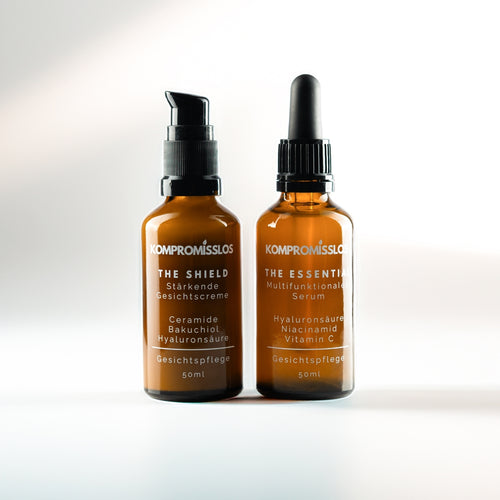
Yes, and for many people it is the most pragmatic solution: nature-based skincare that combines plant-based raw materials with well-researched active ingredients at disclosed doses. Products like these usually do not carry a natural skincare certification, because individual active ingredients or preservatives are not on the standards’ lists. That is not a lack of quality but a trade-off. How to recognise good skincare without a certificate is covered in the article on natural skincare without certification. The Duo is one example of this approach: its base is aloe vera juice, which comes before water on the ingredient list, complemented by extracts of Swiss edelweiss and gentian root. These are combined with active ingredients at disclosed concentrations, such as 5% niacinamide and 2% vitamin C as 3-O-Ethyl Ascorbic Acid. That makes the Duo of serum and cream nature-based, but not certified natural skincare. In her review on Judge.me, Brigitte Z. writes: ‘Already have experience with natural cosmetics. […] Simple, no frills and a good feeling on the skin’ (review translated from German).
Whichever direction you choose, these four questions will help with any product:
- Which active ingredients does it contain, and is their concentration stated?
- What is at the top of the ingredient list?
- Does the product contain fragrances or essential oils that your skin does not need?
- Does the number of products match what your skin actually needs?
If you are currently moving away from conventional skincare, the guide to switching to natural skincare shows you how to go about it. And if you are torn between drugstore, pharmacy and natural skincare, a separate article looks at whether pharmacy skincare is really better.
With The Duo, I deliberately do not promise certified natural skincare, even though it would look good on the packaging. It mattered more to me to combine Swiss plant extracts such as edelweiss and gentian root with active ingredients whose concentrations I can disclose: 5% niacinamide, 2% vitamin C in the stable 3-O-ethyl form and 1% zinc PCA, calculated for The Duo as a whole. That stable form of vitamin C in particular is made in the lab, and for preservation we rely in part on sodium benzoate, which we ourselves classify as synthetic. But what I leave out, I leave out consistently: no silicones, no microplastics, no fragrances, everything vegan. If a certificate is your most important criterion, another brand will suit you better. All the active ingredients and their concentrations are listed openly on our website.
Frequently asked questions
Are there studies that directly compare natural and conventional skincare?
Robust studies that test the natural skincare label as a whole against conventional skincare are few and far between. What gets studied are individual active ingredients or specific formulations, usually compared with a base without active ingredients. That makes sense, too, because both categories are too broad to be compared fairly. For your decision, what counts is the evidence on the individual active ingredient, not the category.
Are chemicals in skincare bad?
No – all skincare is made of chemicals, including water, aloe vera juice and plant oil. What people usually mean is synthetic chemicals. Whether a substance is good for your skin depends on its structure, its dose and how well you tolerate it, not on whether it comes from a laboratory or a field. ‘Chemical-free’ is an advertising promise that no product can keep.
Are nature-identical active ingredients natural or synthetic?
Nature-identical active ingredients are produced synthetically, but their structure is exactly the same as that of their counterpart in nature. Your skin cannot tell the difference. The advantage is consistent purity and quality, without any plants having to be grown for them. Whether a natural skincare standard allows a nature-identical substance is up to each standard.
Can natural skincare cause allergies?
Yes, natural ingredients can cause contact allergies too. A review in Current Allergy and Asthma Reports states that natural ingredients can also be allergenic and that most of the fragrances and essential oils common in products marketed as natural are among the frequent contact allergens. There is more on this in the article on essential oils in skincare. If you keep getting eczema, have it checked by a dermatologist.
Is organic quality in plant extracts a sign of effectiveness?
No. Organic describes how a plant was grown, not how much of the active ingredient ends up in the finished product. What determines the effect is the extraction method, the concentration and the formulation. Organic quality can still be a sensible criterion for farming and the environment. In the Duo, for example, the gentian root is organic and comes from Switzerland, but we do not claim a stronger effect because of it.
Are synthetic active ingredients less sustainable?
Not automatically. Synthetic substances can be readily biodegradable and need no farmland, whereas natural raw materials can require a lot of land, water and transport. The real problem is persistent substances such as silicones or PFAS, which remain in the environment for a long time. A substance’s biodegradability says more about its environmental impact than its origin does – and the amount you actually use counts too.
Is The Duo natural skincare?
No, The Duo is not certified natural skincare but nature-based skincare. Aloe vera juice forms the base, complemented by Swiss extracts of edelweiss and gentian. These are combined with active ingredients such as niacinamide and 3-O-Ethyl Ascorbic Acid at disclosed doses and preserved with sodium benzoate and sodium levulinate. The Duo is vegan, fragrance-free and contains no silicones or microplastics.
Sources
- Bissett DL, Oblong JE, Berge CA. Niacinamide: A B vitamin that improves aging facial skin appearance. Dermatologic Surgery, 2005. Source
- Halla N, Fernandes IP, Heleno SA, Costa P, Boucherit-Otmani Z, Boucherit K et al. Cosmetics Preservation: A Review on Present Strategies. Molecules, 2018. Source
- Mota S, Kümmerer K, de Almeida IM, Sousa E. Benign by design: A paradigm shift in cosmetic ingredient development. International Journal of Cosmetic Science, 2026. Source
- Bourgaud F, Twyman RM, Oksman-Caldentey KM. From plant genetic resources to cosmetic active ingredients: when science meets regulation and market rules. Open Research Europe, 2025. Source
- Sukakul T, Svedman C. What is New in Contact Allergy To Cosmetics for Physicians, Cosmetologists, and Cosmetic Users? Current Allergy and Asthma Reports, 2025. Source