What is clean beauty? What the term means, who defines it and why it’s no proof of quality
NATURAL SKINCARE
At its core, clean beauty means ‘cosmetics without certain ingredients’ – and every brand and retailer decides for itself which substances go on the exclusion list. The term has no legal definition in either Switzerland or the EU, and there is no uniform standard behind it. ‘Clean’ therefore tells you nothing reliable about how well a product is tolerated, how effective it is or how sustainable it is. The only meaningful information is the full ingredient list and disclosed concentrations.
What is clean beauty?
Clean beauty is a marketing term for cosmetics that deliberately leave out certain ingredients and present this as a mark of quality. It took hold mainly in the US market and has spread to Switzerland via retail shelves, social media and brand websites. Clean beauty products typically come with exclusion lists of substances such as parabens, sulphates, silicones, mineral oil or synthetic fragrances. Which substances end up on the list, however, is up to each brand or retailer. One list covers a handful of substances, the next many times that number, and both products call themselves clean. Other promises often come along with it: vegan, cruelty-free, sustainable packaging, ‘non-toxic’. None of this is legally tied to the word clean. An article in the Journal of Drugs in Dermatology therefore groups clean with natural, organic, vegan and cruelty-free as marketing terms whose real meaning dermatology professionals should understand and explain to their patients. For you, that means ‘clean’ describes an attitude or a product range, not a verifiable property of a product.
Is clean beauty a protected term?
No, clean beauty is not a protected term, either in Switzerland or in the EU. There is no authority that decides what counts as clean and no approval a product has to pass to use the label. The fact sheet from the Aargau cantonal consumer protection office states that cosmetics in Switzerland do not need to be registered or authorised. Instead, every product sold through regular channels needs a safety report with a safety assessment by a qualified expert before it is first sold – and that applies whether it is called clean or not. According to the same fact sheet, advertising claims must not be misleading and have to meet six criteria. The same six criteria apply in the EU, where a technical document on cosmetic claims describes them in detail: legal compliance, truthfulness, evidential support, honesty, fairness and informed decision-making. The document states explicitly, however, that these criteria do not define which words may be used. So the word clean is not banned; only the specific claims behind it are checked. And because clean does not name any particular property, it is almost impossible to disprove. That is exactly what makes it so convenient for marketing.
What is the difference between clean beauty and natural skincare?
The difference lies in the question each term answers: natural skincare asks where the ingredients come from, clean beauty asks which substances are missing. A clean product can therefore be made entirely from synthetic raw materials, as long as none of the excluded substances are in it. Conversely, a natural skincare product may contain essential oils or plant extracts that are more problematic for sensitive skin than some synthetic alternatives. Natural skincare, incidentally, is not a legally defined term either – binding criteria only come from private standards such as natural skincare certifications. And whether natural or lab-made makes the bigger difference for your skin is the subject of natural vs conventional skincare.
| Term | What it is about | Who sets the criteria | What it does not tell you |
|---|---|---|---|
| Clean beauty | Which substances are left out | Each brand or retailer for itself | Tolerance, amount of active ingredients, origin |
| Natural skincare without certification | Origin of the raw materials | The brand itself | Share of natural ingredients, amount of active ingredients |
| Certified natural skincare | Origin and processing of the raw materials | Private certifiers with their own standard | Amount of active ingredients and effectiveness |
| Vegan | No raw materials of animal origin | The brand or a private label | Naturalness, tolerance, amount of active ingredients |
What are the criticisms of clean beauty?
The main criticism of the term clean beauty is that it works with fear rather than evidence. Calling a product clean indirectly implies that every other product is dirty or dangerous, even though every cosmetic sold through regular channels needs a safety assessment. Dermatologists at the University of Pennsylvania summed up this criticism in JAMA Dermatology in 2019, right in the title: ‘Natural Does Not Mean Safe’. Four distinct objections can be made:
- Exclusion lists ignore the dose. Whether a substance poses a risk depends on the amount, the type of product and how it is used, not on whether it appears on a list.
- Plant-based does not automatically mean gentle. Fragrances and plant extracts are well-known triggers of contact allergies, and many clean products allow them.
- Leaving something out is not an effect. A product without silicones does not care for your skin any better just because something is missing. What it does depends on what is in it.
- The term gets in the way of comparison. Because every brand has its own criteria, you cannot compare two clean products by their label, only by their ingredient lists.
That does not mean clean beauty products are bad. Many are carefully formulated. But then the quality lies in the formulation, not in the label.
Why is there no official clean list?
There is no binding clean list because ingredient regulation in cosmetics already works differently: through bans, maximum concentrations and a safety assessment for each product, not through a list of good and bad substances. For this, Switzerland largely adopts the annexes of the EU Cosmetics Regulation listing prohibited and restricted substances. For all other substances, the safety assessment of the individual product has to show that it is safe for health. A clean list adds a second, private layer on top of this, which often sounds stricter but brings no assessment of its own. Many of these lists mainly serve to stand out on the shelf. Which warning lists are scientifically sound and which mostly spread panic is covered in the article on harmful ingredients in skincare. If you want to check a product yourself, a guide on how to read an ingredient list will help you more than any label.
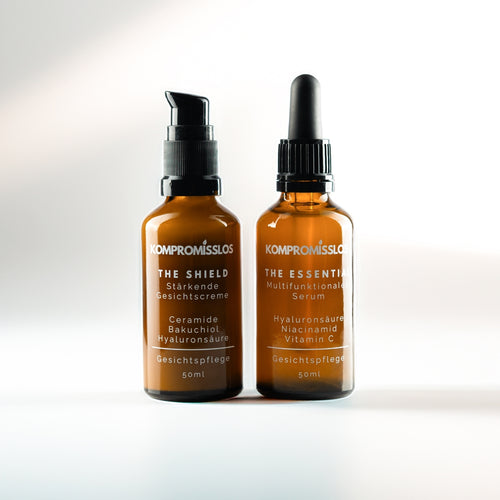
Take our own skincare as an example: The Duo of serum and cream meets the criteria found on typical clean lists. It is vegan, fragrance-free and free from microplastics, parabens and silicones. We still do not call it clean; instead, we disclose the ingredient list and the concentrations of the key active ingredients. That can be checked – a label cannot. In a review on Judge.me, J.D. writes of being delighted ‘with the whole concept and the great transparency regarding ingredients etc.’ (review translated from German).
Is clean beauty better for sensitive skin?
No, clean beauty is not automatically better for sensitive skin, because many clean products contain exactly the substances that most often trigger reactions. A study in the journal Dermatitis analysed the ingredient lists of 1470 products marketed as clean by two US retailers. 93.8 per cent of them contained at least one potential contact allergen. The most common were fragrances and plant extracts, found in 82.9 per cent of the products. A potential allergen does not mean that every skin will react, but that the substance can trigger a reaction in people who are already sensitised.
For sensitive skin, then, what counts is not the word clean but whether a product contains fragrances and essential oils, how long the ingredient list is and whether it includes a substance you have already reacted to. Which additives really matter here, and what the marketing term promises about them, is explained in the article on skincare without additives. If your skin keeps burning, itching or turning red despite a simple routine, that is a case for a dermatologist. A patch test will then show what you are actually reacting to – and replace guesswork based on labels.
Instead of looking for clean, ask yourself three questions: Is a complete ingredient list available online? Are the key active ingredients listed with their concentrations? And does the brand talk in cosmetic terms rather than making medical promises? If a brand does without any label at all, natural skincare without certification gives you further points to check.
I made a conscious decision not to call Kompromisslos clean, even though the word goes down well on the shelf. It would not have explained anything. Instead, our website has the full list of all ingredients and the concentrations for The Duo as a whole: 5% niacinamide, 2% vitamin C as 3-O-Ethyl Ascorbic Acid and 1% zinc PCA. That also includes things that some clean lists frown upon: Sodium Benzoate, for example, a preservative that we ourselves label as synthetic on our website. Without preservation, a water-based product would not be safe. I left out fragrance because scent does nothing for the skin. Even so, I cannot promise that every skin will tolerate everything. No label can do that. What you can do is check every line of our list.
Frequently asked questions
Is clean beauty vegan?
Not automatically. Clean lists usually focus on certain preservatives, silicones or fragrances. That does not automatically rule out animal-derived raw materials such as beeswax, honey, lanolin or carmine. Whether a product is vegan is something you need to check separately, either through a corresponding statement from the brand or via the ingredient list.
Is clean beauty more sustainable?
Not necessarily. Clean primarily describes which substances are missing from the product. The term says nothing about packaging, transport routes, how the raw materials are grown or how many products you buy. Often the most sustainable option is a routine with just a few products that you actually use up.
Is there a clean beauty certification?
There is no uniform, legally recognised clean beauty certification. There are retailer labels and private schemes that use ‘clean’ or ‘non-toxic’ in their marketing, each with its own criteria. If a verified standard matters to you, established natural skincare or vegan certifications offer more transparent rules, even though they are private too.
Does synthetic automatically mean not clean?
No. Most clean lists ban individual substances, not synthetic production as such. Besides, whether a substance is made in a lab or obtained from a plant says nothing about how well it is tolerated. A synthetic preservative can be less problematic for sensitive skin than an essential oil.
Are clean beauty products less effective?
Not in principle, but they are not better either. Clean says nothing about active ingredients or how much of them a product contains. Whether a product does anything depends on which active ingredients it contains and in what concentration. If neither is stated on the packaging or website, you cannot judge effectiveness, whether the product is clean or conventional.
What does non-toxic mean in skincare?
Like clean, non-toxic is an unprotected marketing term with no fixed meaning. It suggests that other products are poisonous. Yet every cosmetic product sold through regular channels in Switzerland must have a safety assessment before it goes on sale. A complete, publicly available ingredient list tells you far more than non-toxic.
Is The Duo clean beauty?
We do not call The Duo clean, because the term says nothing that can be verified. It does, however, meet the criteria found on typical clean lists: vegan, fragrance-free and free from microplastics, parabens and silicones. Instead of a label, you will find the full ingredient list and the concentrations of the key active ingredients The Duo works with.
Sources
- Tran JM, Comstock JR, Reeder MJ. Natural Is Not Always Better: The Prevalence of Allergenic Ingredients in “Clean” Beauty Products. Dermatitis, 2022. Source
- Rubin CB, Brod B. Natural Does Not Mean Safe – The Dirt on Clean Beauty Products. JAMA Dermatology, 2019. Source
- Urban K, Giesey R, Delost G. A Guide to Informed Skincare: The Meaning of Clean, Natural, Organic, Vegan, and Cruelty-Free. Journal of Drugs in Dermatology, 2022. Source
- Kanton Aargau, Amt für Verbraucherschutz. Merkblatt Nr. 26: Vertrieb von Kosmetika in der Schweiz. Stand 26.03.2026. Source
- Sub-Working Group on Claims, Working Group on Cosmetic Products. Technical document on cosmetic claims. Version of 3 July 2017. Source