Natural skincare for mature skin: what it can do and where its limits lie
NATURAL SKINCARE AND AGE
Natural skincare for mature skin delivers results when the formula brings three things together: replacements for missing barrier lipids, moisture binders and an active ingredient with evidence behind it for visible signs of ageing. Plant origin alone says nothing about performance. What counts is concentration, position in the INCI list and how well your skin tolerates it – not the word “natural” on the front of the pack.
For the general criteria, whatever the label: the best face cream for mature skin.
What does mature skin need that natural skincare can provide?
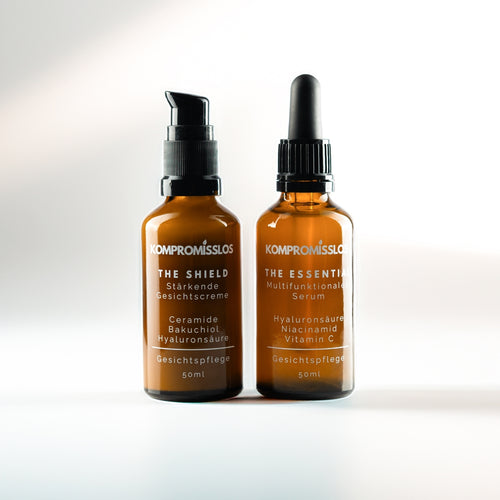
Mature skin mainly needs three things: lipids that make up for the loss of the skin’s own fats, moisture binders that hold water in the outermost layer of skin, and an active ingredient that softens the look of lines and dark spots. All three can be covered with raw materials of plant or biotechnological origin. The loss of lipids is not guesswork: an analysis of stratum corneum lipids showed that all the major lipid classes – and ceramides in particular – decrease markedly with age. That is exactly where good skincare for mature skin comes in. In the Duo of serum and cream, ceramides, squalane and jojoba oil take care of the lipid part, 2% hyaluronic acid the moisture part and 0.3% bakuchiol the part aimed at the look of lines. If you want to know what a routine like this looks like day to day, our article on the skincare routine for mature skin covers it in detail.
All percentages refer to the Duo as a whole, not to either product on its own. This matters, because concentrations in cosmetics are often presented as though they were in every single bottle.
Where does certified natural skincare reach its limits for mature skin?
Certified natural skincare rules out some of the classic anti-ageing active ingredients, and that is a real limitation, not a marketing nuance. Private standards such as COSMOS define two levels, ORGANIC and NATURAL, and specify which raw materials and which chemical processes are permitted at all. That rules out retinol in its usual synthetic form, along with several stabilised vitamin C derivatives and many of the silicones that make a cream feel smooth. For mature skin this means you get a formula with a clear origin for its raw materials, but give up some of the best-researched active ingredients for wrinkle depth. Whether that trade-off works for you depends on how sensitive your skin is and how much you value traceable origin over maximum active-ingredient density. Bear in mind, too, that the term natural skincare is not legally protected in Switzerland; it is defined by private standards and their certification bodies. We explain what the individual labels stand for in our article on natural skincare labels in Switzerland.
Which natural active ingredients have real evidence for mature skin?
For mature skin, bakuchiol is the plant-based active ingredient with the clearest evidence. In a randomised, double-blind twelve-week study with 44 participants, researchers compared a cream containing 0.5% bakuchiol with one containing 0.5% retinol. Both reduced wrinkle surface area and hyperpigmentation with no statistically significant difference, and the retinol group reported flaking and stinging more often. Alongside it are active ingredients that are made in a laboratory but are identical to substances in the skin: niacinamide is one of them, contained at 5% in the Duo as a whole, as are 2% vitamin C as 3-O-ethyl ascorbic acid and 1% zinc. Plant extracts such as 2% edelweiss and 2% gentian root provide antioxidants but have far less clinical data than bakuchiol or niacinamide. That honesty matters, because otherwise you might get the impression that every Alpine extract is as well researched as a standard active ingredient. You can see how these active ingredients are split between our products on the Duo for mature skin. What bakuchiol actually does on the skin is explained in our overview of how bakuchiol works.
How can you tell from the packaging whether natural skincare suits mature skin?
You can recognise worthwhile natural skincare for mature skin by four points on the back of the pack, not by the imagery or floral motifs on the front. First, by the position of the active ingredients in the INCI list: if ceramides, squalane or bakuchiol only appear after the fragrance block, they are little more than decoration. Second, by stated percentages, because a brand that discloses concentrations can be checked. Third, by the number of plant extracts: fifteen extracts in trace amounts don’t make better skincare than three in meaningful quantities. Fourth, by the fragrance content, because on thin, reactive skin essential oils trigger redness more often than preservatives do. In Switzerland there is a fifth point: if the pack shows only a mountain backdrop but no country of manufacture and no responsible company, it tells you nothing about where the product comes from. We have gathered what else to look out for when buying in our overview of natural skincare in Switzerland. You will find an overview of all active ingredients and their function on our ingredients page, together with the percentages.
| What to check | Good sign | Warning sign |
|---|---|---|
| Position of active ingredients | Lipids and active ingredients in the first third of the INCI list | All active ingredients after the fragrance block |
| Concentration | Percentages are stated and can be checked | Only phrases such as “high-strength” or “highly effective” |
| Number of extracts | A few extracts in meaningful quantities | A long list of plants with no clear focus |
| Fragrance | No or very little essential oil | Parfum high up the list with reactive skin |
| Origin | Country of manufacture and responsible company clearly named | Only imagery of mountains or herbs |
How many products does mature skin really need?
Mature skin rarely needs more than two products in the morning and two in the evening, provided those products are well formulated. A serum supplies the water-soluble active ingredients and moisture binders; a cream seals everything in with lipids and reduces water loss through the outer layer of skin. Anything beyond that mainly increases the number of fragrances and preservatives on your skin. With the Duo, that means three to six drops of serum and three to six pumps of cream, morning and evening, for CHF 109.90, lasting two to four months depending on how often you use it. If your skin is calm with your current routine, doesn’t feel tight and shows no redness, you don’t need anything new. How to apply the two steps correctly is explained on our how-to-use page, and you will find the Duo of serum and cream in our shop.
When is natural skincare no longer enough?
Natural skincare is cosmetics and is therefore limited to the outward appearance of your skin. As soon as a diagnosis or treatment is involved, it belongs in a dermatologist’s hands. In practical terms: if redness doesn’t fade, a patch of skin changes, a mole changes shape or colour, itching persists for weeks or weeping patches appear, make an appointment with a dermatologist. That applies even if a product has suited you well in the past. Cosmetics can support the barrier and make your complexion look more even, but they are no substitute for a medical assessment. This is as true of naturally formulated skincare as of conventional products, because the legal line runs not between plant-based and synthetic, but between cosmetics and medicines. With thin, irritated skin, it is worth first looking at the basics of a compromised skin barrier, because many problems start there and often settle faster with fewer products rather than more.
For the Duo, I deliberately chose 0.3% bakuchiol instead of retinol. Not because retinol is bad, but because many of our customers with skin that is both mature and sensitive come to us after retinol has made their skin flake. I preferred a formula that stays comfortable twice a day to one that ends up in the cupboard after two weeks. The same reasoning lies behind choosing 3-O-ethyl ascorbic acid over pure ascorbic acid: more stable and less irritating, but without the kick that pure ascorbic acid shows in tests. It is a deliberate trade-off, and I would rather say so openly than keep quiet about it.
Frequently asked questions
Is natural skincare better for mature skin than conventional skincare?
No, not as a rule. What matters is the formula, not where the raw materials come from. Natural skincare scores on transparency about raw materials and usually shorter ingredient lists, but it does without some well-researched active ingredients such as retinol. For sensitive mature skin, going without can be an advantage; for deep wrinkles, it is more of a drawback.
Can natural skincare get rid of wrinkles?
No. No cosmetic product removes wrinkles, whether it is formulated naturally or synthetically. What is realistic is softening the look of fine lines, because the skin is better hydrated and the barrier is supported. Visible changes take eight to twelve weeks of regular use.
What bakuchiol concentration makes sense for mature skin?
In the best-known comparative study, a cream with 0.5% bakuchiol was used twice a day. The Duo as a whole contains 0.3%, which you apply morning and evening. For sensitive skin, lower concentrations are often the better-tolerated choice over the longer term.
Does niacinamide count as natural skincare?
Niacinamide is made in a laboratory, but it is identical to a substance found in the skin and is permitted in many certified natural skincare products. It is one of the active ingredients where synthetic production is no disadvantage, because the molecule is identical to the one the body makes itself. The Duo as a whole contains 5%.
Does mature skin need a face oil instead of a cream?
Not necessarily. A pure oil supplies lipids but hardly any water, and mature skin loses both. A cream with lipids and moisture binders therefore usually covers more than an oil on its own. An oil can make sense as an extra final layer in winter, but it doesn’t replace the cream.
How long does it take to see results on mature skin?
Tightness and dryness often improve within a few days, because the barrier responds quickly to lipids and moisture. For changes in the look of lines and dark spots, you are better off allowing eight to twelve weeks. Studies on bakuchiol and retinol typically run for twelve weeks.
How much does a minimalist natural skincare routine for mature skin cost?
The Duo of serum and cream costs CHF 109.90 and lasts two to four months depending on how often you use it. Delivery costs CHF 3.70 and is free on orders over CHF 60; it takes one to three working days. You have a 100-day right of return. You can read about other people’s experiences on our reviews page.
Sources
- Rogers J, Harding C, Mayo A, Banks J, Rawlings A. Stratum corneum lipids: the effect of ageing and the seasons. Archives of Dermatological Research, 1996. Source
- Dhaliwal S et al. Prospective, randomized, double-blind assessment of topical bakuchiol and retinol for facial photoageing. British Journal of Dermatology, 2019. Source
- COSMOS-standard AISBL. The COSMOS-standard for organic and natural cosmetics. Source