Bakuchiol benefits: what it does for your skin and how to use it
SINGLE INGREDIENT
The benefits of bakuchiol come down to the fact that this plant-derived ingredient switches on similar genes in the skin to retinol, without being a retinoid itself. In a controlled study using 0.5%, participants showed smoother-looking wrinkles and fewer dark spots after twelve weeks, with less scaling and stinging than under retinol.
Bakuchiol benefits: what happens in the skin?
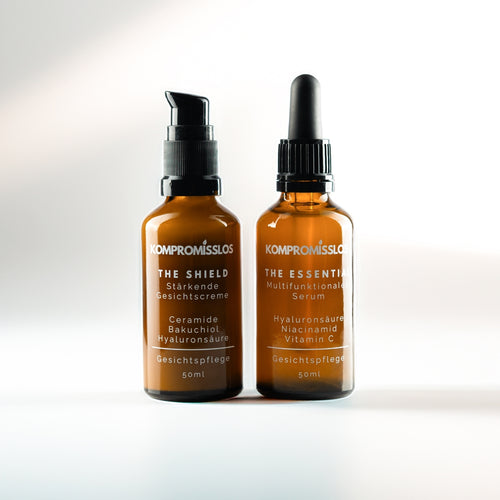
Bakuchiol acts on similar gene-expression processes in the skin to retinol, even though chemically it has nothing to do with vitamin A. In a gene analysis published in the International Journal of Cosmetic Science, treated skin models expressed genes for collagen and for water transport within the cell, among others, more strongly than untreated models. The retinoic acid receptors through which retinol triggers its typical reactions did not respond. It is important to put these figures in context: they are laboratory results on skin models, not promises for your face. How much of this becomes visible in everyday life depends on the concentration, on the rest of the formulation and on how consistently you use it. On the skin, then, bakuchiol doesn’t show up as an instant effect but as a gradual change in texture and pigmentation over weeks. That is exactly why, in The Duo of serum and cream, bakuchiol is designed as a daily companion rather than a two-week course.
How long does bakuchiol take to work?
Allow eight to twelve weeks before a change becomes clearly visible. In the clinical study by Chaudhuri and Bojanowski, 16 women aged between 40 and 65 applied a bakuchiol cream for twelve weeks. Wrinkle depth had decreased measurably after just four weeks, but much more so after eight, and most of all after twelve weeks. So the effect builds up rather than happening all at once. For your everyday routine, that means two things. First, it pays to use a product for long enough before you judge it. Two weeks tell you nothing. Second, there’s no point in constantly slipping new products in during that time, because you will no longer know what made the difference. What you notice sooner than any change in wrinkle depth is how your skin feels: less rough, a more even tone. Those are the first realistic signs. Anything that promises you a change within a few days means something other than what was measured here.
What concentration of bakuchiol makes sense?
Most robust studies use 0.5 to 1% bakuchiol, applied once or twice a day. Below that, the evidence thins out; above it, there is little to suggest that more does more. Ours contains 0.3%, based on the serum and cream together – deliberately below the best-researched amount. The reason is the combination: in our formula, bakuchiol doesn’t work alone but alongside 5% niacinamide, 2% hyaluronic acid, 2% vitamin C as 3-O-ethyl ascorbic acid and 2% gentian root extract, all figures again for the Duo as a whole. For context on that plant-based element, see the article on how gentian root extract works in skincare. You can see which ingredients are included, and in what order, in the complete list of all ingredients. In the end, what counts is not the highest individual figure but whether a formula remains well tolerated over months.
Should you use bakuchiol in the morning or at night?
You can use bakuchiol both morning and evening because, unlike retinol, it is considered photostable. In the randomised comparison study in the British Journal of Dermatology, participants applied bakuchiol twice a day and retinol only in the evening, and neither group reported increased sensitivity to light. That doesn’t mean you can skip sun protection, though. UV radiation remains the single biggest driver of visible skin ageing, whichever active ingredient you use. So if you apply your skincare during the day, sunscreen goes on top, as a separate product. The main practical advantage of photostability is that you don’t have to squeeze bakuchiol into an evening ritual you would skip on tired days anyway. Consistency beats timing. A routine you actually use twice a day will do more for you than a perfectly timed one you forget three times a week. You’ll find the details in the instructions for serum and cream.
| Question | Bakuchiol | Retinol |
|---|---|---|
| Time of day | Can be used morning and evening. | Usually applied in the evening. |
| Frequency in studies | Mostly twice a day. | Mostly once a day. |
| Adjustment period | No gradual introduction was needed in the studies. | Often increased gradually. |
| Reported reactions | Occasional redness in the first few weeks. | More frequent scaling and stinging. |
| Sun protection | Needed during the day. | Needed during the day. |
How do you add bakuchiol to your routine?
Apply bakuchiol after cleansing to slightly damp skin and finish with a cream. You don’t need any more steps than that. With our products, that means 3 to 6 drops of serum followed by 3 to 6 pumps of cream, morning and evening. Bakuchiol is considered easy to combine and doesn’t need to be kept apart from other active ingredients: niacinamide, hyaluronic acid, ceramides, squalane and panthenol can all be used in the same routine without any problem. To see how two of the most discussed active ingredients differ, read the comparison of vitamin C and niacinamide. It only becomes a concern if you use bakuchiol on top of a prescription retinoid or strong acids. In that case, less is more, and you should check with your doctor first. What you don’t need, on the other hand, is a third layer of actives on top. That is precisely why our skincare consists of two steps and not seven.
Who is bakuchiol not the right choice for?
If you have a skin condition that is being treated by a doctor, bakuchiol is no substitute for treatment and shouldn’t be added on your own initiative. Skincare cares for the appearance of the skin, dermatology treats disease, and that line is not a formality. Persistent redness, weeping patches, painful lumps or sudden changes to a mole need to be examined, not covered with more skincare. With severe breakouts, too, a professional is the quicker route than the next serum; the article on skincare for blemish-prone skin covers the cosmetic options alongside that. A review in the Journal of Integrative Dermatology also documents two individual cases of allergic contact dermatitis after using cosmetics containing bakuchiol, both confirmed by patch testing. That is rare, but it shows that even a plant-derived ingredient isn’t automatically suitable for every skin. If your skin reacts, stop using the product rather than pushing through. A test on the inside of your elbow over two to three days costs you little and answers the question in advance.
I am often asked why our label says 0.3% bakuchiol and not 0.5. The honest answer: I didn’t want to make a product that hangs its effect on a single active ingredient. In our formula, bakuchiol works alongside niacinamide, vitamin C and gentian root, and in this combination 0.3% was the level at which tolerance stayed stable over months. That is a trade-off, not optimisation for a figure on the label. If you are looking for the highest single value, you will find it elsewhere. What I stand behind is that every figure is stated openly.
Frequently asked questions
How quickly does bakuchiol work?
Visible changes take weeks, not days. In the clinical study with twelve weeks of use, wrinkle depth had decreased measurably after four weeks and much more so after eight and twelve weeks. So plan on at least eight weeks of consistent use before you judge a product.
Can I use bakuchiol in the morning?
Yes. Bakuchiol is considered photostable, and in the comparison study with retinol neither group reported increased sensitivity to light. Sun protection is still a must, because UV radiation is the single biggest driver of visible skin ageing, whichever active ingredient you choose. Sunscreen goes on as a separate product, as the final layer over your skincare.
Is 0.3% bakuchiol enough?
The best-researched concentrations are 0.5 to 1%; our figure of 0.3% for the serum and cream together is below that. But in our formula bakuchiol doesn’t work alone – it sits alongside niacinamide, vitamin C and hyaluronic acid. Judge the result, not the individual number.
Can I combine bakuchiol with niacinamide or vitamin C?
Yes, bakuchiol is considered easy to combine and doesn’t need to be applied at a different time from niacinamide, vitamin C, hyaluronic acid or ceramides. You only need to be careful if you are also using a prescription retinoid or a strong acid. In that case, it is better to check the order with your doctor.
Is bakuchiol safe during pregnancy?
We don’t make a recommendation on this. There are no clinical studies in pregnant or breastfeeding women, and no safety conclusion can be drawn from the mechanism of action alone. Discuss the question with your doctor or midwife rather than relying on claims from cosmetics advertising.
Does skin need time to get used to bakuchiol?
In the available studies, bakuchiol was applied once or twice a day from the start, with no gradual introduction. If your skin is very reactive, you can still start with one application a day and increase to twice after one to two weeks.
Can bakuchiol cause reactions?
Rarely, but it is possible. A review described two individual cases of allergic contact dermatitis after using cosmetics containing bakuchiol, both confirmed by patch testing. Plant-based does not automatically mean well tolerated. If your skin reacts with persistent redness or itching, stop using the product and have the cause checked by a doctor if necessary.
Sources
- Chaudhuri RK, Bojanowski K. Bakuchiol: a retinol-like functional compound revealed by gene expression profiling and clinically proven to have anti-aging effects. International Journal of Cosmetic Science, 2014. Source
- Dhaliwal S et al. Prospective, randomized, double-blind assessment of topical bakuchiol and retinol for facial photoageing. British Journal of Dermatology, 2019. Source
- Park SJ. A comprehensive review of topical bakuchiol for the treatment of photoaging. Journal of Integrative Dermatology, 2022. Source