Minimalist skincare routine: how many products your skin really needs
ROUTINE
A minimalist skincare routine for your face gets by with four steps: cleanse, one serum, one cream and, during the day, sunscreen. In the morning, water is often enough to cleanse; in the evening, use a mild cleanser if you have worn sunscreen or make-up. Everything else – toner, essence, a second serum, masks or exfoliants – is optional. What matters is not the number of products but that each one has a job of its own and none of them irritates your skin further.
How many skincare products do you really need?
For most adults, three to four products are enough for the face: a mild cleanser, a serum with active ingredients, a cream and a sunscreen for the daytime. These four cover the jobs that skincare can actually do: removing residue, delivering active ingredients and moisture, supplying the skin barrier with lipids and protecting against UV radiation. Anything beyond that usually repeats one of these jobs in different packaging. Everyday reality often looks different. A survey of 1,196 people in German-speaking Switzerland, published in the International Journal of Environmental Research and Public Health, found that adult women used an average of six of the eight categories of leave-on products studied, and men four. That covers the whole body, not just the face, but it shows how quickly products pile up.
The idea that a good routine has to consist of as many steps as possible is, above all, a sales argument. Why we consider it the biggest lie in skincare is explained in a separate piece. If you are already noticing that your skin reacts to your current collection with irritation, you will find the typical signs in the article on skincare overload.
What does a minimalist routine look like morning and evening?
In the morning, a minimalist routine consists of water, serum, cream and sunscreen; in the evening, of a mild cleanser, serum and cream. In the morning, your skin usually only carries what the night has left behind, so lukewarm water is often enough. In the evening, you need to remove the day’s sunscreen, make-up and sebum, and that calls for a mild cleanser. In both cases, the same two skincare steps follow: first the lighter serum, then the richer cream. A separate night cream is not a mandatory step; whether you need one is covered in the article on night cream versus one cream for day and night. If you do use more products, the guide to skincare order in the morning and evening explains how the individual steps follow one another. The minimum kit below shows how little actually changes from one skin condition to the next.
| Skin condition | Morning | Evening | Useful addition |
|---|---|---|---|
| Normal and combination skin | Water, serum, cream, sunscreen | Mild cleanser, serum, cream | None needed |
| Dry or mature skin | Water, serum, a little more cream, sunscreen | Mild cleanser, serum, cream | In cold weather, more cream or a few drops of oil in the evening |
| Sensitive skin | Water, serum, cream, sunscreen | Mild, fragrance-free cleanser, serum, cream | Nothing new without a reason; test new products one at a time |
| Sensitive skin with blemishes | Water, serum, a light layer of cream, sunscreen | Mild cleanser, serum, cream | If inflammation persists, have it checked by a dermatologist |
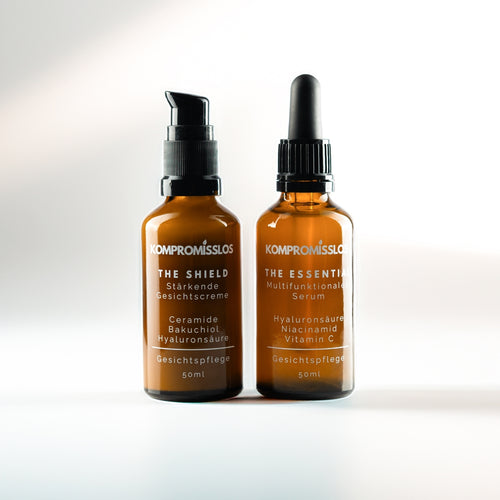
The two skincare steps in the middle stay the same in every row. One example is The Duo of serum and cream: together, the two deliver 5% niacinamide, 2% vitamin C as 3-O-Ethyl Ascorbic Acid and 1% zinc PCA, and the cream also contains ceramide NP, squalane and jojoba oil for the barrier. That covers moisture, active ingredients and lipids in two steps.
Which skincare steps can you skip without missing out?
In most cases, you can skip toner, essence, a second or third serum with similar active ingredients, cleansing with a product again in the morning and daily exfoliation without missing out on anything. If your cleanser is mild and rinses off without residue, a toner no longer has a job of its own; the details are in the article on whether you need a toner. In the morning, lukewarm water is enough for most skin types, so a second cleanse with a product adds little. Which cleanser makes sense in the evening is covered in the article on what kind of cleanser your skin really needs. Layering several serums is rarely necessary either: if two products deliver the same active ingredient, you do not double the effect, only the risk of irritation. Many of these extra steps come from Korean skincare. If you want to know what the 10-step routine does and doesn’t do and how much of it is ritual, the comparison is worth a look. Face masks and special products for individual areas are not a mistake, but they are optional extras. They do not belong in your basic daily kit.
A good test is to ask yourself what would happen if the product ran out tomorrow. If your answer is ‘nothing, really’, it is a candidate for leaving out. In her review on Judge.me, Jacqueline writes about the two products: ‘And there is no longer a jungle of products in my bathroom cabinet’ (review translated from German).
Which step should never be missing from a pared-back routine?
The step that should never be missing from a pared-back routine is sunscreen during the day, followed closely by a cream that looks after the skin barrier. For sunscreen, the evidence is unusually clear. In a randomised trial in Australia with 903 adults under 55, published in the Annals of Internal Medicine, the group using sunscreen daily showed no detectable increase in skin ageing after 4.5 years. Compared with the group that used sunscreen at their own discretion, skin ageing was 24 per cent lower. For hardly any other skincare product has the effect on skin ageing been studied so directly. How much SPF your face needs day to day and how to combine it with serum and cream is explained in the article on sunscreen for your face.
Next comes the cream. A review in Clinical Medicine & Research describes moisturiser as a major component of basic daily skincare, particularly when the barrier is impaired and the skin lacks water. A serum can deliver active ingredients, but it is the cream, with its lipids, that holds on to the moisture your skin receives. How exactly the two steps differ is explained in the article on whether you really need both serum and cream.
Are two products enough for mature or sensitive skin?
Yes, two skincare products are enough for mature or sensitive skin too, as long as together they provide moisture, active ingredients and lipids, and you add cleansing and sun protection. Sensitive skin in particular often benefits when less ends up on it. A review in Anais Brasileiros de Dermatologia names cosmetics as the main triggers of sensitive skin, especially in women, due to overuse and sometimes inappropriate use. The same review recommends moisturisers with few components and no fragrance. Every additional product brings its own fragrances, preservatives and active ingredients, and if your skin reacts, it becomes almost impossible to say which product caused it.
Above all, mature skin needs more lipids and moisture, not more steps. If your skin feels tight in winter, a more generous amount of cream or a few drops of oil in the evening is usually a better answer than an extra specialist product. The line is drawn where sensitive skin turns into a medical condition: rosacea, atopic dermatitis or persistent inflammation should be assessed by a dermatologist. Skincare then plays a supporting role; it does not replace treatment.
In what order should you cut back your routine?
The most sensible way to cut back is to remove duplicates first, then pure in-between steps and finally irritating products, while cleanser, cream and sunscreen stay until the very end. This order ensures that your skin is never left without its basic care. It also shows which product has genuinely contributed something. Cutting at random sometimes means dropping the cream, of all things, and keeping the third serum. This is about which products go first. The order in which you apply the remaining steps is a separate question and hardly changes when you cut back: cleanser, serum, cream and, in the morning, sunscreen last.
- Cut duplicates: two serums with the same active ingredient, day and night creams with almost identical formulas, several moisturising products layered on top of each other.
- Drop in-between steps: toners, essences, boosters and mists that do no job the serum or cream does not already do.
- Cut back on irritating products: acid toners, frequent exfoliation and products with a lot of alcohol or fragrance, especially if your skin stings or feels tight.
- Check your basic kit: cleanser, serum, cream and sunscreen stay. If one of them does not suit your skin, replace it rather than adding another product.
The simplest way to cut back is not to repurchase products once they run out. That way you do not have to throw anything away, and you gradually notice what you actually miss and what you don’t.
From the very start, I limited Kompromisslos to two products, a serum and a cream, instead of building a line with eight steps. We deliberately do not offer a toner or an exfoliant, because I do not think they are necessary for daily skincare. To be honest, though, our two products are not the whole routine. We do not sell a cleanser, and the cream contains no SPF. So you need separate sun protection during the day, just as you need a mild cleanser in the evening. That means we cover two of the four steps; the other two I can’t and won’t replace for you. How serum and cream work together morning and evening is explained on the page on how to use the serum and cream.
Frequently asked questions
Is skinimalism just a trend?
The term skinimalism is new; the principle behind it is not. A few well-tolerated products – a mild cleanser, a cream and sunscreen – match what the specialist literature recommends, particularly for sensitive skin: skincare with few components and no fragrance. What is trendy is the backlash against ten-step routines, not the idea itself.
Is a minimalist routine enough in winter?
Yes. In winter, it is usually the amount that changes, not the number of products. With cold weather and central heating, dry or mature skin needs more cream or a little oil in the evening. An extra specialist product is rarely needed for this. What exactly helps is covered in the article on winter face cream for mature, dry skin.
Do I need an exfoliant in a minimalist routine?
No, an exfoliant is not a fixed part of a minimalist routine. Healthy skin renews itself, and frequent exfoliation mainly puts strain on sensitive and dry skin. For rough, thickened skin, a gentle exfoliant can make sense now and then. When and how often is explained in the article on whether you need to exfoliate your face at all.
How many active ingredients should a routine contain?
There is no fixed number. What matters more is that each active ingredient has a clear job, is declared at a traceable concentration and does not turn up twice in different products. Two to four well-tolerated active ingredients in one serum, plus a cream with lipids, cover the essentials for most skin types.
Is a minimalist routine cheaper?
Usually, yes, because you buy fewer products and no longer pay for duplicates. A single good serum may cost more than a simple toner, but what counts is the total per month. Add up what you currently spend on all your face products and compare it with the cost of a cleanser, serum, cream and sunscreen.
Should I drop unnecessary products all at once or gradually?
If your skin is calm, you can drop unnecessary in-between steps all at once. If it is irritated, first cut the products most likely to irritate, such as acids, fragrances or a lot of alcohol, and keep your cream and sunscreen unchanged. Introduce new products one at a time so that you can link any reaction to a specific product.
Which products do I need in addition to The Duo?
In addition to The Duo, you need separate sun protection during the day, because the cream contains no SPF, and a mild cleanser in the evening if you wear sunscreen or make-up. Otherwise, water is enough for cleansing. With The Duo of serum and cream, you do not need a toner, a second serum or a separate night cream.
Sources
- Manová E, von Goetz N, Keller C, Siegrist M, Hungerbühler K. Use Patterns of Leave-on Personal Care Products among Swiss-German Children, Adolescents, and Adults. International Journal of Environmental Research and Public Health, 2013. Source
- Hughes MC, Williams GM, Baker P, Green AC. Sunscreen and prevention of skin aging: a randomized trial. Annals of Internal Medicine, 2013. Source
- Purnamawati S, Indrastuti N, Danarti R, Saefudin T. The Role of Moisturizers in Addressing Various Kinds of Dermatitis: A Review. Clinical Medicine & Research, 2017. Source
- Duarte I, Silveira JEPS, Hafner MFS, Toyota R, Pedroso DMM. Sensitive skin: review of an ascending concept. Anais Brasileiros de Dermatologia, 2017. Source