Korean skincare: what the 10-step routine does and doesn’t do
BUYING AND BRAND
Korean skincare refers to a skincare philosophy built on many thin layers, known in the West as the 10-step routine. Of these ten steps, three to four do the real work: cleansing, a serum with active ingredients, moisture with lipids and, in the morning, sun protection. The rest is texture, ritual and habit. Three steps done consistently achieve more than ten for two weeks.
Where does the 10-step routine come from?
The 10-step routine comes from South Korea, where skincare is understood as a patient daily habit rather than a course of treatment for an acute problem. It only became a list of exactly ten items in the West, when Korean cosmetics arrived here via online shops, beauty media and later social media. A number can be explained, shared and sold; a flexible habit can’t. That is exactly where the flawed thinking lies: the ten steps are a format, not a dermatological recommendation. No complexion needs ten products just because ten products exist. The routine still works for many people, but it works because of consistency and because of sun protection and moisture, not because of the number of steps. If you want to understand why more products don’t automatically mean better skincare, you will find the longer version of this argument there. The real gain is that skincare becomes a habit rather than an exception on bad skin days.
Which steps are useful and which are ritual?
Four steps are useful: a gentle cleanser, a serum with declared active ingredients, a cream with lipids and, in the morning, sun protection. Everything else on the classic list of ten is either comfort, texture or a repeat of what a well-made product already does. Toner and essence, for example, both mainly provide moisture in a thin layer. If your cream contains enough humectants, you can save yourself two bottles without any noticeable loss, and halve your time at the basin while you are at it. When it comes to cleansing, the opposite of “more is better” applies: two cleansing steps plus an exfoliant plus a toner seven evenings a week is too much for many people, and a weakened skin barrier then shows up as tightness, redness and sudden sensitivity. The following table classifies each of the ten classic steps according to what it actually does day to day.
| Step | Function | Assessment |
|---|---|---|
| 1. Oil cleanser | Loosens sunscreen and make-up | Useful in the evening if you have worn either |
| 2. Foam cleanser | Removes residue and sweat | Useful, but gentle and brief |
| 3. Exfoliant | Loosens dead skin cells | Once or twice a week at most |
| 4. Toner | Hydrates and prepares the skin | Dispensable if your cream does the job |
| 5. Essence | Thin layer of moisture | Pleasant, but not an active step in its own right |
| 6. Serum or ampoule | Delivers concentrated active ingredients to the skin | The most important skincare step |
| 7. Sheet mask | Short burst of moisture | A nice extra with no long-term effect |
| 8. Eye cream | Cares for the thin skin around the eyes | Can usually be replaced by your face cream |
| 9. Moisturiser | Seals in moisture with lipids | Indispensable |
| 10. Sun protection | Protects against UV-related skin ageing | In the morning, the step with the best evidence |
The last point is the only one backed by a large, long-term randomised study: in a randomised study in the journal Annals of Internal Medicine, the group using sun protection every day showed 24% less visible skin ageing after four and a half years than the group that applied sun protection only when they felt like it.
Is there anything to the active ingredients in Korean skincare?
The typical K-beauty ingredients are supported by evidence to very different degrees, and it is worth separating them. Centella asiatica, often sold as cica, has the broadest research base of the botanical ingredients. A review in Evidence-Based Complementary and Alternative Medicine summarises how it works, while also noting that controlled long-term studies in humans are still lacking for robust conclusions. For snail secretion, ginseng, propolis and fermented extracts, the data is thinner – which doesn’t mean they do nothing. It means nobody can credibly put a figure on it. Much better researched are the unspectacular classics that are also found in Korean formulas: niacinamide, vitamin C, hyaluronic acid and ceramides. So what matters more than where an extract comes from is whether the concentration is declared and whether the combination works. Which combinations get on with each other is covered in our overview of which active ingredients go together.
Why we make two products instead of ten
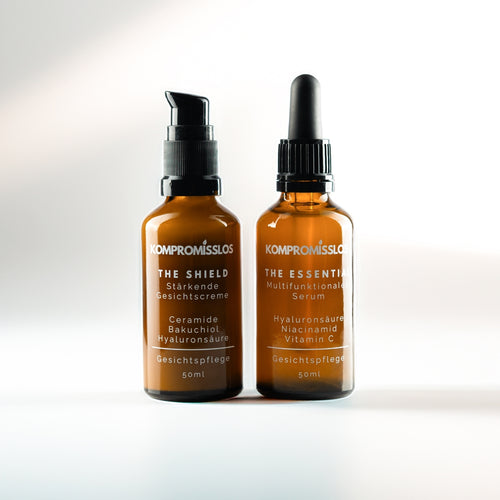
We decided on two products because otherwise the active ingredients would be spread across too many bottles, with too little left in each one. The Duo of The Essential serum and The Shield cream covers the four steps classed above as essential, with the exception of cleansing and sun protection. The Duo as a whole contains 5% niacinamide, 2% hyaluronic acid, 2% vitamin C as 3-O-ethyl ascorbic acid, 1% zinc, 0.3% bakuchiol and 2% each of edelweiss and gentian root extract, plus ceramides, squalane, panthenol and jojoba oil without a stated percentage. These figures always refer to the two products combined, not to the serum or cream on its own. If you want to check the numbers, the full list of ingredients is openly available. The price of this decision is a much shorter shelf: we deliberately don’t make a toner, essence, sheet mask or eye cream.
Who is Korean skincare still worth it for?
The longer routine is worth it for you if the ritual itself gives you something and you keep it up for months. Ten minutes in the evening that you enjoy beat two minutes that you give up after three weeks. The approach also makes sense for oily or blemish-prone skin that tolerates light, water-based layers better than a rich cream, and for anyone who enjoys experimenting with textures. You don’t need the list of ten if your skin is calm, you use sun protection in the morning and apply serum and cream in the evening. In that case, you would be buying extra steps without solving a problem. How two products are divided between morning and evening is shown on our page on how to use the serum and cream. And whether you need both at all is covered in our article comparing serum and cream.
When should your skin be seen by a professional?
Anything that goes beyond skincare belongs with a professional: weeping or bleeding patches, persistent severe redness, painful lumps, sudden changes to a mole, or a complexion that gets worse over several weeks even though you haven’t changed anything. Cosmetics care for the outermost layer of the skin; they don’t diagnose and they don’t replace treatment. That applies to Korean products just as much as to ours. A ten-step routine can even mask a dermatological issue, because so many variables are in play at once that nobody can say any more what the skin is reacting to. If you are unsure, cut back for two weeks to cleansing, a cream and sun protection, and leave out everything else. If your skin calms down during this time, the routine was too full. If the problem persists, the next sensible step is to see a dermatologist, not an eleventh product in the bathroom.
I deliberately launched Kompromisslos with two products, even though a set of six would be easier to sell. The reason is simple: I wanted every active ingredient to be present in an amount that does something, and that isn’t possible when budget and formula are spread across ten bottles. That is why our percentages are on the label and not in the small print. I am open about what I leave out in return: no toner, no essence, no mask. If you love a long evening ritual, you won’t be happy with our two-product approach – and that is fine.
Dominic Bertschin
Frequently asked questions
Do I really have to buy ten products for Korean skincare?
No. The number ten is a marketing format, not a rule. Cleansing, a serum with active ingredients, a cream with lipids and sun protection in the morning cover most of the benefit. Additional steps such as toner, essence or a sheet mask are comfort and texture, not active steps in their own right.
Is double cleansing necessary every evening?
Double cleansing is worthwhile on evenings when you have worn sunscreen or make-up, because oil-soluble residues are hard to remove with water alone. On days without either, a gentle cleanser is enough. Cleansing too often and for too long weakens the skin barrier and shows up as tightness and redness.
Do sheet masks do anything?
Sheet masks provide a short burst of moisture that can remain visible for one to two days. For your complexion over months, it makes no difference whether you use them. As an occasional extra they are unproblematic; as a substitute for a daily cream with lipids they are unsuitable.
Can I mix K-beauty products with a minimalist routine?
Yes. What matters is not where the products come from, but whether the active ingredients get on with each other and whether you stick to the order from thin to thick. It is important to introduce only one new product per week. Otherwise, if you react, you can no longer tell which product caused it.
Is Korean skincare suitable for sensitive skin?
Sensitive skin often tolerates many layers less well than a few. The more products you use at once, the more fragrances, preservatives and acids meet an already irritated barrier. A short routine of gentle cleansing, a serum and a cream makes more sense, adding things gradually only after that.
What replaces toner and essence in a short routine?
A cream with humectants such as hyaluronic acid or panthenol takes over what toner and essence contribute: bringing moisture into the outermost layer of the skin. The difference lies in the texture, not the function. If you like the light layer, you can keep it, but you don’t need it.
Sources
- Hughes MCB, Williams GM, Baker P, Green AC. Sunscreen and prevention of skin aging: a randomized trial. Annals of Internal Medicine, 2013. Source
- Park. Pharmacological Effects of Centella asiatica on Skin Diseases: Evidence and Possible Mechanisms. Evidence-Based Complementary and Alternative Medicine, 2021. Source