Rice water for your face: what the beauty trend can and can’t do
ROUTINE
Rice water for your face is mostly water with a little dissolved starch and traces of antioxidants. It can feel briefly smoothing and pleasant, but it replaces neither serum nor cream: it contains no lipids, no defined amount of active ingredients and no preservative. The only notable skin study on it tested a lab-made gel, not the kitchen version. If you want to try it, use freshly soaked rice water, keep it in the fridge and pour it away after a few days.
What does rice water really do for your face?
On your face, rice water mainly gives your skin a pleasant feel for a short while; for the homemade version, nothing more has been shown. The dissolved starch settles on the skin as a thin film that feels smooth and slightly matt. It is a similar effect to starch in powders or bath additives: pleasant, but superficial, and gone again after the next wash. On top of that come small amounts of substances from the rice grain that show antioxidant activity in the lab. Nobody knows exactly how much of them ends up in your jar, because the type of rice, the amount of water and the soaking time change the result every time. What rice water cannot do is replenish the skin’s lipid layer, hold on to moisture for hours or protect against UV light. If your skin looks grey and tired, a missing kitchen ritual is rarely the reason. Whether dryness, sun damage or too little sleep is behind it is explained in the article on why your complexion looks dull and grey.
The trend comes from East Asia, where rice water has long been part of skin and hair care, and social media turned it into a quick glow hack. As a hair rinse, rice water is a separate topic that is deliberately left out here. For your face, the verdict is: a harmless ritual with a light, caring feel, not an active-ingredient product.
What is in rice water, and how much of it actually reaches your skin?
Rice water mainly contains starch, plus small amounts of protein, minerals, B vitamins, inositol and phenolic compounds, only a little of which actually reaches your skin. Most of the substances that are interesting as antioxidants, such as ferulic acid and gamma-oryzanol, sit in the bran and the germ. White rice has largely been stripped of them, and its soaking water releases correspondingly little. Gamma-oryzanol is also fat-soluble and barely passes into water. Then there is the question of what happens after you apply it. Rice water consists almost entirely of water, which evaporates within minutes. What remains is a thin starch film with the dissolved residues. A serum works differently: the active ingredients are dissolved at a known concentration, in a base that keeps them stable and spreads them evenly. Rice water has neither.
Inositol is often cited as the reason rice water works. The research on it, however, used the isolated substance, not rice water. Concluding from this that the soaking water has an effect is a leap that no study has backed up so far.
What do studies show about rice water on the skin, and what don’t they show?
There is essentially one study on rice water on the skin, and it shows lab results and good tolerability, but no proof that rice water from your kitchen works on your face. In 2018, a research team led by Joana Marto analysed the composition of rice water in the journal Cosmetics and tested it in the lab. There it showed antioxidant activity and inhibited elastase, an enzyme involved in breaking down elastic fibres. The researchers then made it into a gel containing 96 per cent rice water, which a group of 12 volunteers used for 28 days, supplemented by a tolerability test with repeatedly applied patches. The gel was well tolerated by the skin and had suitable cosmetic properties. What this tells us remains limited: twelve people, a gel with a defined lab formulation, and enzyme values from a test tube. Inhibiting elastase in a test tube does not mean fewer wrinkles on your face.
A second line of evidence leads to rice starch. In a study published in Acta Dermato-Venereologica, the forearm skin of healthy volunteers was irritated with the surfactant sodium lauryl sulfate and then bathed twice a day for 15 minutes in bath water containing rice starch. The recovery of the irritated skin, measured by the water lost through it, improved by 20 per cent. This suggests that starch does not disturb the skin and can support barrier recovery. But it was a bath additive in a known amount on the forearm, not rice water on the face.
When a guide talks about ‘studies’ on rice water, it is worth asking which kind: a lab experiment, a gel with a fixed formulation, or actual kitchen rice water on the face? For the last of these, there is no efficacy study so far.
Boiled, soaked or fermented: which rice water is meant for your face, and how long does it keep?
For the face, people usually mean soaked rice water, and it only keeps for a few days in the fridge. To make it, rinse the rice briefly, cover it with fresh water, leave it to stand for about half an hour and pour off the cloudy water. Boiled rice water is the drained cooking water, which is thicker and richer in starch. Fermented rice water is left at room temperature until it smells sour. Online, it is precisely this version that is hailed as the most effective, because the pH drops and new substances form during fermentation. But nobody controls what exactly is fermenting in your jar. Rice is frequently contaminated with spores of the bacterium Bacillus cereus, and a review in the journal Foods describes how this germ can multiply in cooked rice products at temperatures as low as 4 °C. That is a finding from food safety, not dermatology. But it shows that rice water is not a germ-free product. So you can skip fermenting it on the kitchen worktop.
| Rice water | How it is made | What is in it | How long it keeps | Risk |
|---|---|---|---|---|
| Soaked | Leave rice to stand in cold water, then pour off the water | A little starch, traces of dissolved substances | A few days in the fridge | Low, as long as it is fresh and kept cold |
| Boiled | Cook rice in plenty of water, pour off the cooking water and let it cool | More dissolved starch, thicker | A few days in the fridge | Medium: rich in starch, so germs from the rice find good conditions |
| Fermented | Leave soaking or cooking water to ferment at room temperature | Starch, fermentation products, microorganisms in unknown amounts | Unclear, goes off quickly | Highest: uncontrolled fermentation, acidic, more likely to irritate sensitive skin |
Conflicting figures circulate about how long it keeps, ranging from two days to more than a week. There is no reliable number, because nobody has tested it for your jar. So stick to simple rules: make it fresh, put it straight into a clean container with a lid in the fridge and pour it away after a few days. If it smells sour or rotten, turns slimy or looks cloudier than on the first day, it goes down the sink. With shop-bought skincare, by contrast, preservation and the period after opening are what count; read more on how long skincare keeps after opening.
Which skin types should not use rice water?
Rice water is mainly unsuitable for skin whose barrier is already compromised and for skin that reacts quickly to anything new. If you have redness, flaking, broken skin or diagnosed eczema, an unpreserved homemade liquid does not belong on your face; what matters then is getting it checked by a dermatologist. Fermented rice water is the worst choice for sensitive skin, because it is acidic and contains microorganisms in unknown amounts. If you know you react to rice, leave it out anyway. If you are prone to blemishes, there is no proven benefit, and a starch film that sits under your skincare for hours does nothing for your skin. For dry skin, rice water is not harmful, but it is not enough, because it brings no oils with it. Which kitchen remedies genuinely help with tightness, and which do not, is covered in the overview of home remedies for dry facial skin.
If you still want to try rice water, test it on a small area first and watch your skin for a few days. The article on how to patch test a new face product explains how to do this properly.
Where does rice water fit into a short routine, and what can’t it replace?
In a short routine, rice water has a place at most as an optional in-between step straight after cleansing, and it replaces neither serum nor cream nor sunscreen. If you want to use it, stick to this order:
- Cleanse your face, then apply fresh rice water from the fridge with clean hands or a fresh cotton pad.
- Let it absorb briefly; do not leave it on until your skin feels tight.
- Then apply your serum and cream as usual, because rice water does not hold moisture in the skin.
- In the morning, still use sunscreen, as rice water does not protect against UV light.
Whether such an in-between step is needed at all is a separate question, and the answer to whether you need a toner at all is usually a short one. If you know rice water from the K-beauty world: there it is one step among many, and the article on what the Korean 10-step routine really does sorts out which of them actually do the work.
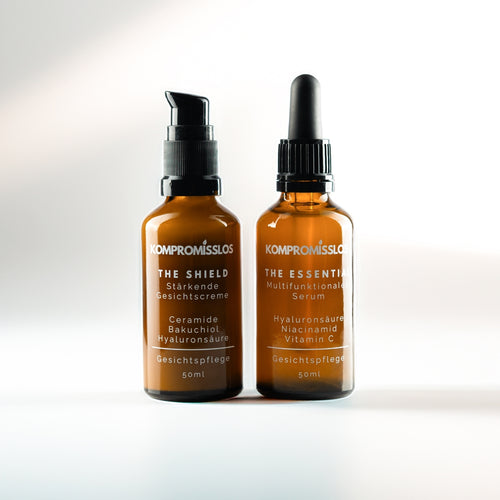
What the trend promises – moisture, a more even-looking complexion and protection against oxidative stress – is delivered more reliably by a stable, preserved formulation. The Duo of The Essential serum and The Shield cream contains 5% niacinamide and 2% vitamin C as 3-O-Ethyl Ascorbic Acid; the serum adds hyaluronic acid in three molecular sizes, and the cream adds ceramide NP, squalane and jojoba oil for the lipid layer. The difference from rice water is not how natural it is, but that the key active ingredients are listed with their concentrations.
I have nothing against kitchen trends. But I want to know what ends up on the skin and in what amount, and that is exactly what nobody can tell you about rice water. That is why we disclose the concentrations of the key active ingredients in the Duo: 5% niacinamide, 2% vitamin C in the stable 3-O-Ethyl form and 1% zinc PCA. And the Duo is preserved, so you do not have to pour it away after a few days like rice water. We deliberately do not sell a toner. If you like rice water as a toner, use it; it is not necessary, and the Duo does not need it to work. What is in the two products, and what it is there for, is set out on the page listing all the active ingredients and their concentrations.
Frequently asked questions
Can I use rice water on my face every day?
Yes, you can use rice water every day, as long as it is fresh and your skin stays calm. However, no study shows any extra benefit from daily use. Hygiene matters more than frequency: always straight from the fridge, a clean pad, and a fresh batch after a few days. If your skin stings, itches or turns red, stop using it.
Do I need to wash rice water off after applying it?
No, rice water applied as a toner does not need to be washed off. Let it absorb briefly, then apply your serum and cream. If you use thick cooking water as a mask, rinse it off with lukewarm water after a few minutes so that no starch film is left under your skincare.
Does rice water lighten dark spots?
There is no evidence for this. No study has shown that rice water visibly lightens dark spots on the face. Spots are mainly caused by UV light and hormonal influences, which is why daily sunscreen is the more effective step. Spots that change, grow or are unevenly coloured should be checked by a dermatologist.
Does rice water clog pores?
There is no reliable data on this. Rice water contains no oils, so it is not a typical pore-clogging substance. Even so, a thick starch film from boiled rice water that stays under a cream for hours is not a good idea for blemish-prone skin. If you are prone to blemishes, use thin soaking water or skip it altogether.
Is rice water in shop-bought products better than homemade?
In terms of hygiene, yes, because shop-bought products are preserved, have a tested formulation and a period after opening. Whether they are also more effective depends on what else is in the formula; the rice content alone is rarely the reason. So look at the other active ingredients in the ingredient list rather than at the word rice on the packaging.
Does rice water help with atopic eczema or acne?
No, rice water is not a solution for atopic eczema or acne; both should be assessed by a dermatologist. On irritated or inflamed skin, unpreserved homemade liquids are more of an added risk than a help.
Do I need rice water if I use The Duo?
No. The Duo provides moisture with hyaluronic acid, among other things. It contains vitamin C at a disclosed 2%, and the cream supplies the lipids that rice water lacks. If you enjoy the step, apply fresh rice water after cleansing, let it absorb briefly and follow with the serum and cream from the Duo.
Sources
- Marto J, Neves Â, Gonçalves L, Pinto P, Almeida C, Simões S. Rice Water: A Traditional Ingredient with Anti-Aging Efficacy. Cosmetics, 2018. Source
- De Paepe K, Hachem JP, Vanpee E, Roseeuw D, Rogiers V. Effect of rice starch as a bath additive on the barrier function of healthy but SLS-damaged skin and skin of atopic patients. Acta Dermato-Venereologica, 2002. Source
- Rodrigo D, Rosell CM, Martinez A. Risk of Bacillus cereus in Relation to Rice and Derivatives. Foods, 2021. Source