Do you need a toner? When it’s worth it and when it’s a wasted step
ROUTINE
You do not need a toner in a modern skincare routine – it is not an essential step. Healthy skin regulates its own pH within a few hours of cleansing. A toner only makes sense if it delivers an active ingredient of its own or removes a layer of cleanser left behind. As a mere in-between step, it costs money and time, and with a high alcohol content it puts extra strain on sensitive skin.
What was toner originally meant for?
Toner was originally a corrective step for a type of cleansing that hardly exists any more. Until well into the last century, people washed their faces with traditional soap. Soap is strongly alkaline and, combined with hard tap water, leaves a fine film on the skin. Toner therefore had two jobs: to remove this film and to restore the skin’s acid mantle more quickly. To do this, products typically contained alcohol and astringent plant extracts such as witch hazel. According to a study in the International Journal of Cosmetic Science, the natural pH of the skin’s surface averages about 4.7, which is clearly in the acidic range. Today’s cleansers, by contrast, are mostly mild and adjusted to a pH close to that of the skin. That removes precisely the job toner was once invented for. The more important question is therefore which cleanser your skin actually needs, not what you put on afterwards.
There is also a point that is rarely made openly: healthy skin restores its pH on its own after washing. A study in Skin Research and Technology compared long-term use of soap with long-term use of a mildly acidic cleanser and found no difference between the groups in pH recovery.
What do modern toners actually do?
Modern toners do four very different things, and that is exactly why the general question of whether you need a toner cannot be answered. Today, the same shelf label covers clarifying toners with alcohol, purely hydrating toners, acid toners with exfoliating active ingredients and essences that work more like a runny serum. The first removes something, the second adds moisture, the third loosens dead skin cells and the fourth delivers active ingredients. Apart from their liquid texture and their place in the routine, these four categories have little in common. When people say toner is unnecessary, they usually mean the first. When they say it is indispensable, they usually mean the third or fourth. So the useful question is not whether you need a toner, but which of these four jobs is still left undone in your routine. For most routines, the honest answer is none of them, because cleanser, serum and cream already cover them. Only when a gap remains does the product category become interesting.
| Type of toner | Job | Makes sense if | Replaced by |
|---|---|---|---|
| Clarifying toner | Removing residue | Your cleanser leaves a film | A cleanser that rinses off without residue |
| Hydrating toner | Supplying humectants | The skincare you use afterwards is very light | A serum with hyaluronic acid |
| Acid toner with AHA, BHA or PHA | Loosening dead skin cells | You want to exfoliate gently on a regular basis | An exfoliant once or twice a week |
| Essence or booster | Delivering active ingredients in a runny texture | Your serum does not cover that active ingredient | A serum with a suitable list of active ingredients |
The third type is where overdoing it is most likely. Knowing which acid suits which skin often already tells you whether an acid toner makes sense every day or only occasionally.
Do you need a toner in a minimalist routine?
In a minimalist routine, you do not need a toner if your cleanser, serum and cream are properly matched. The reason is simple: a toner sits between two steps that usually already cover its jobs. A mild cleanser leaves no film that a toner would need to remove. A serum delivers moisture and active ingredients to the skin in a more targeted way than a water-based in-between layer can. And a cream seals in both. Adding a fourth product anyway makes the routine longer without making it work any better. What is striking is that the question about toner almost never comes up on its own. It usually comes together with the question of whether you really need both a serum and a cream. Both questions have the same core: it is not about the number of steps, but about whether each step has a job of its own.
One customer wrote to tell us that she had kept a clarifying toner in her bathroom for years and still felt a pulling sensation after every cleanse. She asked which additional product she was still missing. My answer went in the other direction: first leave out the toner and see whether the pulling sensation remains. If it does, the cause is not a missing step but more likely the cleanser before it. This order of steps does not sell a new product, but it answers the question more cleanly.
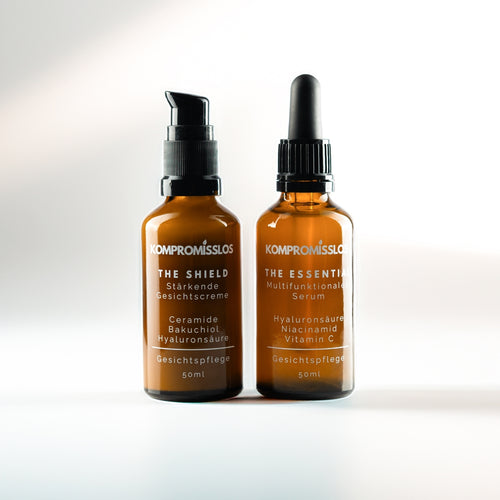
That is exactly why our range consists of two products. The Duo of Essential serum and Shield cream covers the steps after cleansing, morning and evening, with 3 to 6 drops of serum and 3 to 6 pumps of cream.
When toner becomes counterproductive
A toner becomes counterproductive above all when it contains a lot of alcohol and is used several times a day. The brief feeling of matte skin comes from stripping away oil – and that oil is then missing. For sensitive or dry skin, this is a daily step backwards rather than a skincare step. A second pattern appears with acid toners, which are often used in addition to an exfoliant without anyone ever adding up the total amount of exfoliation. Roughness, stinging when you apply your serum and redness are then not a reaction to one product but to the sum of them. A third pattern is habit: the toner stays because it has always been there. If your skin becomes more irritated rather than calmer with more products, it is more useful to look at the skin barrier and its limits than to reach for the next bottle on the shelf. In this case, fewer steps are the more effective measure.
If your tap water is very hard, your skin may feel rough for a moment after washing. That is not an argument for an alcohol-based toner, but for applying your skincare straight after drying your face.
How can you tell whether a toner is worth it for you?
Whether a toner is worth it for you comes down to four points, not the marketing copy on the bottle. The first is its job: the product must do something that no other step in your routine does. The second is the list of active ingredients, with verifiable details rather than vague promises. The third is your cleanser, because if it rinses off without residue, the traditional purpose disappears. The fourth is how your skin reacts after two to three weeks without the product, because that is the most honest test there is. This order is deliberately designed so that you leave things out first and only add afterwards. Doing it the other way round means collecting products whose contribution can never be judged individually. And if no clear reason remains after these four points, that is a perfectly valid result, not an oversight.
- Check its job: which gap does it fill that cleanser, serum and cream leave open?
- Check the label: does it list specific active ingredients with percentages, or only mood words? One example is our active ingredients with disclosed concentrations.
- Check your cleanser: does it leave a film after rinsing or not?
- Leave it out and observe: two to three weeks without the product tell you more than any advertising copy.
I deliberately did not add a toner to our range, even though it would be the easiest way to turn two products into three. The reason is simple: everything a good toner could deliver is already in our Duo. 5% niacinamide, 2% hyaluronic acid, 2% vitamin C as 3-O-Ethyl Ascorbic Acid and 1% zinc are figures that apply to The Duo as a whole. An extra liquid in between would not increase these concentrations, only the price. If I ever make a third product, it will be because it can do something the other two cannot. Not because a routine is supposed to look like it has more steps. How the two products build on each other is deliberately kept simple.
Frequently asked questions
Does your skin really need a toner?
No, toner is not a necessary step for healthy skin. A mild cleanser, a serum and a cream already cover the jobs of a traditional toner. It only makes sense if it brings an active ingredient of its own or if your cleanser leaves a noticeable film.
What is the difference between a toner and a tonic?
There is no protected distinction between toner and tonic; both terms refer to water-based products used after cleansing. In practice, toner tends to suggest something clarifying, while tonic tends to suggest something more caring. What matters is not the name but the ingredient list behind it.
Does toner replace cleansing?
No, a toner does not replace cleansing. It is applied without water and only picks up surface residue, not sunscreen, make-up or sebum. Using it instead of a cleanser means leaving out exactly the step that clears the skin. It is fine for a quick refresh in between, but not as a replacement.
Can I use a toner instead of a serum?
As a rule, no, because a serum is much more concentrated and stays on the skin for longer. A toner largely evaporates and delivers less active ingredient per application. If you have to choose, the serum is the step with the greater effect on your complexion.
Is toner with alcohol bad for your skin?
Alcohol in toner is not problematic in principle, but it is rarely helpful for sensitive or dry skin. High amounts strip oil from the skin’s surface and can encourage tightness and redness. If Alcohol Denat is near the top of the ingredient list and your skin is quickly irritated, an alcohol-free product is the gentler choice.
How often should I use a toner?
That depends on the type. A purely hydrating toner can be used morning and evening. An acid toner, on the other hand, does not belong in every routine every day, especially not on top of an exfoliant. Add up the total exfoliation in your week rather than looking at products individually.
Do I need a toner if I use The Duo?
No. The Duo is designed so that only two steps follow cleansing: serum and cream, morning and evening. The active ingredients a toner could deliver are already in it. An extra toner makes the routine longer without increasing the concentrations the Duo works with.
Sources
- Lambers H, Piessens S, Bloem A, Pronk H, Finkel P. Natural skin surface pH is on average below 5, which is beneficial for its resident flora. International Journal of Cosmetic Science, 2006. Source
- Takagi Y, Kaneda K, Miyaki M, Matsuo K, Kawada H, Hosokawa H. The long-term use of soap does not affect the pH-maintenance mechanism of human skin. Skin Research and Technology, 2015. Source