Rose water for your face: what the hydrosol really does and what is just scent
ROUTINE
Rose water for your face is refreshing and smells lovely, but beyond that it does very little for your skin. Genuine rose water is a hydrosol: the water left over from distilling rose flowers, with a small amount of rose oil dissolved in it. It gives your skin no moisture that lasts, and its scent components are among the well-known contact allergens. If you love the scent and your skin stays calm, you can use it. It does not replace a skincare step, though, and if your skin is sensitive, you are better off skipping it.
What exactly is rose water, and how does a hydrosol differ from perfumed rose water?
At its best, rose water is a hydrosol: the water produced alongside rose oil when rose flowers are steam-distilled. A small share of the scent compounds stays finely dispersed in it. A study in Food Research International analysed 22 hydrosols made from orange blossom and two species of rose. According to the findings, hydrosols contain less than 1 gram of dispersed essential oil per litre, and for Rosa damascena the median was 205 milligrams per litre. Rose hydrosol is therefore almost 100 per cent water that smells of roses. Under the same name, however, shops also sell quite different products: water with added perfume or rose oil, rose water from the baking aisle, which is labelled under food law rather than for use on skin, and face sprays that contain glycerin, alcohol or preservatives as well as rose water. The name on the bottle tells you little. What you are really buying only becomes clear from the ingredient list.
| Product | Typical label | What is in it | What to look out for |
|---|---|---|---|
| Rose hydrosol | Rosa Damascena Flower Water listed first | Distillation water with a little dissolved rose oil | Prone to microbial growth if not preserved |
| Perfumed rose water | Aqua, Parfum or rose oil | Water with added fragrance | Purely a carrier for fragrance, no hydrosol |
| Rose water from the baking aisle | Food ingredient list | Hydrosol or water with flavouring | Not labelled for use on skin |
| Rose spray or mist | Flower Water plus Glycerin, Alcohol, preservatives | Face spray with additives | Where alcohol and fragrance allergens sit in the list |
What can rose water demonstrably do for your face, and what is just marketing?
What rose water can demonstrably do on facial skin is mostly this: cool it briefly, wet the surface and smell nice. For the promises circulating in guides and shops, there are no robust studies using rose water on the face. Research on the Damask rose is extensive, but it usually refers to something else. A review in the Iranian Journal of Basic Medical Sciences summarises numerous pharmacological findings on Rosa damascena. The studies looked at various products and isolated components from the flowers, petals and rosehips, in laboratory and animal experiments. None of this tells you what a hydrosol containing a few hundred milligrams of essential oil per litre does on your cheek.
A laboratory finding on an extract is a statement about that extract at that concentration, not about a bottle of water on the supermarket shelf. The same goes for claims such as firming or pore-refining. A brief chill and evaporating water make your skin feel tighter, but they do not change it. Honestly assessed, rose water is a feel-good product. That is not a criticism, just a different category from skincare.
Can rose water replace a toner or a moisturiser?
Rose water does not replace a moisturiser, because water on its own evaporates from the skin and leaves nothing behind that binds or holds moisture. That takes two things: humectants, which bind water, and lipids, which slow down evaporation. A hydrosol provides neither in any meaningful amount. Can it replace a toner? As a watery in-between step, yes – only that step is optional in the first place. Whether you need a toner at all is a separate question, which we have answered in its own article.
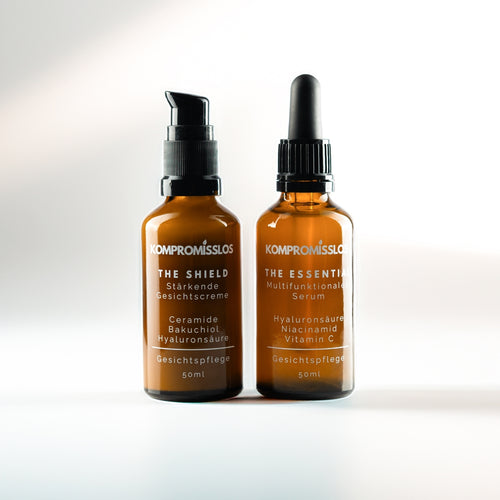
If you like to apply something light and watery after cleansing, you do not need an extra product for it. A light serum meets exactly that wish and brings ingredients that stay on the skin. The Essential is a serum of this kind with an aloe vera base: the juice comes first in the INCI, alongside hyaluronic acid in three molecular sizes. The Shield then holds the moisture in the skin with Ceramide NP and squalane. Both are fragrance-free. Together they make up the Duo of serum and cream, and there is no watery in-between step before them.
How can you tell from the INCI what is in your rose water?
In the INCI, you can recognise a genuine rose hydrosol by Rosa Damascena Flower Water or Rosa Centifolia Flower Water being listed first, with no Aqua ahead of it. If Aqua comes first, followed by Parfum or Rosa Damascena Flower Oil, it is perfumed water. For your skin, four further clues in the list matter:
- Fragrance ingredients listed by name: Citronellol, Geraniol or Linalool at the end of the list show that the product contains fragrance allergens that have to be declared. How to read these details and what fragrance-free really guarantees is covered in a separate article.
- Alcohol: if Alcohol or Alcohol Denat. appears near the top, the spray is more likely to dry your skin. Find out more about which alcohols dry your skin.
- Preservatives: if there are none at all, the hydrosol only stays stable for a short time after opening.
- Additives such as glycerin: they turn rose water into more of a light hydrating spray. That makes more sense than pure hydrosol, but it is no substitute for a serum or cream.
The fact that citronellol and geraniol are found in pure hydrosol too is not a labelling trick. In a study in Current Microbiology, citronellol and geraniol were the main components of rose oil and rose hydrosol from Rosa damascena, together accounting for more than 55 per cent of the components detected. The scent of rose cannot be separated from these substances.
Which skin types should be wary of rose water?
Rose water is a tricky choice for skin that has already reacted to fragrances, and for sensitive skin that reddens or becomes irritated easily. The reason lies in the scent components themselves. An analysis in Contact Dermatitis covering 23 Spanish centres makes this clear: of 19,588 people who were patch tested, 1,590 reacted to a fragrance marker. Of these, 1,013 were also tested with a series of individual fragrances, and geraniol turned out to be the most common allergen. That does not mean rose water causes problems for every skin. It means that natural does not automatically mean mild when a product takes its character from scent molecules.
You should also be careful if you have a known fragrance allergy, eczema or rosacea. In these cases, discuss your skincare with a dermatologist first, because a scented water is more of a risk than a help. If you are unsure how your skin will react, you can patch test a new skincare product properly before it goes on your face every day.
A thermal water spray is not rose water: it consists of mineral water and usually contains no scent compounds from flowers. If you are torn between the two in the shop, look at the INCI first and only then at the bottle.
How should you use rose water if you like it anyway?
If you like rose water, apply it after cleansing and follow straight away with serum and cream so that it does not simply evaporate. Spraying it onto your skin or patting it in with clean hands is enough. You do not need a cotton pad, as it soaks up some of the water again. What matters is the next step: rose water that evaporates with no skincare on top can leave your skin feeling tight. As a refresher during the day it is fine, as long as no tightness follows.
When you buy it, hygiene matters more than where the roses come from. The study in Food Research International observed microbial growth in all the hydrosols tested when they were stored in non-sterile containers, both at room temperature and at 5 °C. Contaminated samples reached about 7 log10 CFU per millilitre, whereas the French Pharmacopoeia recommends no more than 2 log10 CFU per millilitre. The authors therefore consider preservatives or aseptic filling necessary. A spray head offers better protection than an open bottle. How manufacturers keep water-based products stable is explained in the article on preservatives in natural skincare.
Wanting a rose scent is completely understandable. In her review on Judge.me, Regula R. writes about our cream: ‘[…] the scent of the cream is a bit too sharp for me. A drop of rose water or something would be nice’ (review translated from German). Fragrance-free does not mean odourless: the raw materials smell of themselves. We still do not add rose water, and that is a deliberate decision.
I did not put rose water in the Duo, even though I understand why people would like it. Rose water mainly brings scent, and we deliberately leave out fragrances, natural ones included. We do not make a toner either. The routine consists of two products instead of eight: cleanse your face with water, then 3–6 drops of serum, followed by 3–6 pumps of cream, just as it says on the page on how to use them. I do not want to talk you out of rose water. If you love the scent and your skin stays calm, use it. It is just not a skincare step your skin needs, and that is why I do not sell you one.
Frequently asked questions
Can I use rose water on my face every day?
Yes, if your skin does not react to it, you can use rose water every day. Make sure you apply serum or cream afterwards so that the water does not evaporate unprotected. If redness, stinging or itching occurs, leave it out. With daily use, the hygiene of the bottle matters all the more, so choose a spray head over an open bottle.
Is rose water from the supermarket or the baking aisle suitable for your face?
Rose water from the baking aisle is labelled as a food, not as a cosmetic. It may be a hydrosol, but it may also be water with flavouring, and its ingredient list follows different rules. For your face, a cosmetic product with an INCI list is the more transparent choice, because there you can spot fragrance allergens, alcohol and preservatives.
Can I make rose water myself?
Homemade rose water is usually an infusion of petals rather than a hydrosol. Without preservatives it is prone to microbial growth, even in the fridge. Roses from the florist are also not intended for skin or food. If you make it anyway, only prepare small amounts, keep it cool and throw it away after a few days.
How long does rose water last once opened?
How long rose water lasts depends mainly on how it is preserved. Preserved products carry a PAO symbol showing how long they keep after opening, and that is what you go by. According to laboratory data, unpreserved hydrosols can become contaminated even in the fridge. If it smells different, turns cloudy or develops flakes, throw it away.
Does rose water help with redness or rosacea?
Cool water can feel pleasant on reddened skin for a moment, but there is no proven effect of rose water on rosacea. Because rose water contains fragrance compounds, it can even irritate sensitive skin further. If redness persists or you suspect rosacea, have it checked by a dermatologist.
Is rose water the same as rose oil or rosehip oil?
No. Rose oil is the essential oil of the rose flower, highly concentrated and a fragrance in its own right; more on this in the article on essential oils in skincare. Rose water contains only traces of it. Rosehip oil, on the other hand, is a fatty oil from the seeds of the rosehip and has nothing to do with fragrance; a separate article on it is on the way.
Do I need rose water if I use The Duo?
No. With the Duo, cleansing with water is followed directly by serum and cream; there is no in-between step. The serum provides moisture with hyaluronic acid, and the cream holds it in with Ceramide NP and squalane. If you like the scent and your skin tolerates it well, you can keep using rose water, but The Duo does not need it.
Sources
- Labadie C, Ginies C, Guinebretiere MH, Renard CMGC, Cerutti C, Carlin F. Hydrosols of orange blossom (Citrus aurantium), and rose flower (Rosa damascena and Rosa centifolia) support the growth of a heterogeneous spoilage microbiota. Food Research International, 2015. Source
- Ulusoy S, Boşgelmez-Tinaz G, Seçilmiş-Canbay H. Tocopherol, carotene, phenolic contents and antibacterial properties of rose essential oil, hydrosol and absolute. Current Microbiology, 2009. Source
- Boskabady MH, Shafei MN, Saberi Z, Amini S. Pharmacological effects of Rosa damascena. Iranian Journal of Basic Medical Sciences, 2011. Source
- Silvestre JF, Mercader P, González-Pérez R, Hervella-Garcés M, Sanz-Sánchez T, Córdoba S, et al. Sensitization to fragrances in Spain: A 5-year multicentre study (2011–2015). Contact Dermatitis, 2019. Source