Alcohol in skincare: good or bad? Which alcohols dry your skin and which care for it
NATURAL SKINCARE
Alcohol in skincare is not automatically bad, because the word covers very different substances. The ones that can dry your skin out are mainly short-chain alcohols such as Alcohol denat., Alcohol (ethanol) or Isopropyl Alcohol, especially when they sit near the top of the ingredient list and your skin is already dry or sensitive. Fatty alcohols such as Cetearyl Alcohol, by contrast, are waxy conditioning ingredients that give creams their texture. So what matters is not whether “Alcohol” appears on the INCI list, but which one it is and where it sits.
Is alcohol in skincare bad for your skin?
Alcohol in skincare is usually only a problem when it is a volatile, short-chain alcohol in a high proportion and your skin is sensitive to it. Even so, the blanket fear of the word is understandable, because ethanol noticeably strips oil from the skin’s surface. A study in the British Journal of Dermatology tested alcohols at concentrations of 60 to 100 per cent in patch tests: the skin barrier, measured by water loss, and redness did not change significantly, but skin hydration did fall significantly. In a washing test, a detergent irritated the skin more than alcohol did. The study comes from hand hygiene rather than facial skincare, but it shows the key point: in the test, alcohol did not damage the healthy barrier, but it did dry it out.
A review in the Journal of Occupational Medicine and Toxicology adds two points. Ethanol acts as a penetration enhancer, making it easier for other substances to get into the skin. And ethanol is associated with skin irritation or contact dermatitis, especially in people with a deficiency of the enzyme aldehyde dehydrogenase. For resilient skin, a little ethanol in one product is rarely relevant. For dry, mature or irritated skin, the effect adds up when it turns up every day and in several products. This article is about alcohol as an ingredient. What drinking alcohol does to your face is covered in our article on alcohol and skin.
Which alcohols dry out your skin?
The alcohols that dry skin out are mainly short-chain, volatile ones: Alcohol denat., Alcohol, SD Alcohol and Isopropyl Alcohol. They evaporate quickly, dissolving oils from the skin’s surface as they go and taking moisture with them. That is exactly why a product with a lot of ethanol feels fresh and light and dries quickly, which many people find pleasant. Incidentally, Alcohol denat. is nothing more than ethanol with a bitter or unpleasant substance added so that nobody drinks it. For your skin, this denaturing makes little difference. How much a product dries your skin out depends mainly on the amount. If one of these alcohols is among the first three to five ingredients, the proportion is usually high. If it only appears far down the list, it is often just a solvent for a plant extract and plays a minor role in terms of quantity. You are most likely to come across high amounts in clarifying products, sprays, light fluids and some sunscreen textures. If you are wondering whether a traditional toner with alcohol is necessary at all, the guide Do you need a toner? has the answer.
Why are fatty alcohols like Cetearyl Alcohol good for your skin?
Fatty alcohols condition the skin because they have long carbon chains and therefore behave like waxes, not like ethanol. Rather than evaporating, they stay on the skin, make it supple and reduce the feeling of roughness. In a formulation they have a second job: they give creams body and help to bind water and oil together in a stable way. Cetearyl Alcohol is a blend of Cetyl Alcohol and Stearyl Alcohol and is usually obtained from plant oils such as coconut or palm oil. Other members of the group are Cetyl Alcohol, Stearyl Alcohol, Behenyl Alcohol and Myristyl Alcohol. Without these thickeners, many creams would be runny or would separate.
Fatty alcohols are not trouble-free for everyone either, but problems are rare. A case series in the Australasian Journal of Dermatology describes five contact allergies to cetostearyl alcohol and notes that emulsifiers are an uncommon cause of allergic contact dermatitis. All five people also had other positive test reactions, mostly to creams containing corticosteroids. If you already have a known allergy to ointment bases, you should therefore read the INCI list carefully. For everyone else, there is no reason to avoid fatty alcohols.
| Type of alcohol | How it appears on the INCI list | Job in the product | Effect on the skin |
|---|---|---|---|
| Short-chain alcohol | Alcohol denat., Alcohol, SD Alcohol, Isopropyl Alcohol | Solvent, light texture, quick drying | Can dry skin out in high amounts |
| Fatty alcohol | Cetearyl Alcohol, Cetyl Alcohol, Stearyl Alcohol, Behenyl Alcohol | Texture, emulsion stability | Makes skin supple, does not dry it out |
| Aromatic alcohol | Benzyl Alcohol, Phenethyl Alcohol | Preservation, solvent, fragrance | Usually unremarkable in normal amounts |
| Polyhydric alcohol | Glycerin, Pentylene Glycol, Propylene Glycol | Humectant, preservation aid | Binds water, does not dry skin out |
How do you spot the different alcohols on an INCI list?
You can tell which type of alcohol you are dealing with from its full name and its position on the list, not from the word “Alcohol” on its own. Above a certain quantity, ingredients are listed in descending order of proportion, so position tells you a lot. The basics are covered in the guide on how to read an ingredient list. For alcohols, four checks are enough:
- If “Alcohol”, “Alcohol denat.”, “SD Alcohol” or “Isopropyl Alcohol” stands on its own, it is a short-chain, volatile alcohol.
- If it is preceded by a long name such as Cetyl, Stearyl, Cetearyl or Behenyl, it is a fatty alcohol with a conditioning function.
- If an ingredient is called Glycerin or ends in “Glycol”, such as Pentylene Glycol or Propylene Glycol, it is a polyhydric alcohol and usually a humectant.
- Check the position: among the first five ingredients, the alcohol counts; far down the list, it is usually a minor detail.
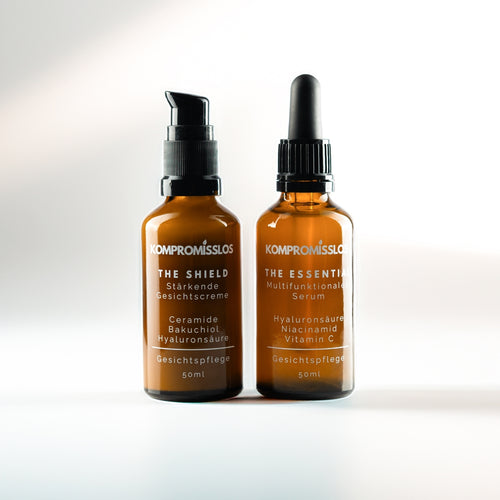
A classic source of confusion is panthenol: the name ends in “-ol”, and chemically it really is an alcohol, but it is provitamin B5, which binds moisture rather than drying the skin out. The same goes for glycerin, which is chemically an alcohol and yet one of the best-known humectants. There is more on this in the article on glycerin in skincare. One example of a list that contains all three groups is The Duo: it contains Cetearyl Alcohol as a plant-based fatty alcohol, Glycerin, Pentylene Glycol and Panthenol, but no Alcohol denat. and no ethanol. In a review on Judge.me, J.D. writes of being delighted “with the whole concept and the great transparency regarding ingredients” (review translated from German). That kind of transparency is exactly what you need to assess an ingredient list for yourself.
Why is alcohol so common in natural skincare?
Alcohol is common in natural skincare because ethanol is obtained from plants and does several jobs at once that would otherwise call for synthetic ingredients. First, it dissolves plant actives: many extracts are made with ethanol, and some of it ends up in the finished product as a solvent. Second, in higher amounts it supports preservation, because microorganisms grow less well in alcohol-rich water. Third, it creates a light, quickly absorbed texture without silicones. That explains why Alcohol so often appears near the top of the list in natural skincare in particular. Natural does not automatically mean kind to skin, though: ethanol from organic grain dries the skin out just as much as any other ethanol. So a natural skincare label tells you nothing about the alcohol content. How little terms such as “natural” or “no additives” mean legally is shown in the article on Swiss skincare without additives. In the end, the ingredient declaration is the only thing you can rely on.
If you have sensitive skin and are looking for natural skincare without drying alcohol, you do not have to give up natural skincare – you just have to read more carefully. Creams usually manage entirely without ethanol, because they get their texture from oils, fatty alcohols and emulsifiers. With toners, sprays, gels and very light fluids, it pays to take a second look.
When should you avoid skincare with alcohol?
You should avoid skincare with a lot of Alcohol denat. or ethanol if your skin is dry, mature, red or irritated, or if it stings and feels tight after you apply a product. With skin like this, the lipid layer is already thin, and every extra step that strips away oil makes itself felt. This applies especially to products you use twice a day over large areas, in other words serums and creams. A sunscreen spray with alcohol on the odd day matters less than a serum that goes on your skin every morning and evening. Skin also tolerates alcohol less well than usual after exfoliating or shaving, or in dry, heated indoor air in winter. You can be less strict if your skin is oily and resilient, as a light, quick-drying texture can even feel pleasant on it.
It is important to know where skincare ends and medicine begins: if every product stings, your skin flakes or redness persists for weeks, the cause may be rosacea, eczema or a contact allergy. That belongs with a dermatologist, and skincare then plays only a supporting role. If you are specifically looking for a gentle cream, check for fragrance as well as alcohol – there is more on this in the article on fragrance-free moisturisers.
I made the full INCI list of The Duo public so that you can check every type of alcohol for yourself, panthenol included. If you look it up, you will find Cetearyl Alcohol, Glycerin and Pentylene Glycol, but no Alcohol denat. and no ethanol. Even so, “alcohol-free” would be the wrong wording, because with a fatty alcohol on the list it would simply not be true. What an INCI list does not reveal is the amount of each ingredient. That is why I disclose the concentrations of the active ingredients, such as 5% niacinamide and 1% zinc PCA for The Duo as a whole. Exactly how much Cetearyl Alcohol it contains is not stated there, but you do not need that figure to judge whether a product dries your skin out. You can find the complete list from A to Z under the ingredients of The Duo.
Frequently asked questions
What does “alcohol-free” mean on the packaging?
“Alcohol-free” usually means that a product contains no ethanol or Alcohol denat. Fatty alcohols such as Cetearyl Alcohol, but also Benzyl Alcohol or Glycerin, can still appear on the list without the claim being wrong. There is no uniform definition. If you want to be sure, read the INCI list rather than the marketing claim on the front.
Is Alcohol denat. in sunscreen a problem?
For most skin types, Alcohol denat. in sunscreen is not a problem; it creates a light texture that absorbs quickly. On very dry or sensitive skin, however, an alcohol-rich spray or fluid can feel tight. In that case, a creamy texture without alcohol near the top of the list is the better choice. What matters more than the alcohol is that you apply enough sunscreen.
Is Benzyl Alcohol bad for your skin?
Benzyl Alcohol is generally considered safe in cosmetic amounts. In an analysis in the Journal of the European Academy of Dermatology and Venereology, 146 of the 70,867 patients tested, or 0.21 per cent, had a positive reaction, most of them only a weak one. It is used as a preservative, solvent and fragrance component. There is more on this in the article on preservatives in natural skincare.
Why is there alcohol in serums?
In serums, ethanol usually serves as a solvent for active ingredients and plant extracts and creates a light texture that dries quickly. It also makes it easier for other substances to get into the skin. For resilient skin, that is not a problem. For dry or sensitive skin, a serum without Alcohol near the top of the list is the gentler choice, because you use it every day.
Is glycerin an alcohol?
Yes, chemically glycerin is a trihydric alcohol, but on the skin it has nothing in common with ethanol. Glycerin does not evaporate; instead, it binds water in the outermost layer of the skin and is one of the well-researched humectants. That is why it appears near the top of the list in many creams and serums without drying the skin out.
Is Cetearyl Alcohol comedogenic?
Cetearyl Alcohol is not considered a typical pore-clogger, and the old comedogenicity scales are not very reliable anyway. Whether a cream encourages blemishes on your skin depends on the whole formulation and on your skin, not on a single raw material. The article on what comedogenic really means explains why.
Does The Duo contain alcohol?
The Duo contains no Alcohol denat. and no ethanol, so no drying alcohol. Its INCI list does, however, include Cetearyl Alcohol, a plant-based fatty alcohol that acts as an emulsifier and provides texture, along with Glycerin and Panthenol. The honest description of The Duo is therefore free of drying alcohol, not alcohol-free.
Sources
- Löffler H, Kampf G, Schmermund D, Maibach HI. How irritant is alcohol? British Journal of Dermatology, 2007. Source
- Lachenmeier DW. Safety evaluation of topical applications of ethanol on the skin and inside the oral cavity. Journal of Occupational Medicine and Toxicology, 2008. Source
- Rademaker M, Wood B, Greig D. Contact dermatitis from cetostearyl alcohol. Australasian Journal of Dermatology, 1997. Source
- Geier J, Ballmer-Weber B, Buhl T, Rieker-Schwienbacher J, Mahler V, Dickel H, et al. Is benzyl alcohol a significant contact sensitizer? Journal of the European Academy of Dermatology and Venereology, 2022. Source