Panthenol for skin: benefits, how to use it and when it really helps
SINGLE INGREDIENT
Panthenol is the stable alcohol form of vitamin B5, and in skincare it works as a humectant and barrier-care ingredient. It binds water in the outer layer of skin, smooths rough patches and supports irritated skin as it recovers. The concentrations studied most are 2.5 and 5 per cent. Panthenol is considered very well tolerated.
What does panthenol do for your skin?
Panthenol draws water into the outer layer of skin, makes the skin’s surface more supple and supplies the building block from which your skin makes pantothenic acid. Chemically, panthenol is the alcohol form of vitamin B5. In the skin, it is converted into pantothenic acid, a component of coenzyme A, which is involved in early steps of fatty acid and sphingolipid synthesis. It is precisely these lipids that sit between the skin cells of the outer layer and form a central part of your skin barrier. The effect therefore shows on two levels: immediately, as a humectant that binds water and smooths the surface, and over several days, as support for the skin’s own recovery. That is why panthenol is found in pharmacy products for stressed skin, in perfectly ordinary face creams and in products for use after cosmetic treatments. What panthenol is not: an anti-ageing ingredient in the classic sense. It changes neither pigmentation nor collagen formation, but makes your skin calmer, more supple and more resilient to external irritants.
Panthenol for irritated skin: what’s behind it?
With irritated skin, panthenol speeds up the restoration of barrier function and improves the moisture content of the outer layer of skin. One piece of evidence for this is a study in the Journal of Dermatological Treatment in which the skin was deliberately irritated with a surfactant and then treated twice a day with either a cream containing dexpanthenol or the base alone. Under the active cream, the barrier recovered measurably faster, moisture content rose more and visible redness decreased more clearly. The context is important: this was a deliberately induced irritation of healthy skin, not a complexion with a long-term underlying condition. For you, in everyday life, this means panthenol suits phases in which your skin has been knocked off balance for a short time – after cold weather, after too much cleansing, after overly long hot showers or after a product that your skin suddenly stopped tolerating.
Which skin condition is panthenol worth it for?
Panthenol is worth it above all for dry, rough, tight or temporarily irritated skin – in other words, whenever the barrier needs support rather than additional active ingredients. Typical triggers for such phases are central-heating air in winter, frequent washing, a change of climate or an overambitious routine with several acids at once. For skin that is stable, feels neither dry nor sensitive and shows no redness, panthenol is pleasant but not the ingredient that makes the difference. In that case, consistent sun protection and enough moisture will do more for you. This is exactly the difference between skin condition and skin type: the condition changes over weeks, the type stays the same, and panthenol is an ingredient for your skin’s condition. Panthenol is also the right ingredient for a few days after cosmetic treatments or after strong sun exposure. If you are unsure, an honest assessment of your current skin condition will help you more than any new product.
| Ingredient | Main job | When it’s the better choice |
|---|---|---|
| Panthenol | Binds water and supports the recovery of the outer layer of skin. | When your skin is irritated, rough or temporarily stressed. |
| Ceramides | Replace missing barrier lipids between the skin cells of the outer layer. | When your skin is permanently dry and loses moisture quickly. |
| Squalane | Leaves a light lipid film on the surface. | When your skin feels tight but can’t tolerate a heavy cream. |
| Niacinamide | Acts on sebum production, pores and evenness. | When your complexion looks unsettled or shiny. |
| Hyaluronic acid | Binds water in the upper layers of skin. | When what’s missing is mainly moisture rather than calm. |
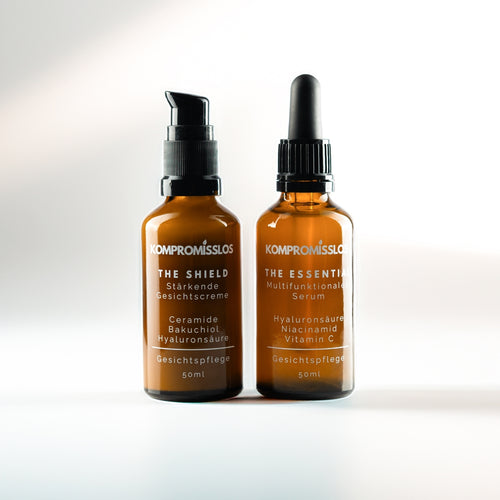
For permanently dry skin, combining panthenol with ceramides for the barrier makes more sense than panthenol alone, because the two work at different points. That is exactly how the Kompromisslos serum and cream are designed.
How much panthenol does a product need to make a difference?
Concentrations in the low single-digit percentage range make sense, because that is where panthenol has been studied. A review in the Journal of Dermatological Treatment summarises studies in which emulsions with 2.5 and 5 per cent dexpanthenol improved the moisture content of the outer layer of skin and barrier function compared with the control, with stronger effects at 5 per cent. No minimum dose that applies to every product can be derived from this, but it does give a useful guide. If panthenol sits right at the end of a long INCI list behind fragrances and preservatives, it is usually well below one per cent and more of a skincare extra than a main active ingredient. If it is in the first third of the list, it helps carry the formulation. Don’t rely on the packaging design: a cream that makes a big deal of vitamin B5 doesn’t necessarily contain more of it than one that simply lists it in the list of active ingredients.
How often should you use panthenol?
Panthenol can be used every day, morning and evening, and that is how it delivers its benefits most reliably. Unlike acids or retinoids, there is no adjustment phase, no build-up dose and no reason for rest days. The ingredient is water-soluble, is not stored and works through a continuous supply. If your skin is stressed at the moment, you can cut back everything else during this phase and stick to cleansing, moisture and panthenol until it has calmed down. That is often more effective than adding another product. One point is often overlooked: panthenol works best on slightly damp skin, because it binds water, and that water has to be there. If you apply it to completely dry skin in a very dry room, you lose part of the effect. This is what the order looks like in everyday life, described in more detail in the how-to-use guide.
- Cleanse gently morning and evening and just pat your skin lightly dry.
- Apply 3 to 6 drops of serum to skin that is still slightly damp.
- Spread 3 to 6 pumps of cream on top to seal in the moisture.
- Wait about two minutes before applying sun protection or make-up in the morning.
What happens if you don’t tolerate panthenol?
Reactions to panthenol are rare but do happen, and they usually show up as burning, itching or small patches of redness shortly after application. The expert panel of the Cosmetic Ingredient Review has assessed panthenol and related compounds as safe at the concentrations normally used in cosmetics, which does not rule out an individual reaction. If you suspect panthenol is the problem, only a systematic approach will help: leave out all products except a cleanser and a simple cream, let your skin settle for two weeks, then reintroduce products one at a time. An additional test on the inside of your forearm over three days narrows down the cause further. Very often it turns out that it was not panthenol but fragrances or overly aggressive cleansing that triggered the reaction. If you generally react quickly, read what matters with sensitive skin before you condemn a single ingredient.
When to see a professional: Skincare cares for the skin; it does not treat skin diseases. If redness, itching or flaking lasts longer than two to three weeks, spreads, weeps or hurts, it should be checked by a dermatologist. A serum is then not the wrong choice as such, but simply the wrong tool.
I deliberately included panthenol in The Duo as a foundation, not as a headline ingredient. The reason is simple: active ingredients such as niacinamide or bakuchiol need skin that tolerates them. When the barrier is compromised, it reacts to everything, and then every formulation becomes a risk. Panthenol is one of the building blocks that create this foundation without demanding attention itself. That is why I don’t write it in big letters on the bottle. Something I come across again and again in customer enquiries: people are looking for a calming product on top of five others. Most of the time, it would make more sense to leave out four of them.
Frequently asked questions
Is panthenol the same as dexpanthenol?
Dexpanthenol is the dextrorotatory form of panthenol and the version most commonly used in studies. Packaging often just says panthenol, which can mean the pure D-form or a mixture. For everyday skincare, the difference is small; in the scientific literature, dexpanthenol is the more precise term.
Can I use panthenol on sensitive skin?
Yes, panthenol is usually well tolerated by sensitive skin, because it neither exfoliates nor shifts the pH significantly. If your skin is very reactive, still test a new product for three days on a small area along your jawline before applying it more widely.
Is one per cent panthenol in a cream enough?
One per cent can make a noticeable difference as a skincare extra, but it is below the 2.5 and 5 per cent tested in the available studies. As the only measure for very stressed skin, that is not much. As part of a formulation with other barrier-friendly ingredients, it makes sense.
Can panthenol be combined with vitamin C or niacinamide?
Yes, panthenol is considered one of the least problematic partners and gets on with niacinamide, vitamin C, hyaluronic acid, ceramides, squalane and bakuchiol. It doesn’t compete for any receptor and doesn’t shift the pH. You can see which other pairings work in the overview on combining skincare ingredients.
Is panthenol vegan?
Panthenol used in cosmetics is produced synthetically and is therefore independent of animal-derived raw materials. What matters is still the whole formula, because a product with vegan panthenol may contain beeswax or lanolin elsewhere. At Kompromisslos, both products are formulated to be vegan throughout.
Does panthenol make skin greasy or clog pores?
No, panthenol is water-soluble, leaves no greasy film and is considered non-comedogenic. A heavy film on the skin almost always comes from the oils, waxes or emulsifiers in the base. For blemish-prone skin, it is therefore worth looking at the texture rather than at this ingredient.
How quickly can you tell whether panthenol is helping?
Most people notice smoother skin and less tightness within a few days, because this part is based on binding water. Support for the barrier takes longer, because the outer layer of skin renews itself in about four weeks. So judge a product after four weeks of consistent use, not after three days.
Sources
- Proksch E, Nissen HP. Dexpanthenol enhances skin barrier repair and reduces inflammation after sodium lauryl sulphate-induced irritation. Journal of Dermatological Treatment, 2002. Source
- Proksch E, de Bony R, Trapp S, Boudon S. Topical use of dexpanthenol: a 70th anniversary article. Journal of Dermatological Treatment, 2017. Source
- Scott LN et al. Safety Assessment of Panthenol, Pantothenic Acid, and Derivatives as Used in Cosmetics. International Journal of Toxicology, 2022. Source