Allantoin benefits for skin: what the classic soothing ingredient in your cream does
ACTIVE INGREDIENTS
On the skin, allantoin acts as a mild conditioning and protective ingredient: it is meant to smooth rough patches, make skin feel more supple and visibly calm irritation. According to a US safety report, cosmetics use it at concentrations of up to 2 per cent, and it is considered well tolerated. Its strength is this gentleness, not a spectacular effect. Good studies on the pure substance are scarce. As a supporting ingredient in a well-designed cream, allantoin makes sense; as a reason to buy an extra product, it rarely does.
What is allantoin and where does it come from in cosmetics?
Allantoin is a small, water-soluble nitrogen compound that is almost always made synthetically for cosmetics, even though it was first known from plants. Chemically, it belongs to the pathway by which uric acid is broken down: many mammals produce it as part of their metabolism, whereas humans hardly do, because they lack the enzyme required. Allantoin owes its reputation as a skincare ingredient to comfrey (Symphytum officinale), a traditional medicinal plant whose root is rich in it. A review in the journal Molecules on the borage family, to which comfrey belongs, names allantoin as a typical constituent of these plants. However, it also points out that comfrey species in particular contain toxic pyrrolizidine alkaloids, whose use should be avoided.
That is why the allantoin in creams is, as a rule, not extracted from the root but synthesised from simple starting materials, which keeps the alkaloids out. The result is a pure, odourless substance without any accompanying plant compounds, and it is easy to work into water-based creams and gels. Either way, the ingredient list simply says “Allantoin”. So if a pack shows a picture of comfrey, that tells you little about where the substance in the tube actually comes from.
What are the benefits of allantoin for skin?
Allantoin acts on the skin mainly as a mild protective and conditioning ingredient that makes rough, flaky patches look smoother and the skin as a whole feel more supple. Product descriptions usually mention three functions: allantoin is said to soften the outermost layer of the skin and gently loosen dry flakes, to make dry skin feel more comfortable, and to calm irritated skin. The US safety assessment by the Cosmetic Ingredient Review takes a more sober view and classifies allantoin as a skin-conditioning agent, meaning an ingredient that improves the condition of the skin’s surface. In the USA, the Food and Drug Administration (FDA) also lists allantoin in its monograph for over-the-counter skin protectants, at a permitted concentration of 0.5 to 2 per cent.
What allantoin is not: a fat or a lipid. It does not leave a film on the skin, and it does not replace ceramides, squalane or oils. If your skin feels tight, flakes and reacts to almost everything, the cause usually lies deeper. In that case, it is worth first finding out how to recognise a damaged skin barrier rather than hunting for a single soothing ingredient. Allantoin can make your skin feel more comfortable during a phase like this, but the real work is done by mild cleansing, fewer irritants and a cream with enough lipids.
What do studies show about allantoin, and where is the evidence thin?
The evidence on allantoin is surprisingly thin: what is well established is above all its good tolerability, while robust clinical data on the effect of the pure substance are rare. Many studies on wound healing come from animal experiments, cell cultures or new wound dressings in which allantoin is just one ingredient among several. One large controlled trial makes for sobering reading. In the ESSENCE study, published in the Orphanet Journal of Rare Diseases, 169 patients with epidermolysis bullosa, a severe inherited blistering disease, received either a cream with 6% allantoin or the same base without allantoin for three months. There was no statistically significant difference in the time until the target wound had fully closed, nor in the proportion of wounds that closed. The cream was well tolerated, but it was no more effective than the base alone.
A second study, in Phytotherapy Research, compared pure allantoin with an aqueous comfrey root extract adjusted to the same allantoin content. On artificially irritated skin in healthy volunteers, the preparations containing the extract showed the greater potential to relieve irritation, and creams performed better than gels with the same ingredients for hydration and redness. The authors conclude that the effect of the comfrey extract cannot be attributed to allantoin alone. For you, this means two things: the reputation of comfrey ointment does not carry over one-to-one to a product with synthetic allantoin, and the base of a cream often matters as much as any single active ingredient.
Allantoin is also found in wound and scar products. These are generally classed as medicines or medical devices and have little in common with a face cream. Open wounds, weeping patches, eczema or atopic dermatitis should be seen by a doctor or a pharmacist; they do not belong in your skincare routine.
What concentration of allantoin do creams contain, and can you tell from the INCI list?
Creams usually contain allantoin in low concentrations: the safety report in the International Journal of Toxicology lists 1,376 cosmetic products containing allantoin at concentrations of up to 2 per cent. Higher amounts are rare, partly because allantoin dissolves only to a limited extent in water. You cannot tell the exact amount from the INCI list, because percentages are not required on cosmetics. Its position does give you a clue: ingredients are listed in descending order of quantity, and only for very small amounts is the order no longer binding. If allantoin appears near the end, between preservatives and thickeners, the amount is small. With allantoin, that is not a shortcoming but the usual dose. How to interpret the list as a whole is explained in the article on how to read an ingredient list.
Allantoin complexes occasionally appear in ingredient lists as well, such as Allantoin Panthenol or Allantoin Ascorbate. According to the Cosmetic Ingredient Review report, there are gaps in the data on how and at what concentration these complexes are used, but the safety data were sufficient for the uses assessed.
| Where allantoin is used | Concentration | What the figure means |
|---|---|---|
| Face creams and body care | up to 2% (according to the safety report) | Usual conditioning dose, mostly near the end of the INCI list |
| Over-the-counter skin protectants in the USA | 0.5 to 2% | Range set by the FDA for this product group |
| Study cream for epidermolysis bullosa | 6% | Medical trial, no more effective than the base |
| Ointments with comfrey extract | depends on the extract | Allantoin is only one of many plant compounds |
Allantoin or panthenol: how do the two soothing ingredients differ?
Allantoin and panthenol are not competitors but two soothing ingredients with a different focus: allantoin is regarded mainly as a smoothing, protective ingredient for rough patches, panthenol mainly as a humectant. Panthenol is the precursor of vitamin B5 and binds water in the skin. It has been studied more thoroughly than allantoin on irritated, dry skin, and the details are in the guide to panthenol for skin and when it really helps. In practice, the two often appear together, sometimes even as a ready-made complex. That makes sense, because they do not get in each other’s way.
If you have to choose, the question is not which ingredient is stronger but what your skin needs right now. If it mainly feels dry and tight, a humectant such as panthenol is the more obvious building block. If the issue is rather rough, flaky patches on the cheeks or around the nostrils, allantoin is a good fit. If you are looking for a plant-based soothing ingredient, you will often come across Centella asiatica (cica), which is a different kind of ingredient altogether. None of these ingredients automatically makes a cream good. What matters is that the rest of the formula does without unnecessary irritants.
Which skin types benefit from allantoin, and when is it just an extra?
Allantoin is worthwhile above all for dry, rough or temporarily stressed skin that benefits from a mild conditioning ingredient with little potential to irritate. When it comes to caring for sensitive skin, it is a welcome building block, because it rarely causes problems of its own. You will rarely need a separate product just for the allantoin, though. It is a supporting ingredient that can make a good cream a little more pleasant, but it does not make up for missing lipids, overly harsh cleansing or an overloaded routine.
- Useful for rough, flaky patches after cold, wind or dry air from central heating.
- Useful as a companion if you use acids or retinoids and your skin needs a little more comfort.
- Pleasant for sensitive skin that does best with a few well-tolerated ingredients.
- Just an extra if a product makes a big deal of allantoin but lists it right at the end of the INCI list.
- No substitute for getting wounds, eczema, atopic dermatitis or persistent itching checked by a professional.
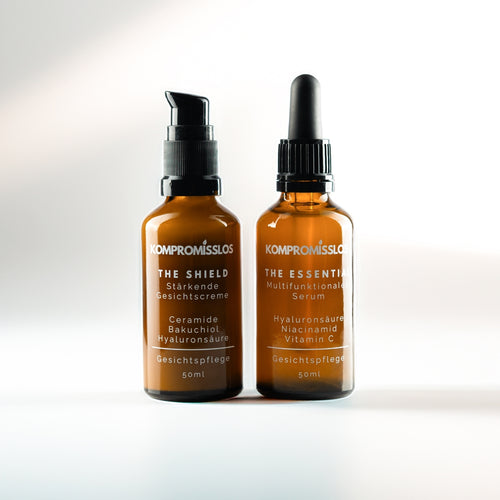
For a calmer-looking complexion, the formula as a whole counts for more than any single name on the pack. The Duo of serum and cream contains no allantoin. There, the soothing, barrier-supporting role is taken on by panthenol, by aloe vera juice as the base, which comes first in the INCI list, and, in The Shield cream, by ceramide NP and squalane – all without fragrance. This supports the skin barrier and helps the skin look calmer, without the need for yet another soothing ingredient.
Allantoin is not in our INCI list, and that is a deliberate limitation. I wanted two products instead of eight, and no ingredient that is only there to look good on the label. For the soothing role, we rely on panthenol, on aloe vera juice as the base of both products and, in the cream, on ceramide NP and squalane, all without fragrance. Allantoin is a solid ingredient, but the evidence does not suggest that a routine is missing anything without it, as long as these building blocks are right. If you specifically want allantoin, you do not need a third product for it as long as your skin is calm. And with wounds or eczema, the question belongs with a professional anyway, not with me. You can see exactly what is inside in our full A–Z ingredient list.
Frequently asked questions
Is allantoin harmful or irritating to the skin?
No, allantoin is considered very well tolerated. The expert panel of the Cosmetic Ingredient Review regards it as safe at the usual concentrations of up to 2 per cent. As with any ingredient, an allergic reaction cannot be ruled out, but it is not typical. If your skin reacts to an allantoin cream, other ingredients such as fragrance may just as well be the cause. So test new products on a small area first.
Is allantoin vegan?
The allantoin in cosmetics is, as a rule, made synthetically and therefore not of animal origin. The exception is products with snail mucin: it contains allantoin naturally but is not vegan. Whether a cream as a whole is vegan depends on all of its ingredients anyway. So rely on a clear vegan label from the manufacturer rather than on a single ingredient.
Is allantoin the same as urea?
No. Allantoin is chemically related to urea and contains urea building blocks in its structure, but it is a separate substance with a different role in skincare and no substitute for urea. What urea can do as a humectant and which amounts make sense on the face is explained in the article on using urea on your face.
Does allantoin help with spots or scars?
Allantoin is not a remedy for spots, nor is it a proven scar ingredient. Scar gels usually combine it with other ingredients, so any effect cannot be attributed to allantoin alone. In a skincare cream, it can make the skin around blemishes feel more comfortable. For inflamed acne or noticeable scars, a dermatologist is the right person to see.
Can I combine allantoin with retinol or acids?
Yes, allantoin can be combined with retinol, AHAs or BHAs; there are no known interactions that would argue against it. It can make your routine a little more comfortable, but it does not remove the cause of irritation. If your skin stings or flakes, using the acid or retinol less often will help more than adding a soothing ingredient on top.
Does allantoin clog pores?
There is no evidence that allantoin clogs pores. It is water-soluble, not an oil or a wax, and it is used in very small amounts. Whether a cream causes problems for blemish-prone skin depends far more on its base – the oils, waxes and emulsifiers – than on the allantoin it contains.
Do I need an allantoin cream if I use The Duo?
No, as long as your skin is calm. The Duo contains no allantoin, but the soothing role is taken on by panthenol, aloe vera juice as the base, and ceramide NP and squalane in the cream, all fragrance-free. An additional allantoin cream would only make your routine longer. With wounds, eczema or persistent irritation, what you need is a professional, not another product alongside the Duo of serum and cream.
Sources
- Becker LC, Bergfeld WF, Belsito DV, Klaassen CD, Marks JG Jr, Shank RC et al. Final report of the safety assessment of allantoin and its related complexes. International Journal of Toxicology, 2010. Source
- U.S. Food and Drug Administration. 21 CFR § 347.10 Skin protectant active ingredients. Code of Federal Regulations. Source
- Paller AS, Browning J, Nikolic M, Bodemer C, Murrell DF, Lenon W et al. Efficacy and tolerability of the investigational topical cream SD-101 (6% allantoin) in patients with epidermolysis bullosa: a phase 3, randomized, double-blind, vehicle-controlled trial (ESSENCE study). Orphanet Journal of Rare Diseases, 2020. Source
- Savić VLj, Nikolić VD, Arsić IA, Stanojević LP, Najman SJ, Stojanović S et al. Comparative Study of the Biological Activity of Allantoin and Aqueous Extract of the Comfrey Root. Phytotherapy Research, 2015. Source
- Chrzanowska E, Denisow B, Ekiert H, Pietrzyk Ł. Metabolites Obtained from Boraginaceae Plants as Potential Cosmetic Ingredients – A Review. Molecules, 2024. Source