Centella asiatica (cica): benefits for irritated skin and when panthenol is enough
ACTIVE INGREDIENTS
The main benefits of centella asiatica for skin are hydration and calming. The plant, also known as tiger grass or cica, supplies triterpenes such as asiaticoside and madecassoside. In small studies, creams containing centella extract improved skin hydration, and in one of them, water loss and artificially induced redness also went down. It is a solid supporting ingredient for irritated, dry skin, but no more effective than proven barrier ingredients. If your skincare already contains panthenol and ceramides, you usually do not need cica on top.
What does centella asiatica do for your skin?
In skincare, centella asiatica mainly helps the skin hold on to moisture and can visibly calm irritated skin. According to a review in Postępy Dermatologii i Alergologii, this is largely down to four pentacyclic triterpenes: asiaticoside, madecassoside, asiatic acid and madecassic acid. The extract also contains flavonoids and phenolic acids, which are regarded as antioxidants. The plant itself is a small, creeping herb that grows in damp parts of the tropics and subtropics, especially in Asia. It has been used in folk medicine for centuries and is widely known in English as gotu kola.
One important caveat: much of the research on centella comes from medicine – on wounds, burns and scar tissue, for example – and often uses isolated compounds in pharmaceutical preparations. None of that tells you what a face cream with a small, usually undisclosed amount of extract can achieve. What realistically remains for skincare is this: more moisture in the outermost layer of the skin, less water escaping from it and calmer skin after minor irritation. That is useful, but it is the same job that other well-researched skincare ingredients already do.
What is cica and what is a cica cream used for?
Cica is a marketing term that in cosmetics usually stands for centella asiatica, and cica creams are mainly used on dry, tight or stressed skin. Typical situations are skin that has been over-exfoliated, skin after sunburn or skin during the heating season, when everything feels tight. The problem with the term is that it is not protected. Not every product with ‘cica’ on the packaging contains a meaningful amount of centella. Some creams rely mainly on panthenol, zinc or ceramides and use the name as shorthand for ‘soothing’. Only the ingredient list tells you whether there is any centella in it and how much. This is what to look for in the INCI list:
- Centella Asiatica Extract or Centella Asiatica Leaf Extract: the whole-plant extract.
- Madecassoside or Asiaticoside: individual triterpenes isolated from the plant.
- Asiatic Acid or Madecassic Acid: the two acids from the same group of compounds.
- Its position in the list: if centella appears far down, after the preservatives and fragrance, the amount is usually very small.
- Parfum and essential oils: they are also found in some cica products and are a poor match for irritated skin.
What do studies show about centella for irritated skin?
Studies on centella show measurable effects on hydration and the skin barrier, but they are small, were carried out on arms and hands rather than the face, and hardly any involved genuinely irritated skin. In a study in the Indian Journal of Pharmaceutical Sciences, 25 volunteers applied creams and gels containing 2.5% or 5% centella extract to their forearms twice a day for four weeks. The 5% formulations performed best: the skin surface was better hydrated, transepidermal water loss fell, and in a test model in which mild redness is deliberately induced, the redness was dampened.
A double-blind study in the Journal of Basic and Clinical Physiology and Pharmacology looked at 30 batik workers whose dry skin is exposed to irritating dyes at work. It compared a centella cream with a ceramide cream, applied to the hands and arms. After four weeks, both had improved skin hydration, and there was no significant difference between centella and ceramide. That is the most honest finding on the subject: centella has a measurable effect, but it is no better than proven barrier ingredients. What is still missing are larger studies on the face and in people with genuinely sensitive skin.
Cica or panthenol: which is more soothing?
There is no general answer to whether cica or panthenol is more soothing, because there are no studies comparing the two directly. Both support the barrier and bind moisture; they simply come at it from different directions. Panthenol is a single, clearly defined substance that the skin converts into pantothenic acid (vitamin B5), and it has been used in skincare and medicine for decades. Centella is a plant extract whose composition varies depending on where the plant comes from and how it is processed. In practice, this means that if your skincare already contains panthenol and ceramides, an extra cica product rarely makes a noticeable difference.
| Criterion | Centella asiatica (cica) | Panthenol |
|---|---|---|
| Type of ingredient | Plant extract with several triterpenes | Single, defined substance (provitamin B5) |
| Main job in skincare | Retaining moisture, calming irritated skin | Binding moisture, supporting the barrier |
| Variation between products | Large; extract quality is usually not stated | Small; same substance, only the concentration varies |
| Makes sense if | You tolerate a particular product well and enjoy using it | Your skin feels tight and loses moisture after irritation |
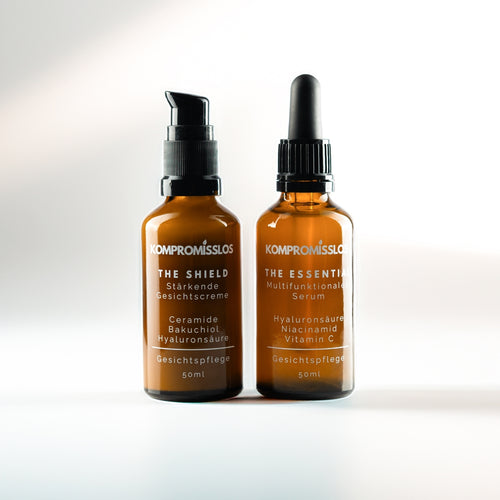
There is no centella in The Duo of serum and cream; instead, it contains panthenol and ceramide NP, which is exactly the barrier side of this comparison. If you are already layering several soothing trend ingredients such as cica or ectoin, you can often cut back rather than add more. In her review on Judge.me, Barbara F. writes about switching from a Korean 7-step routine: ‘Two products, clear ingredients, no frills’ (review translated from German).
Which skin types benefit from centella asiatica?
Centella asiatica makes most sense for dry, tight and temporarily irritated skin – in other words, for a barrier that needs extra support at the moment. That includes skin that has had too many acids or retinoids, skin in winter and skin that regularly feels tight after cleansing. Sensitive skin can benefit too, as long as the product as a whole is gently formulated, without fragrance and without a long list of extracts. If you tend towards combination skin, you will often find centella in light gels and serums that do not weigh the skin down. What matters is less the name on the packaging than the formula as a whole. So whether a serum for sensitive skin is one your skin will tolerate depends more on its base, the number of active ingredients and fragrance than on any single trendy ingredient.
Centella makes less sense as an answer to a medical problem. Recurring redness with pustules, weeping or very itchy patches and eczema should be seen by a dermatologist. A cica cream can at most play a supporting role there; it cannot replace a proper diagnosis.
Can centella asiatica irritate your skin?
Yes, centella asiatica can itself irritate the skin, although this is rare. Over the past few decades, the journal Contact Dermatitis has published several case reports of allergic contact dermatitis caused by centella extract, including one from 2010 with the plain title ‘Contact dermatitis due to Centella asiatica’. This is not unusual for plant extracts: they contain many different substances, and any one of them can trigger an allergy in some people. On top of that, some cica products also contain fragrances or essential oils, which are themselves among the well-known triggers of contact allergies. If a supposedly soothing cream stings, itches or causes small blisters, it is not soothing for your skin, whatever the packaging says.
Try a new cica cream on a small patch of skin for a few days first, for example on the side of your neck. If your skin stays calm, you can use it on your face. If it reacts, stop using the product and take a close look at the ingredient list.
I will say it openly, because cica is on so many shelves right now: The Duo does not contain centella asiatica. You can check this in our full list of ingredients. For the barrier, the Duo contains panthenol and ceramide NP, with aloe vera as the base of both products. Among the plant extracts, you will find edelweiss extract and gentian root from Switzerland, for example. My principle is that two products should be enough, not eight. If you like a cica cream and your skin tolerates it well, there is no need to throw it away. But you do not need it as a third step on top, and I would never make a routine longer just to follow a trend.
Frequently asked questions
Is tiger grass the same as centella asiatica?
Yes, tiger grass is one of several common names for centella asiatica. Other names include Asiatic pennywort, gotu kola and, in cosmetics, the short form cica. They all refer to the same plant. On ingredient lists it always appears under its Latin name, for example as Centella Asiatica Extract, or as an individual ingredient such as Madecassoside.
Does cica help with redness?
Cica can slightly reduce temporary redness caused by irritation – at least, that is what one small study with artificially induced redness suggests. With persistent redness, the cause is rarely a missing ingredient and more often a trigger you should cut out. What skincare can do cosmetically for facial redness, and when it needs to be checked by a doctor, is a topic in its own right.
Can I combine cica with retinol?
Yes, cica and retinol can be combined; there is no known incompatibility between the two. Whether centella actually softens the typical irritation caused by retinol, however, has barely been studied. More important than an extra product is introducing retinol slowly, on just a few evenings a week at first, and keeping the rest of your skincare gentle in between.
Is cica suitable for mature skin?
Yes, cica is suitable for mature skin, especially if it is dry or quick to react. However, there is hardly any good data on visible effects on wrinkles from cosmetic cica creams. If your skin has become more sensitive over the years, a plan for sensitive mature skin will help you more than yet another soothing extract.
Does centella help with acne marks?
There is no good data on cosmetic cica creams for acne marks. The research on scar tissue comes from medicine and cannot be transferred to a face cream. Flat red or brown marks usually fade with time and consistent sun protection. Indented scars belong in the hands of a dermatologist; no cream will help with those.
Is cica a K-beauty invention?
No, cica is not a K-beauty invention. Centella asiatica has been used in Asian folk medicine for centuries and was in skincare products long before the trend. It was, however, mainly Korean cosmetics that started the trend around the short name cica. How much of Korean skincare as a whole is worth keeping is a separate question.
Do I need cica if I use The Duo?
No, as a rule you do not. The Duo contains no centella, but it does contain panthenol and ceramide NP, which do the same job for dry, tight skin: retaining moisture and supporting the barrier. If your skin tolerates a cica cream well, you can add it during a phase of irritation, but you do not need it as a permanent step alongside the Duo of serum and cream.
Sources
- Bylka W, Znajdek-Awiżeń P, Studzińska-Sroka E, Brzezińska M. Centella asiatica in cosmetology. Postępy Dermatologii i Alergologii, 2013. Source
- Ratz-Łyko A, Arct J, Pytkowska K. Moisturizing and antiinflammatory properties of cosmetic formulations containing Centella asiatica extract. Indian Journal of Pharmaceutical Sciences, 2016. Source
- Anggraeni S, Umborowati MA, Damayanti D, Endaryanto A, Prakoeswa CRS. Role of Centella asiatica and ceramide in skin barrier improvement: a double blind clinical trial of Indonesian batik workers. Journal of Basic and Clinical Physiology and Pharmacology, 2021. Source
- Gomes J, Pereira T, Vilarinho C, Duarte Mda L, Brito C. Contact dermatitis due to Centella asiatica. Contact Dermatitis, 2010. Source