Sensitive mature skin: anti-ageing care without redness or stinging

Gentle on mature skin
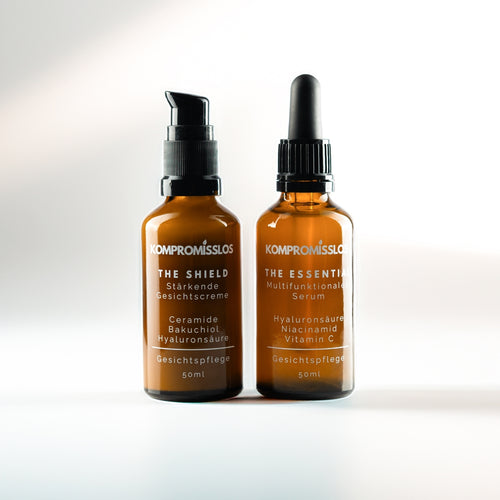
The Duo – serum & face cream
★★★★★ 4.9/5 · 120+ reviews
Fragrance-free and dermatologically tested: a cream with bakuchiol instead of retinol and with ceramides, plus a light serum.
CHF 109.90 119.80 · free shipping in Switzerland · 100-day trial
Why does skin become more sensitive with age?
Skin does not become more sensitive with age for everyone, but its barrier is more easily disrupted and slower to repair – and that is exactly what makes it more reactive. A study in the Journal of Clinical Investigation compared the skin barrier of 20- to 30-year-olds with that of people over 80. In the older group, the barrier was already disrupted after 18 tape strips instead of 31, and after 24 hours it had recovered by only 15 per cent, compared with 50 per cent in the younger group. The researchers put this down to a shortage of all the key lipids in the stratum corneum, the skin’s outermost layer. At 45, you do not have the skin of an 80-year-old, but the direction is the same: whatever damages the barrier has a longer-lasting effect.
For women, the menopause adds another factor. A review in the Journal of the American Academy of Dermatology describes how falling oestrogen levels go hand in hand with dryness, thinner skin, fine lines and lower skin moisture. It also helps to be clear about what sensitive skin actually is. In Acta Dermato-Venereologica, an expert group from the International Forum for the Study of Itch defines it as burning, stinging, itching or tingling in response to stimuli that should not normally cause such sensations. The skin may look normal or red, and the symptoms cannot be explained by a skin disease. The basics of sensitive skin: causes, care and what to leave out apply to mature skin too. What changes from 40 onwards is mainly that the margin for error gets smaller.
Which anti-ageing ingredients can sensitive mature skin tolerate?
Sensitive mature skin tolerates above all those ingredients that support the barrier rather than challenge it: ceramides, niacinamide in moderate doses, humectants, squalane and bakuchiol. Retinoids, high-strength acids and pure ascorbic acid are trickier, because they often cause tingling, flaking or redness, especially at the start. That does not mean you have to do without them. It means using them deliberately and one at a time, rather than treating them as a standard part of every routine.
Whether retinol could still work for you is covered in the comparison bakuchiol or retinol for sensitive skin. What niacinamide can do, and when it becomes too much, is explained in niacinamide benefits: what it can do and what it can’t.
Which ingredients should you avoid with sensitive mature skin?
With sensitive mature skin, it is best to avoid anything that can irritate without doing a job for your skin – above all, fragrance. Fragrance serves no skincare purpose, yet it is a common trigger of contact allergies. A review in the journal Dermatitis estimates that up to 4.5 per cent of adults are allergic to fragrance ingredients. Among the most frequent culprits it names linalool and limonene once they have oxidised in the air – both components of many essential oils. Natural fragrance is therefore not automatically gentler than synthetic perfume. The second group is anything that puts extra strain on the barrier at a time when it is already slower to recover. The third group is not an ingredient but a combination: several strong actives at once can overwhelm even skin that would tolerate each of them on its own.
- Perfume, fragrance and essential oils, even natural ones.
- Alcohol denat. or ethanol near the top of the ingredient list. Fatty alcohols such as cetearyl alcohol are a different thing and actually condition the skin.
- Daily acid toners or high-strength peels, especially on top of retinol.
- Grainy scrubs and cleansing brushes that mechanically wear down the outer layer of the skin.
- Harsh, stripping cleansers and hot water.
Not every tingle after you apply a product means you have to stop using it straight away. How to tell a harmless tingle from a genuine reaction is explained in the article on face cream stinging.
How do you build an anti-ageing routine without stinging, and how do you introduce new products?
An anti-ageing routine without stinging starts with a stable foundation – a mild cleanser, a serum, a cream and sunscreen during the day – and only then do you add anything new, one product at a time. If your skin currently feels tight, flakes and stings at almost everything, check for the signs of a damaged skin barrier first, and let the anti-ageing actives wait. Once your skin is calm, stick with the basics for two to three weeks so you know how it behaves without any experiments. Then introduce a single new product and give it at least two weeks before you add the next one. If you change several products at once and your skin starts to sting, you will not know which one caused it. How to try out a new product on a small area first is explained in the guide on how to patch test skincare.
Fewer products mean fewer possible triggers. That is exactly why The Duo is built on just two steps: a serum with niacinamide, vitamin C as 3-O-Ethyl Ascorbic Acid and zinc PCA, and a cream with ceramides, squalane and bakuchiol instead of retinol, both fragrance-free and dermatologically tested. That is not a promise that every sensitive skin will tolerate the products – it simply means fewer products your skin can react to. One customer, Carmen, writes in her review on Judge.me: “My skin tolerates the serum very well, even though I’m very sensitive” (review translated from German). That is one person’s experience, not proof of how your skin will respond. What the rest of the routine looks like is shown in skincare for mature skin: the routine you actually need.
When are stinging and redness more than just sensitive skin?
Stinging and redness are more than just sensitive skin if the redness persists even after you have stopped all new products, or if visible changes such as bumps, scaling or blisters appear. In that case, see a dermatologist. According to the expert group’s definition, sensitive skin is characterised precisely by the fact that its symptoms cannot be explained by a skin disease. If you notice anything beyond stinging and fleeting redness, there may be an underlying condition, and it should be checked. Skincare can then play a supporting role, but it cannot replace a diagnosis.
- The redness lasts for weeks, even after two to three weeks without any new products.
- Visible small blood vessels, bumps or pustules in the centre of the face, often with episodes of flushing.
- Swelling, blisters or intense itching after using a product – possibly an allergic reaction.
- Scaly, weeping or sharply defined patches.
- Stinging with no trigger at all, even when you are not using any skincare.
The second pattern in particular is a reason to get checked for rosacea. What cosmetics can still do in that case is covered in rosacea skincare: what cosmetics can do.
Try it yourself
The Duo – serum & face cream
★★★★★ 4.9/5 · 120+ reviews
Serum with niacinamide, hyaluronic acid and vitamin C, cream with ceramides and bakuchiol. Not happy? A short message is all it takes.
CHF 109.90 119.80 · free shipping in Switzerland · 100-day trial