3-O-Ethyl Ascorbic Acid: the stable form of vitamin C and when it’s worth it
SINGLE INGREDIENT
3-O-Ethyl Ascorbic Acid is a vitamin C derivative in which an ethyl group protects the most vulnerable part of the vitamin C molecule. As a result, it oxidises much more slowly than pure L-ascorbic acid and can be formulated at a skin-friendly pH. In the skin, it is converted into ascorbic acid, where it acts as an antioxidant.
What exactly is 3-O-Ethyl Ascorbic Acid?
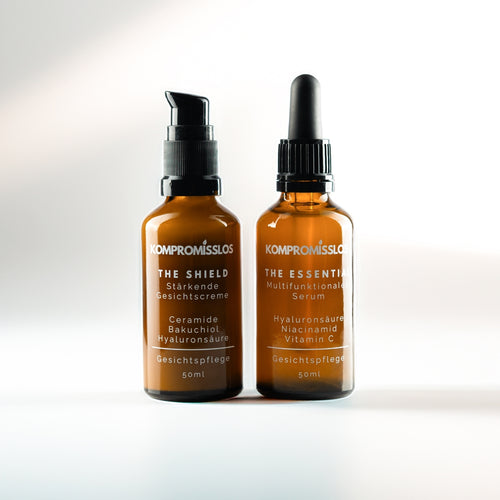
3-O-Ethyl Ascorbic Acid is pure vitamin C with a chemical protective cap. An ethyl group sits at the third position of the ascorbic acid molecule – exactly where oxidation would otherwise begin in untreated vitamin C. In German-language texts, you will find it as 3-O-Ethyl-Ascorbinsäure; on the packaging, the INCI name is 3-O-Ethyl Ascorbic Acid, occasionally abbreviated to EAA or ETVC. It is important to understand that this is not a substitute with a similar effect, but the same vitamin in packaging that travels better. The ethyl group is split off in the skin, after which ordinary ascorbic acid remains. That is why this detour is not seen as a compromise, but as the solution to a formulation problem that has occupied the cosmetics industry for decades. You can read which active ingredients we use and why in the overview of our ingredients; the Duo of serum and cream contains 2% of it.
Why is 3-O-ethyl ascorbic acid more stable than pure vitamin C?
The reason lies in the charge of the molecule. At normal pH, pure L-ascorbic acid readily gives up a proton, becomes charged and then oxidises quickly, which is why serums with L-ascorbic acid have to be formulated to be very acidic, usually below pH 3.5. That acidity is the most common reason for stinging and redness in sensitive skin. For the ethylated form, according to a study in the International Journal of Pharmaceutics: X, the pKa is 7.72 – well above the skin’s pH. At a pH close to that of the skin, around 5.5, the ingredient stays uncharged, which makes it both more stable and easier to transport through the upper layers of the skin. In practice, this means the formula does not have to be acidic for the ingredient to work, and your serum will not turn brownish within a few weeks. Incidentally, brownish discolouration is the most reliable sign that a vitamin C product is past its best.
What does 3-O-ethyl ascorbic acid do for your skin?
Once converted into ascorbic acid, it acts as an antioxidant and supports the skin against the effects of UV radiation and environmental stressors. Vitamin C also intervenes in melanin formation by inhibiting the enzyme tyrosinase, which is why it is one of the most widely used active ingredients for a more even complexion. This is most visible on darker marks left behind after blemishes have healed, and on a generally dull complexion. Vitamin C is not a lightener in the sense of bleaching; rather, it slows the formation of new pigment. To put it honestly, this does not happen overnight. Expect eight to twelve weeks of consistent use before you see a difference in the mirror, and even then you are more likely to notice a more even overall look than individual spots disappearing. We explain how to deal with darker marks after spots have cleared in our article on blemish-prone skin.
L-ascorbic acid or 3-O-ethyl ascorbic acid: which suits you?
If your skin tolerates acidity well and you want the strongest body of research, L-ascorbic acid is the better-evidenced choice. It is the best-studied form and needs no conversion step in the skin. The price for this is the low pH, limited shelf life after opening and the familiar darkening of the formula. With sensitive skin, when combining with other active ingredients, and for products that need to last several months, the ethylated form comes into its own. To be fair, one point belongs here too: how completely the conversion in the skin takes place has not yet been fully established, and the clinical data are thinner than for L-ascorbic acid. People who have tried both forms usually end up deciding on the basis of tolerance rather than research. That is understandable, because even the most effective serum is no use to you if you stop using it after two weeks because it stings.
| Criterion | L-ascorbic acid | 3-O-ethyl ascorbic acid |
|---|---|---|
| pH of the formula | Usually needs to be below 3.5. | Effective even at a pH close to the skin’s. |
| Stability | Oxidises relatively quickly. | Oxidises much more slowly. |
| Tolerance | Can sting on sensitive skin. | Generally better tolerated. |
| Evidence | The best studied. | Fewer clinical studies available. |
What concentration makes sense, and what can you combine it with?
Typical concentrations of 3-O-Ethyl Ascorbic Acid in skincare products are between 1 and 5%; in the Duo of serum and cream, it is 2% in total. More is not automatically better, because above a certain amount it is mainly the likelihood of irritation that rises, not the effect. When it comes to combinations, the good news is that the ethylated form is less complicated than its reputation suggests. Vitamin E and vitamin C complement each other as antioxidants, niacinamide can be used alongside it without any problem, and there is no conflict with hyaluronic acid either. The old warning about vitamin C and niacinamide comes from laboratory conditions that have little to do with finished formulas. We have explained the background in our article on vitamin C or niacinamide. You can see how our active ingredients are spread across two products in the serum and cream of the Duo.
When 3-O-ethyl ascorbic acid is not the right choice
If your skin is currently irritated, raw or very flaky, it is better to postpone starting. An antioxidant is care for a functioning barrier, not a remedy for skin that is out of balance right now. In that case, calming and hydrating products come first, the active ingredient afterwards. Two to three weeks’ break costs you less than starting again after a strong reaction, and your skin will thank you with a better starting point. Restraint is also worthwhile if you are already using several active products at once, because otherwise, if your skin reacts, you will not know which product caused it. And if skin changes persist for weeks, change, weep or hurt, that belongs with a dermatologist, not in a skincare routine. You can find out when best to apply the serum and how much to use on our how-to-use page.
I deliberately decided against pure L-ascorbic acid, even though it is the better-known form. The reason was feedback I kept hearing: vitamin C stings. If a serum has to be set at pH 3 for the ingredient to survive, then I lose precisely the people I made the Duo for – women with sensitive skin who have already tried several products without success. With 2% 3-O-ethyl ascorbic acid, I get a formula at a pH close to the skin’s that still contains what it says on the packaging, even after months. In return, I accept that the research on this form is thinner – and I would rather tell you that openly than keep quiet about it.
Frequently asked questions
Is 3-O-Ethyl Ascorbic Acid real vitamin C?
Yes. It is ascorbic acid with an attached ethyl group that is split off again in the skin. After that, ordinary ascorbic acid remains. So the difference lies not in the active ingredient itself, but in how stable it stays until you apply it and how well it reaches the upper layers of the skin.
What percentage of 3-O-ethyl ascorbic acid makes sense?
In skincare products, 1 to 5% is usual. A higher concentration does not automatically give a better result, but it does increase the likelihood of irritation. What matters more than the figure is whether the formula states a percentage at all, because without it you cannot compare anything.
Does 3-O-ethyl ascorbic acid sting?
As a rule, no, because the formula does not have to be strongly acidic. That is precisely its practical advantage over pure L-ascorbic acid. If a product with this ingredient does sting, it is usually down to other ingredients or to a skin barrier that is currently compromised.
Can I combine 3-O-Ethyl Ascorbic Acid with niacinamide?
Yes. The widespread warning against this combination goes back to lab experiments with pure ascorbic acid under heat and cannot be applied to modern formulations. In finished products, the two ingredients regularly sit side by side, often even in the same formula. So you do not need to plan waiting times or split them between morning and evening.
Should you use it in the morning or evening?
Either works. In the morning, its antioxidant protection complements your sun protection; in the evening, the ingredient does no harm. Regularity matters more than the time of day. We recommend using it morning and evening, because a steady supply achieves more than a particularly well-chosen time.
Does vitamin C replace sun protection?
No. An antioxidant neutralises free radicals generated by UV radiation, but it does not block the radiation itself. Sun protection and vitamin C complement each other but do not replace each other. If you want to soften discolouration, you will not get far without consistent sun protection, because new UV exposure rebuilds exactly what the ingredient softens over weeks.
How long does it take to see results?
Expect eight to twelve weeks with regular use. A more even skin tone usually shows earlier than a visible change in individual dark spots. If you notice no difference at all after three months, it is more worthwhile to look at your sun protection and routine than at a higher concentration.
Sources
- Iliopoulos F. et al., 3-O-ethyl-l-ascorbic acid: Characterisation and investigation of single solvent systems for delivery to the skin, International Journal of Pharmaceutics: X, 2019. Source