Essential oils in skincare: why natural products can irritate sensitive skin
NATURAL SKINCARE
Essential oils in skincare are not harmful in principle, but they are one of the typical reasons why natural skincare can irritate sensitive skin. They mainly provide fragrance, consist of dozens of individual compounds and can oxidise into stronger allergens on contact with air. Some citrus oils also make the skin more sensitive to light. If your skin is quick to burn, redden or itch, skincare without essential oils is the calmer choice. Fatty plant oils such as jojoba oil are something else entirely and do not belong in this category.
Why does natural skincare so often contain essential oils?
Natural skincare so often contains essential oils because they are the obvious way to give a product a scent without using synthetic fragrances. Certified natural cosmetics rule out synthetic perfume oils, whereas natural fragrances from plants are permitted. For many buyers, a fresh or floral smell is part of what nature is supposed to feel like, and lavender, rose or orange meet that expectation instantly. Then there is marketing: an essential oil can be presented as a botanical active ingredient, even if its main job in the cream is to smell nice. Whether a natural product is fundamentally better or worse than a conventional one is a separate question, which we look at in natural vs conventional skincare. Here, the only concern is fragrance, which in natural skincare usually comes from essential oils.
We can see how strong the expectation of a scent is in our own reviews. In her review on Judge.me, Daniela B. writes about our fragrance-free skincare: ‘As far as the scent is concerned, I first had to get used to the lack of freshness’ (review translated from German). In other products, it is usually essential oils that provide exactly this freshness.
Are essential oils in skincare bad for your skin?
Essential oils in skincare are not bad for every skin type, but for sensitive skin they bring a risk without any skincare benefit. Four things matter: which oil, in what concentration, how old the product is and what state your skin barrier is in. Two different reactions are involved. Irritation shows up quickly as burning, stinging or redness and depends on the dose – less oil means less reaction. A contact allergy, by contrast, is a reaction of the immune system that often develops only after repeated contact, appears with a delay and usually stays for good. A review in the journal Dermatitis lists almost 80 essential oils that have already caused contact allergies and notes that most reactions are caused by pure oils or highly concentrated products. If your sensitive skin reacts quickly anyway, the barrier is often already weakened, and irritants penetrate more easily.
Many of the allergenic individual compounds appear on the packaging under their own names, such as Limonene or Linalool. How to read these names is explained in our article on fragrance-free moisturisers.
Which essential oils most often irritate sensitive skin?
In allergy tests, tea tree, orange, ylang-ylang, sandalwood, clove, laurel and citronella oil stand out most often. The Dermatitis review mentioned above analysed which oils produced positive skin tests in patients with suspected contact dermatitis. Nine oils exceeded 2 per cent positive reactions: laurel, turpentine, orange, tea tree, citronella, ylang-ylang, sandalwood, clove and costus root. These figures come from a group of people who were already affected, not from the general population, but they do show which oils keep coming up. Lavender is not on this list, but it is still not the harmless classic it seems, as the next section shows. In facial products you will also often come across peppermint and eucalyptus oil, which are noticeable mainly for a cooling tingle. That tingle feels fresh, but on sensitive skin it is more a sign of irritation than of anything working.
- Frequently positive in skin tests: tea tree, orange, ylang-ylang, sandalwood, clove, laurel, citronella.
- Cooling and tingling: peppermint, eucalyptus.
- Prone to oxidation in air: lavender, tea tree and other oils high in terpenes.
- Making skin sensitive to light: cold-pressed citrus peel oils such as bergamot.
Why do fragrances become more irritating over time?
Fragrances from essential oils become more irritating over time because their terpenes react with oxygen and form hydroperoxides, which are considerably stronger allergens than the original compounds. A study in Contact Dermatitis showed that lavender oil has no natural protection against this oxidation and can become an important source of allergenic hydroperoxides on exposure to air. For tea tree oil, a paper in the American Journal of Contact Dermatitis found in animal testing that freshly distilled oil was only very weakly sensitising, whereas oxidised oil was three times stronger. In the same paper, the peroxide content of oil left on a windowsill rose from under 50 to over 500 ppm within four days.
Both studies looked at pure oils, not finished creams. For everyday use, it still means that products containing essential oils should not sit open in a warm bathroom for months, and the PAO symbol on the packaging tells you how long they should keep after opening. This applies in particular to facial oils with essential oils in dropper bottles, which draw in air every time they are opened. Then there is the second meaning of ‘over time’: even if you have tolerated a product for years, you can still develop an allergy to it, because sensitisation builds up through repeated contact.
If your skin suddenly reacts to a product you have tolerated for a long time, it is worth checking when you opened it. If the redness and itching persist after you stop using it, get it checked at a dermatology practice, ideally taking your own products along for the patch test.
Which essential oils make skin sensitive to light?
Cold-pressed citrus peel oils such as bergamot, lime, lemon or bitter orange are the main essential oils that make skin sensitive to light, because they contain furocoumarins. These compounds react to UV light and can trigger a phototoxic reaction that may look like severe sunburn with blisters and leave dark patches behind. A case report in the Journal of the American Academy of Dermatology describes two people who developed blistering skin reactions within 48 to 72 hours of contact with bergamot aromatherapy oil followed by UV exposure – one of them merely from the vaporised scent in a sauna. The authors identify the furocoumarin bergapten as the main cause and note that bergamot oil in cosmetics has therefore been restricted or banned in most countries. On the face this is particularly tricky, because hardly any other part of the body gets more light. With products that stay on your skin during the day, you should therefore be especially critical of citrus oils, however fresh the scent may sound.
Which plant oils are confused with essential oils?
The oils most often confused with essential oils are fatty plant oils such as jojoba, sunflower or rosehip seed oil, which are chemically something completely different. Fatty oils are usually pressed from seeds or kernels, consist of lipids, have hardly any smell and care for the skin’s surface. Essential oils are usually distilled or pressed from flowers, leaves or peel, are volatile and provide fragrance. On the ingredient list, the ending is often a good clue: ‘Seed Oil’ or ‘Kernel Oil’ points to a fatty oil, ‘Leaf Oil’, ‘Peel Oil’ or ‘Flower Oil’ more likely to an essential oil. A good example is our own The Duo: its INCI list includes Simmondsia Chinensis Seed Oil (jojoba oil) and Helianthus Annuus Seed Oil (sunflower oil), but no essential oils. The plants go in as extracts and juice instead, such as edelweiss, gentian root and aloe vera. Whether a fatty oil encourages blemishes on your skin is a different question, which we cover in the article on comedogenic oils.
| Everyday name | INCI example | Type of oil | Main job |
|---|---|---|---|
| Jojoba oil | Simmondsia Chinensis Seed Oil | Fatty oil | Cares for the skin, helps hold in moisture |
| Sunflower oil | Helianthus Annuus Seed Oil | Fatty oil | Supplies lipids |
| Rosehip seed oil (wild rose oil) | Rosa Canina Fruit Oil | Fatty oil | Supplies lipids |
| Rose oil | Rosa Damascena Flower Oil | Essential oil | Fragrance |
| Tea tree oil | Melaleuca Alternifolia Leaf Oil | Essential oil | Fragrance, marketed as clarifying |
| Bergamot oil | Citrus Aurantium Bergamia Peel Oil | Essential oil | Fragrance |
If you simply want to find products with no fragrance at all when you shop, looking at the oils alone is not enough. How to recognise fragrance-free skincare reliably is explained in our guide to fragrance-free moisturisers.
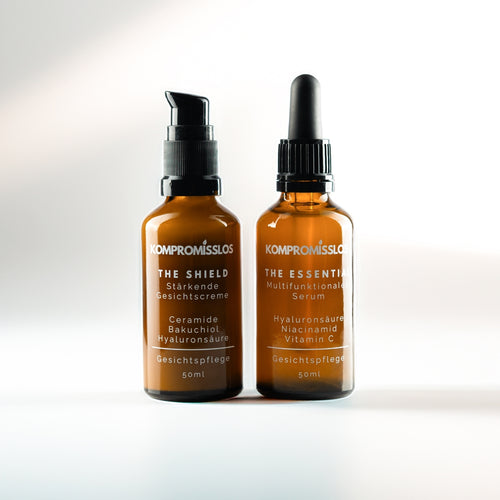
I deliberately developed The Duo to be fragrance-free, and for us that also means no essential oils, not even as ‘natural fragrance’. The plants I wanted in it go in as extracts and juice: edelweiss and gentian root from Switzerland, and aloe vera as the base of both products. Botanicals, yes. Fragrance, no. The reason is simple: fragrance does nothing for your skin in terms of care, it can only irritate it. To be honest, the price of that decision is a product without a feel-good scent of rose or citrus, and some customers need a while to get used to it. Fragrance-free also does not mean that no skin can react to anything. I cannot rule that out for any ingredient. You can check exactly what is in it in our complete list of all ingredients from A to Z.
Frequently asked questions
Is lavender oil good for your skin?
For sensitive skin, lavender oil is not a good choice, even though it has a reputation for being soothing. Its main components, linalool and linalyl acetate, oxidise in air into stronger allergens, as a study in Contact Dermatitis has shown. In a face cream, it mainly provides fragrance. If the scent matters to you, a lavender bag in your wardrobe is the kinder option for your skin.
Is tea tree oil good for spots?
Diluted, tea tree oil can help with mild spots, but used neat it is not a good idea. In a randomised study of 60 people with mild to moderate acne, a gel containing 5% tea tree oil was more effective than a placebo over 45 days. At the same time, tea tree is one of the oils that frequently test positive in skin tests, and oxidised oil is considerably more sensitising. If your acne is pronounced or persistent, have it assessed at a dermatology practice.
Is a fragrance molecule from a plant different from one made in a lab?
No, a fragrance molecule is the same whether it was distilled from lavender or produced in a laboratory, and your skin reacts to it in the same way. The study in Contact Dermatitis found that the fragrance compounds in lavender oil oxidise in air just as quickly as the pure synthetic compounds. An essential oil also brings many other individual compounds with it. Why natural fragrances are therefore not automatically better tolerated is explained in Swiss skincare without additives.
Can I apply essential oils neat?
You should not apply essential oils neat to the skin on your face. According to a review in the journal Dermatitis, most allergic reactions to essential oils are caused by pure oils or highly concentrated products. Even a single drop of tea tree oil directly on a spot can irritate the skin around it. If you want to use an essential oil, only use it heavily diluted and never on irritated skin.
Is rose oil suitable for mature skin?
True rose oil is an essential oil and mainly gives mature skin fragrance rather than any particular care. It is often confused with rosehip seed oil, a fatty oil that supplies lipids. What mature skin actually needs is explained in natural skincare for mature skin. If your skin also gets irritated easily, the article on sensitive mature skin will help.
How much essential oil is allowed in cosmetics?
There is no general maximum amount for essential oils in cosmetics. Instead, individual ingredients are regulated: certain fragrance allergens must be listed individually on the packaging above a low threshold, and photosensitising substances such as the furocoumarins from citrus oils are restricted. How much essential oil a product contains is decided by the manufacturer as part of its safety assessment. The amount is not stated on the packaging; the order of the ingredient list only shows you whether an oil is near the top or near the bottom.
Does The Duo contain essential oils?
No, The Duo contains no essential oils and is fragrance-free. According to the published ingredient list, neither essential oils nor Limonene or Linalool are in the two products. The oils in the Duo are fatty plant oils such as jojoba oil and sunflower oil, while the plants go in as extracts of edelweiss and gentian root and as aloe vera juice. You will find all the details directly on The Duo.
Sources
- de Groot AC, Schmidt E. Essential Oils, Part IV: Contact Allergy. Dermatitis, 2016. Source
- Hagvall L, Sköld M, Bråred-Christensson J, Börje A, Karlberg AT. Lavender oil lacks natural protection against autoxidation, forming strong contact allergens on air exposure. Contact Dermatitis, 2008. Source
- Hausen BM, Reichling J, Harkenthal M. Degradation products of monoterpenes are the sensitizing agents in tea tree oil. American Journal of Contact Dermatitis, 1999. Source
- Kaddu S, Kerl H, Wolf P. Accidental bullous phototoxic reactions to bergamot aromatherapy oil. Journal of the American Academy of Dermatology, 2001. Source
- Enshaieh S, Jooya A, Siadat AH, Iraji F. The efficacy of 5% topical tea tree oil gel in mild to moderate acne vulgaris: a randomized, double-blind placebo-controlled study. Indian Journal of Dermatology, Venereology and Leprology, 2007. Source