Rosehip oil for your face: what it does, what’s myth and who it suits
ACTIVE INGREDIENTS
Rosehip oil for your face is a light plant oil pressed from the seeds of wild roses and made up mainly of linoleic acid and alpha-linolenic acid. It makes dry skin feel softer and slows water loss at the surface. It is not natural retinol in any reliable dose, and the vitamin C is in the fruit, not in the seed oil. Because it consists largely of polyunsaturated fatty acids, it goes rancid quickly. For dry and mature skin it is an option, but you do not need it.
What is rosehip oil, and is wild rose oil the same as rose oil?
Rosehip oil, rosehip seed oil and wild rose oil all mean the same thing: a fatty oil pressed from the seeds of rose hips, the fruit of wild roses. On the ingredient list it usually appears as Rosa Canina Seed Oil, from the dog rose, or Rosa Rubiginosa Seed Oil, from the sweet briar, which is often sold under its Spanish name, Rosa Mosqueta. For skincare purposes the two are very similar; the composition varies more with origin, harvest and pressing than with the name. The golden-yellow to orange colour comes from carotenoids, natural pigments from the plant. Cold-pressed oil has a faint, seedy smell but no fragrance as such.
Apart from the name, rosehip oil has little in common with true rose oil. Rose oil is obtained from rose petals; it is a strongly scented, highly concentrated essential oil and appears in cosmetics only in small amounts. If your skin reacts to fragrance, this mix-up matters, and why essential oils such as true rose oil can irritate sensitive skin is a topic of its own. Rose water, in turn, is a water-based distillate of the petals with no oil in it and belongs in a third category altogether.
What does rosehip oil do for your skin?
Rosehip oil deposits lipids on the skin’s surface, smooths rough patches and helps keep water in the skin. A review of plant oils in the International Journal of Molecular Sciences gives the following figures for its main fatty acids: linoleic acid 35.9 to 54.8 per cent, alpha-linolenic acid 16.6 to 26.5 per cent and oleic acid 14.7 to 22.1 per cent. The balance is interesting, because the same review describes linoleic acid as directly involved in maintaining the skin’s water barrier, whereas oleic acid is described as a fatty acid that can disrupt the barrier with long-term use. In rosehip oil, oleic acid only comes third.
It also contains fat-soluble antioxidants. In an analysis of two cold-pressed rosehip seed oils in the journal Food Chemistry, tocopherols, in other words vitamin E, reached up to 1124.7 mg/kg and carotenoids up to 107.7 mg/kg. These substances mainly protect the oil itself from spoiling. What rosehip oil cannot do is hydrate. An oil contains no water and no humectants. If your skin feels thirsty and tight, it is more likely to be missing a water-binding step such as a serum than yet another oil.
Does rosehip oil really contain natural retinol and vitamin C?
No, not in a form you could rely on in your skincare. The retinol myth does have a grain of truth: the scientific literature lists trans-retinoic acid, also known as tretinoin, as a component of rosehip seed oil. A 2024 review in Frontiers in Pharmacology even speaks of large amounts, but gives no standardised content and notes that the yield of tretinoin depends on the extraction method. That is exactly the problem. A bottle of rosehip oil generally does not say how much retinoid it contains, and the amount can vary from batch to batch. A medicine containing tretinoin has a declared, tested amount; a plant oil does not. If what you really want to know is when to start using real retinol, rosehip oil is no substitute.
With vitamin C, the case is even clearer. Rose hips are known for their vitamin C content, but the same review gives those figures for the fruit, not for the seed oil. Ascorbic acid is water-soluble and does not pass into the oil in any significant amount when the seeds are pressed. The antioxidants in the oil are fat-soluble: tocopherols and carotenoids.
| Claim | What is behind it | Verdict |
|---|---|---|
| “Natural retinol” | Tretinoin is mentioned in the literature, but the content is not standardised | No substitute for a dosed retinoid |
| “Packed with vitamin C” | Vitamin C is in the fruit, not in the seed oil | For vitamin C, choose a product that declares its form of vitamin C |
| “Suits every skin type” | The fatty acid profile is favourable, but that is no guarantee | Test it yourself if your skin is prone to blemishes |
| “Keeps for a long time” | A high share of polyunsaturated fatty acids | Store it cool and dark, and use it up quickly |
Which skin types does rosehip oil suit, and who is better off without it?
Rosehip oil suits dry, mature and normal skin best, especially skin that can take a few more lipids in the evening. It absorbs relatively quickly and leaves less of a film than heavy oils. One point in its favour for sensitive skin is that pure rosehip oil contains no fragrance. Still, not every skin tolerates every plant oil, so a small test is worthwhile: try it on a small patch along your jawline for a few evenings before using it on your whole face.
For oily or blemish-prone skin, the answer is less clear-cut. Whether an oil clogs pores can hardly be read from tables, because the usual scales are based on old tests of raw materials. There is a separate article on what comedogenic really means. In practice, if you notice more blemishes after two to three weeks, stop using it. If you are looking for an oil that is much more resistant to oxidation, jojoba oil for your face is worth a look. If you have acne, rosacea or inflamed skin, the question of skincare belongs with your dermatologist first. In those cases an oil is at most a companion, not a treatment.
Can rosehip oil help with scars and acne marks, and where does skincare stop?
For scars, there are early indications from one study, but no reason to regard rosehip oil as a scar remedy. A frequently cited study was published in 2015 in the Journal of Cosmetics, Dermatological Sciences and Applications: 108 people who had undergone skin surgery at a Spanish university hospital completed the study, of whom 76 applied pure rosehip seed oil twice a day and 32 received no treatment. After 6 and 12 weeks, the treated scars showed less redness, and after 12 weeks also less discolouration and less indentation. The limitations are clear: a single product, a single clinic, a visual assessment and a control group with no skincare at all rather than a different oil. The study was sponsored by a pharmaceutical company, and the authors themselves describe their results as preliminary.
In everyday terms, this means you can apply rosehip oil to a healed, flat scar if you like how it feels. Fresh wounds, raised or itchy scars, burn scars and sunken acne scars belong in the hands of a professional. Acne marks, on the other hand, are usually not scars but discolouration that fades over time. How reliably they fade depends more on sun protection and patience than on an oil – see how to get rid of acne marks and what actually fades.
Why does rosehip oil go rancid so quickly, and how should you store it?
Rosehip oil goes rancid quickly because a large part of it consists of polyunsaturated fatty acids, which react readily with oxygen. A 2026 study in the journal Antioxidants compared four oils directly: the rosehip oil tested contained 72.0 per cent polyunsaturated fatty acids, and in a heat stress test jojoba oil held out longest, followed by olive, sunflower and, last of all, rosehip oil. The order matched the share of polyunsaturated fatty acids in the oils. Light, heat and air speed up oxidation. Rancid oil smells sharp, like old nuts or oil paint, and no longer belongs on your face.
- Choose a dark glass bottle and close it straight after every use.
- Keep it cool, not on the bathroom windowsill; the fridge works well.
- Buy small bottles that you will use up within a few months.
- Do not let the dropper touch your fingers or your skin.
- Give it a quick sniff before each use: if the smell has changed, throw it away.
The period after opening is printed on the packaging next to the open-jar symbol. What this symbol means, and how else to judge skincare shelf life after opening, is covered in a separate guide.
How do you apply rosehip oil, and do you even need it alongside a serum and cream?
Two to three drops are enough for your whole face, ideally in the evening as the last step, warmed between your palms and gently pressed in. Oil goes on after water-based products, because otherwise it holds back the next layer. The broader question of order, and whether an oil can replace your cream, is answered in the article on whether your skin actually needs a serum or a face oil.
Whether you need it at all depends on your cream. If it already supplies lipids, an extra oil is a top-up for very dry days, not a mandatory step. To be fair, this does not apply to everyone in the same way. In her review on Judge.me, Daniela B. writes: “However, the cream does not give my mature, dry skin enough moisture in winter. That is why I combine it with a natural facial oil in the evening, so that my skin is better nourished” (review translated from German). That is exactly how an oil makes sense: targeted, in the evening, as needed.
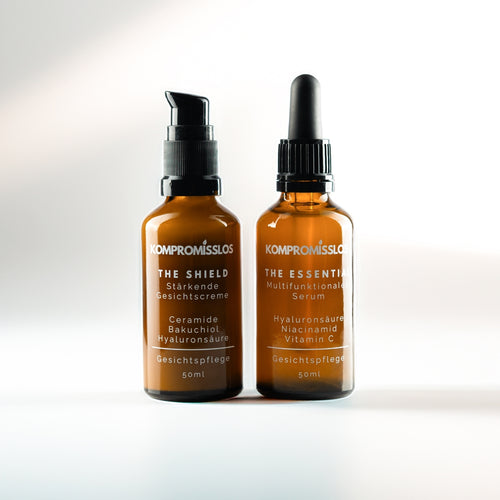
For context: The Duo, made up of serum and cream, contains no rosehip oil. The lipids in The Shield come from squalane and jojoba oil, among others – both more stable than an oil with so many polyunsaturated fatty acids – plus ceramide NP. Many people reach for rosehip oil because they want a gentle alternative to retinol; for that, the cream relies on bakuchiol. If you like rosehip oil, you can use it sparingly in the evening after the cream. But you do not need it.
I have not added a face oil to our range, even though it would be the obvious thing to do. Two products instead of eight means, for me, that each one has a job of its own. In our routine, The Shield supplies the lipids with squalane and jojoba oil, so a third product just for oil would duplicate that job. And the cream contains bakuchiol instead of retinol. That is also why you will never read from me that rosehip oil is natural retinol: an active ingredient whose amount nobody can state is not an argument as far as I am concerned. If your skin needs more richness in the evening in winter, a drop of oil is a legitimate addition, and I would rather say that openly. You can read in full which active ingredients are in the serum and cream.
Frequently asked questions
Can I use rosehip oil on my face every day?
Yes, if your skin tolerates it well. Two to three drops in the evening are enough. For dry skin, daily use is often pleasant in winter, while in summer every other evening is enough for many people. If more blemishes appear after a few weeks or your skin feels coated, use less or leave the oil out.
Should I use rosehip oil in the morning or at night?
The evening is the better time. In the morning, a film of oil can interfere with sunscreen and make-up and make your skin look shiny. Rosehip oil does not protect against UV radiation, so sunscreen remains a separate step during the day. If you still want to use it in the morning, take just one drop and let it sink in well.
Does rosehip oil clog pores?
There is no blanket answer. Because of its high linoleic acid content, rosehip oil is considered fairly light, but there is hardly any reliable data on pore clogging on the face, and the well-known comedogenic scales are imprecise. The most honest answer comes from your own test on a small area over two to three weeks.
Can I combine rosehip oil with retinol or bakuchiol?
Generally, yes. Rosehip oil contains no exfoliating acids and goes on as the last step after a retinol or bakuchiol product. Especially if a new retinol routine is drying out your skin, a drop of oil in the evening can feel good. If your skin becomes irritated, the retinoid is usually the cause, not the oil. In that case, start by using the retinol less often.
Is rosehip oil good for wrinkles?
There are no robust studies showing an effect on wrinkles. Rosehip oil makes dry skin softer, so fine lines caused by dryness are less noticeable. It does not change deeper wrinkles. Daily sunscreen and retinoids are far better studied for skin ageing. In that context, an oil is skincare, not a wrinkle treatment.
How can I tell if my rosehip oil has gone rancid?
By the smell. Fresh rosehip oil has a mild, seedy smell; rancid oil smells pungent and musty. It often feels thicker too, and the colour may darken. If in doubt, throw it away, because oxidised oil no longer cares for your skin and is more likely to put a strain on it. Storing it cool, dark and tightly closed means you can use it for longer.
Do I need rosehip oil if I use The Duo?
No. The Duo contains no rosehip oil: the cream supplies lipids with squalane, jojoba oil and ceramide NP, and it also contains bakuchiol. If your skin still needs more richness in the evening, you can apply two to three drops sparingly after the cream. It is not a mandatory step in a routine with The Duo’s serum and cream.
Sources
- Lin TK, Zhong L, Santiago JL. Anti-Inflammatory and Skin Barrier Repair Effects of Topical Application of Some Plant Oils. International Journal of Molecular Sciences, 2017. Source
- Grajzer M, Prescha A, Korzonek K, Wojakowska A, Dziadas M, Kulma A et al. Characteristics of rose hip (Rosa canina L.) cold-pressed oil and its oxidative stability studied by the differential scanning calorimetry method. Food Chemistry, 2015. Source
- Oargă Porumb DP, Cornea-Cipcigan M, Cordea MI. Unveiling the mechanisms for the development of rosehip-based dermatological products: an updated review. Frontiers in Pharmacology, 2024. Source
- Valerón-Almazán P, Gómez-Duaso AJ, Santana-Molina N, García-Bello MA, Carretero G. Evolution of Post-Surgical Scars Treated with Pure Rosehip Seed Oil. Journal of Cosmetics, Dermatological Sciences and Applications, 2015. Source
- Fagoaga C, Moreno A, Fernández-Julián N, Castellano G. Oxidative Stability and Kinetics of Oxidation of Rosehip, Sunflower, Olive and Jojoba Oils. Antioxidants, 2026. Source