Serum or face oil: what your skin actually needs
COMPARISON
Whether you choose a serum or a face oil comes down to function: a serum delivers water-soluble active ingredients such as niacinamide or hyaluronic acid into the upper layers of the skin. A face oil provides lipids and slows water loss, but does not hydrate the skin itself. For most skin conditions, serum plus cream is the foundation; the oil remains optional.
What is the difference between a serum and a face oil?
The difference lies in the base. A serum is water-based and carries active ingredients that dissolve in water, such as niacinamide, hyaluronic acid or a stable vitamin C derivative. A face oil contains no water. It is made of plant oils or individual lipids and sits on the surface of the skin as a film of oil. In dermatology, skincare ingredients are broadly divided into three groups: humectants, which bind water; emollients, which smooth the surface; and occlusives, which slow water loss. A serum works mainly in the first group, a face oil in the second and third. That leads to a practical rule: an oil can hold moisture in, but it cannot supply it. If you want to know which group of active ingredients is in a product, and in what concentration, you will find the details in our complete ingredient list. So the question is rarely which is better, but which of the two jobs your skin needs doing right now.
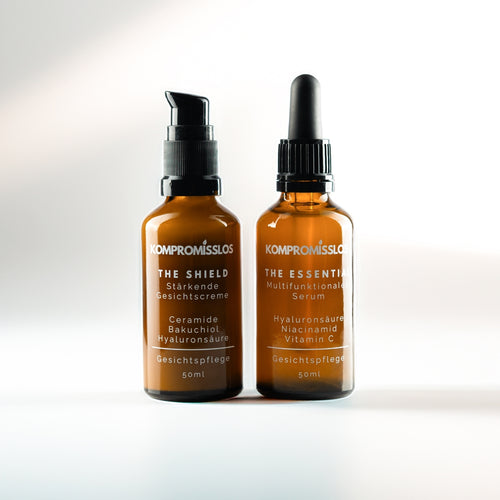
A serum works in the uppermost layers, where active ingredients such as the 5% niacinamide and 2% hyaluronic acid in the Duo do their job. An oil stays on top.
Serum or face oil: which suits the condition of your skin?
Decide based on the condition of your skin, not your skin type. A skin type stays the same for years; a skin condition changes with the seasons, stress, central heating and age. If your skin feels tight but doesn’t flake, it is usually short of water rather than oil. In that case, a serum will do more than an oil. If, on the other hand, it flakes, looks dull and feels rough, it is short of lipids, and an oil or a richer cream is the right answer. If your complexion is unsettled and prone to blemishes, an extra oil is rarely the solution, because it doesn’t regulate sebum production and makes the texture heavier. The most common mistake is with skin that is dehydrated and oily at the same time: it feels dry but produces enough sebum. What helps here is hydration from a serum, not another layer of oil on top. A simple test in the evening helps you work out which it is: wash your face, wait ten minutes and apply nothing. If your skin feels tight, it lacks water. If it feels rough, it lacks lipids.
| Skin condition | What helps first | Role of the face oil |
|---|---|---|
| Tight, not flaky | Hydrating serum, then cream | Hardly needed |
| Flaky, rough, dull | Serum plus a rich cream | Useful as a thin final layer |
| Oily with blemishes | Light serum, light cream | Usually unnecessary |
| Sensitive and red | A short routine with few active ingredients | Only test on a small area |
| Mature and low in lipids | Serum plus a cream with ceramides | Can be added in the evening |
In what order do you apply serum, cream and face oil?
The order goes from thin to thick, in other words from water-based to oil-based. First the serum on slightly damp skin, then the cream and, if you use one, the face oil right at the end. The reason is simple: an oil forms a film that water-based products struggle to get through afterwards. If you apply the oil first, less of the serum reaches the place where it is meant to work. With our products, 3 to 6 drops of serum and 3 to 6 pumps of cream morning and evening are the foundation, and in most cases you don’t need any more steps. You’ll find the exact method, with amounts and waiting times, on the how-to-use page. If you add an oil, take two or three drops and press them in lightly rather than massaging them in. Twenty to thirty seconds between steps is enough for the previous layer to settle.
There is one caveat for the morning: an oil makes the skin shinier and can interfere with make-up. So test it in the evening first, over two weeks.
Can a face oil replace your moisturiser?
In most cases, no. A moisturiser is an emulsion and contains three things at once: water, lipids and humectants. A pure face oil contains only the lipid component. It can slow evaporation, but it brings no water with it that could be held in. That is exactly why the literature on skincare products describes the combination of a humectant and an occlusive as sensible: a humectant on its own can also release water back into the environment. In practice, this means that oil on dry, unhydrated skin feels pleasant for a moment but changes little. Oil over well-hydrated skin can help to hold the effect. That is precisely why the Duo relies on serum and cream as a matched pair rather than an additional product. There is one exception: with very dry, flaky skin, an oil over the cream in the evening can noticeably add comfort. Even so, it is no substitute for the cream.
When a face oil makes sense – and when you can skip it
A face oil makes sense in clearly defined situations: for very dry skin in winter, after long periods in heated rooms, for mature skin that is low in lipids, or as short-term support after cleansing that was too harsh. You can skip it if your skin stays soft after serum and cream, doesn’t feel tight and shows no flaking. An oil is not an active-ingredient product in the narrower sense, as plant oils mainly supply fatty acids plus small amounts of other compounds. A review in the International Journal of Molecular Sciences classifies plant oils by their fatty acid profile and shows that oils differ considerably in this respect. For unsettled skin, oils high in oleic acid tend to be less suitable; for dry skin, they tend to be a better fit. This explains why an oil helps one person and makes the next person’s complexion worse. So always test just one oil at a time over several weeks, rather than buying a blend straight away.
If you are torn between an extra oil and a targeted active ingredient, it is worth looking at the question of whether vitamin C or niacinamide should come first. An oil won’t address pigmentation or pores, whereas an active ingredient in a serum can soften their appearance. You can see which active ingredients work together in the Duo on the product page.
When it is better to ask a professional
Skincare cares for the skin; it doesn’t replace a diagnosis. If your skin stays red, weeps, burns, flakes or itches for weeks despite a simple, consistent routine, it needs to be assessed by a dermatologist, not treated with a change of product. The same applies to severe breakouts with painful lumps, to sudden reactions to products you previously tolerated well, and to anything that changes quickly. A face oil can even get in the way during such phases, because it adds more ingredients to the mix and makes assessment harder. What skincare can do is improve how your skin feels, support the skin barrier and make your complexion look more even. Customers describe how that feels in everyday life in their collected reviews. Anything beyond that is medicine, not cosmetics. A GP or a dermatology practice will get to the bottom of it faster than yet another product trial.
I am often asked why we don’t have a face oil in our range. The honest answer: I didn’t want to sell a third step that does nothing extra for most people. Instead of offering a separate oil, I put the lipids where they are needed anyway, namely in the cream. Squalane, jojoba oil and ceramides are ingredients in the Duo and work there together with the water-soluble active ingredients. If you have very dry skin, you can add a pure oil on top in the evening. I just don’t sell it as standard, because for most people it isn’t.
Frequently asked questions
Which is better, serum or face oil?
Neither is better in principle, because they do different jobs. A serum delivers water-soluble active ingredients into the upper layers of the skin; a face oil slows water loss at the surface. If you have to choose one, a serum combined with a cream is the more reliable foundation for most skin conditions.
Can I use a serum and a face oil together?
Yes, that works well as long as the order is right. First the serum on slightly damp skin, then the cream, and finally two or three drops of oil. That way, the film of oil doesn’t block the path of the water-soluble active ingredients. Start in the evening so that you can observe how your skin tolerates it without pressure.
Does face oil go on before or after moisturiser?
After the cream. The rule is thin to thick, in other words from water-based to oil-based. An oil forms a film that water-based products applied afterwards struggle to get through. If you apply the oil first, you reduce the effect of the serum and cream without gaining any benefit.
Do I need a face oil if I have oily skin?
Usually not. Oily skin already produces enough of its own lipids and is more often short of water than of oil. An extra oil makes the texture heavier without solving the underlying problem. A light hydrating serum and a light cream make more sense, so that your skin stays cared for without looking shiny.
Can a face oil replace a serum?
No. A face oil contains no water-soluble active ingredients such as niacinamide, hyaluronic acid or vitamin C derivatives, because these don’t dissolve in oil. It can hold moisture in, but it can’t deliver active ingredients. If you have to do without one of them, drop the oil rather than the serum.
Which face oil doesn’t clog pores?
That depends on the fatty acid profile, not on the name of the oil. Oils high in oleic acid are tolerated less well by blemish-prone skin than lighter alternatives. Jojoba oil and squalane are considered particularly well tolerated. The only way to be sure is to test it on a small area over two to four weeks.
Is a serum enough without a cream?
For most skin conditions, no. A serum supplies active ingredients and moisture, but little of the oil that holds that moisture in. Without a cream to finish, some of it evaporates again. For very oily skin in summer, a serum on its own can be enough for a while, but as a long-term solution the combination is more stable.
Sources