Squalane benefits: what it does, how to use it and which skin it suits
SINGLE INGREDIENT
The benefits of squalane come from what it is: a skin-identical, fully saturated hydrocarbon used in skincare as a lightweight oil. It replaces lipids your skin is missing, slows down moisture loss and absorbs without leaving a greasy film. Squalane suits dry, sensitive and dehydrated skin, and is usually well tolerated by blemish-prone skin too.
Squalane or squalene: what one letter changes
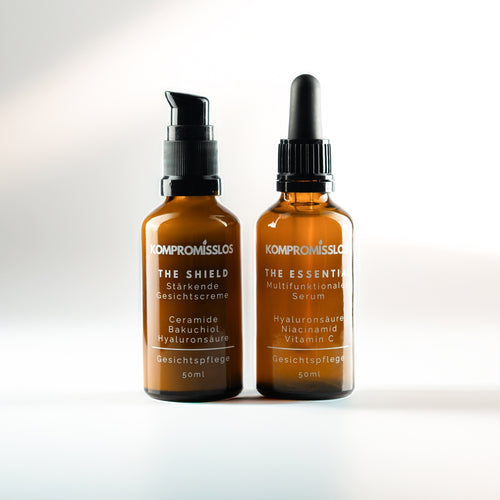
Squalane is the fully saturated, oxidation-stable form of squalene, and squalene is the unsaturated natural substance that your skin produces itself. According to a review in the journal Molecules, squalene makes up around 13 per cent of the lipids on the skin’s surface, which makes it one of the building blocks of an intact skin barrier. Its weakness is its sensitivity: the six double bonds in the molecule react with air and light, and the oil goes rancid. Hydrogenation saturates these double bonds, producing squalane with the molecular formula C30H62. This form stays odourless and stable for a long time, which is why cosmetics almost always use squalane rather than squalene. Historically, the raw material came from shark liver; today it is mostly plant-derived, usually from olives or fermented sugar cane. You can see the role squalane plays in our formula in the Duo’s full ingredient list.
What does squalane do for your skin?
Squalane works as an emollient: it settles between the cells of the skin’s outermost layer, smooths the surface and slows down water loss. In doing so, it supports the skin barrier rather than changing it. One distinction matters here, because it is often blurred: squalane does not attract moisture. A humectant such as hyaluronic acid binds water; squalane holds it in. The two do not replace each other, they complement each other. You notice the difference on skin that feels tight and rough after washing even though you are using enough hydrating skincare. Squalane closes exactly that gap without leaving a shiny film. According to a study in the journal Molecules, squalane’s saturated structure also makes it very well tolerated by the skin, and it does not clog pores. What squalane does not do: it does not fade dark spots, it does not firm, and it does not replace sun protection.
Which skin conditions benefit from squalane?
Squalane is worth it above all for dry, dehydrated, sensitive and over-treated skin – in other words, wherever lipids are lacking or the protective layer is under strain. The reason is always the same: these skin conditions lose water too quickly, and squalane slows down exactly that loss. For oily skin with plenty of its own sebum, on the other hand, the added benefit is small; there, it is more worthwhile to look at your cleansing. What matters in any case is not the skin type on paper but the current condition of your skin, and that changes with the season, air conditioning and age. Skin that looks shiny in summer can already be noticeably flaky and tight by February. So the honest answer is rarely a blanket yes or no; it is a question of the season. The cases below cover the most common situations in which squalane really makes a difference, and one in which it is unnecessary.
Dry and mature skin
Over the years, the skin produces fewer lipids of its own. Squalane replaces some of them. Read more about what else dry skin needs as you get older.
Dehydrated skin
Dehydrated means low in water, not low in oil. Squalane does not solve that on its own, but it seals in the moisture from a water-based serum.
Sensitive skin and redness
Squalane is low in fragrance and irritants. For sensitive skin, that often matters more than an additional active ingredient.
Over-treated skin
After too many acids, your skin needs a break rather than more actives. Squalane gives back structure without adding another irritant.
Combination and blemish-prone skin
Squalane is light and considered non-comedogenic, so it works for the dry zones of combination skin. It does not replace a suitable cleanser.
When you don’t need it
If your cream feels good and nothing is tight or flaky, you don’t need an extra squalane oil. It would not be solving a problem.
Ceramides or squalane: what your skin needs and when
Ceramides and squalane solve two different problems, so asking which one to choose is usually the wrong question. Ceramides are building blocks of the barrier itself: they belong to the mortar between the cells of the outer skin layer and are incorporated there. Squalane sits more on and between the cells, replaces missing skin oil and seals the surface. If your skin has become thin and easily irritated after cleansing, cold or too many acids, the signs point to a barrier problem, and ceramides are then the more direct lever. If it mainly feels rough, dull and dry but is not overly reactive, squalane is often enough. Well-designed formulas use the two side by side, as does our Duo of serum and cream, because they do not compete. The table below briefly sums up when each of the two is the more obvious choice.
| Criterion | Squalane | Ceramides |
|---|---|---|
| Role | Replaces missing skin oil on the surface. | Top up building blocks of the barrier itself. |
| Suits | Rough, dry, over-treated skin. | Irritated, thin, reactive skin. |
| Texture | Light, absorbs quickly. | Usually built into a cream. |
| Noticeable straight away | Yes, as a smoothing effect. | More over a period of weeks. |
Squalane or hyaluronic acid: what is your skin missing?
Whether squalane or hyaluronic acid is the better choice depends on whether your skin is short of water or short of oil. Hyaluronic acid is a humectant that binds water in the outer layer of the skin; squalane is a lipid that slows down the evaporation of that water. If your skin feels tight and looks dull but still gets shiny in the T-zone, it is more likely dehydrated, and hyaluronic acid is then the more direct lever. If it feels rough and flaky, it is more likely lacking oil, and squalane is the better fit. Often it is both, so here too the either-or question usually misses the point: first the water-based serum with hyaluronic acid, then the product containing squalane. For what else goes with it, see our article on what to mix with squalane.
How often should you use squalane, and what can you combine it with?
Squalane can be used morning and evening and combined with almost all common active ingredients, because it is chemically unreactive and does not shift the pH. That is its practical advantage over more delicate ingredients: squalane does not bring any new intolerances into your routine. The order follows the texture, from light to heavy. First the water-based serum, then the product containing squalane, and finally a pure oil if you need one. If squalane goes on first, it can slow down the serum that follows, because the surface is already sealed. How often depends on the condition of your skin: twice a day for dry skin, and for combination skin often just in the evening and only on the dry zones. If you are unsure about the order, our guide to how to use the products will help. The basic rule for every combination: squalane is the supporting act, not the lead.
To answer the most common questions specifically: shea butter and squalane go well together, although shea butter is richer and better suited to very dry skin or winter. Aloe vera and squalane are a water-and-lipid pair: aloe first, then squalane. Coenzyme Q10 and peptides can be used alongside it without any problem. With AHAs, BHAs and salicylic acid, let the acid absorb first and apply squalane on top afterwards, so that the pH is preserved. If you want to know which active ingredients generally get on with each other, you will find a detailed overview.
How much squalane should a product contain, and when is it not tolerated?
There is no universal minimum concentration for squalane, because squalane is not a dose-dependent active ingredient but a skincare base. With niacinamide or vitamin C, a percentage makes sense because the amount determines the effect. With squalane, what counts is where it appears in the INCI list and what it is combined with. Pure squalane oils consist of one hundred per cent of the substance; in a serum or cream the proportion is inevitably lower. A high figure is therefore not a mark of quality, just a statement about the texture. For The Essential serum and The Shield cream, we only state percentages where the amount genuinely matters. Intolerance to squalane itself is rare, because the molecule is unreactive. If your skin reacts to a squalane product, the cause is usually fragrance, the preservative system or another oil in the same formula.
Is squalane safe for your skin?
Yes – based on current knowledge, squalane is not harmful in skincare. The independent expert panel of the Cosmetic Ingredient Review assessed squalane and squalene and concluded that both are safe as cosmetic ingredients; in the tests of the time, neither irritated skin or eyes, even undiluted. Its reputation as a tricky oil usually comes from squalene: when it oxidises in air and light, it forms peroxides. In a study in the British Journal of Dermatology, squalene itself was scarcely comedogenic, whereas its peroxides were highly comedogenic. Squalane no longer has any double bonds, so it does not oxidise in this way. What comedogenic actually means and which oils really are a problem is covered in a separate article. Concerns relate more to the source: squalane from shark liver is chemically identical but not an option for vegan skincare, while plant-derived squalane from olives or sugar cane avoids the issue. So squalane is not harmful – but it can still be unnecessary if your skin is not missing anything.
When a professional is the better choice: Persistent redness, weeping or itchy patches, or skin changes that do not improve over several weeks should be checked by a dermatologist. Skincare looks after the surface of your skin; it does not replace a diagnosis.
I put squalane in the Duo because it is the least conspicuous ingredient in the whole formula, and that was exactly the point. With niacinamide or vitamin C, I deliberately state percentages, because there the amount is decisive. With squalane, such a figure would be pure marketing, so I don’t declare one. It is what stops the products from feeling sticky. It was also important to me that the source is plant-based. Squalane from shark liver is simply out of the question for a vegan brand, even if the molecule were chemically identical.
Frequently asked questions
What is squalane?
Squalane is a clear, odourless skincare oil; chemically, it is a saturated hydrocarbon with the formula C30H62. It is made by hydrogenating squalene, a lipid your skin produces itself in its sebum, which is why squalane is considered skin-identical. In creams and serums, it keeps skin supple and slows down water loss. Today it is mostly sourced from olives or fermented sugar cane.
Is squalane the same as squalene?
No. Squalene is the unsaturated natural substance found in sebum, and it oxidises quickly when exposed to air and light. Squalane is its hydrogenated, saturated form and stays stable. That is why cosmetics use squalane almost exclusively, even though the two terms are often mixed up in everyday use.
Is squalane vegan?
Squalane can be obtained from plant or animal sources; the molecule is identical in both cases. Historically it came from shark liver, but today it is mostly made from olives or fermented sugar cane. You can tell whether a product is vegan from the declared source, not from the name squalane.
How often should you use squalane?
Twice a day, morning and evening, is no problem. For combination skin, an evening application on the dry areas is often enough. Squalane needs no settling-in period and has no maximum duration of use. You can use it all year round or only seasonally, when your skin gets drier in winter.
Does squalane clog pores?
Squalane is considered non-comedogenic and is usually well tolerated by blemish-prone skin too. That is not a guarantee, because reactions remain individual. If you get more blemishes after switching, it is worth looking at the other ingredients in the formula.
Does squalane help with wrinkles?
Not directly with real wrinkles. Squalane smooths the skin’s surface and holds in moisture, so fine dehydration lines look less pronounced. Deeper wrinkles come from changes in the dermis that a skincare oil cannot reverse. Lab studies on skin cells, such as the Molecules paper listed in the sources, are interesting but are no proof of fewer wrinkles on the face. Which ingredients have better evidence is covered in our guide to what really works for wrinkles.
Can squalane be combined with acids?
Yes, ideally with a short gap between them. Apply your AHA, BHA or salicylic acid first and let it absorb, then follow with squalane. That way the acid keeps its pH, and your skin gets a soothing layer afterwards. Squalane itself does not shift the pH and does not react with acids.
Does squalane replace a moisturiser?
No. Squalane does not bind water; it holds in the moisture that is already there. Without a water-based step beforehand, such as a serum with hyaluronic acid, it simply seals a dry surface. So the sensible order is moisture first, lipid afterwards.
Sources
- Huang ZR, Lin YK, Fang JY. Biological and Pharmacological Activities of Squalene and Related Compounds: Potential Uses in Cosmetic Dermatology. Molecules, 2009. Source
- Wolosik K, Chalecka M, Gasiewska G, Palka J, Surazynski A. Squalane as a Promising Agent Protecting UV-Induced Inhibition of Collagen Biosynthesis and Wound Healing in Human Dermal Fibroblast. Molecules, 2025. Source
- Cosmetic Ingredient Review Expert Panel. Final Report on the Safety Assessment of Squalane and Squalene. Journal of the American College of Toxicology, 1982. Source
- Motoyoshi K. Enhanced comedo formation in rabbit ear skin by squalene and oleic acid peroxides. British Journal of Dermatology, 1983. Source