What to mix with squalane: which active ingredients suit it and when to apply it
INGREDIENT COMBINATION
Working out what to mix with squalane is straightforward: this saturated hydrocarbon barely reacts chemically, does not shift the pH and sits happily alongside niacinamide, vitamin C, hyaluronic acid, ceramides, bakuchiol, vitamin E and retinol. What matters is not the combination but the order: squalane goes after the water-based steps, never before them. None of these seven pairings involves a genuine incompatibility.
Why does squalane get on with almost every active ingredient?
Squalane gets on with almost every active ingredient because it barely reacts chemically. It is a fully saturated hydrocarbon, made by hydrogenating unsaturated squalene. According to a paper in the International Journal of Cosmetic Science, it is precisely this saturated structure that stops squalane from oxidising and explains why it is so widely used as an emollient. For your routine, this means three things. Squalane has no reactive double bonds that could attack a vitamin C derivative. It does not shift a pH that an acid or another active ingredient depends on. And it does not occupy a target that a second active ingredient would have to compete for. The three classic combination problems in skincare are pH conflicts, oxidation and too many irritants at once. Squalane causes none of them, because it is not an active ingredient but a skincare base. What it actually does for your skin is explained in detail in our article on squalane benefits and how to use it.
For the same reason, squalane appears in the “no restrictions” column of almost every combination table. If you want to read up on the system behind this, you will find it in our overview of ingredient combinations.
Do niacinamide, hyaluronic acid and vitamin C go with squalane?
Yes, all three can be used with squalane without restriction, on the same day and in the same routine. Niacinamide, hyaluronic acid and stable forms of vitamin C such as 3-O-ethyl ascorbic acid are water-based; squalane is a lipid. The two groups work on different levels and therefore do not interfere with each other. Hyaluronic acid binds water in the upper layers of the skin, and squalane then slows down the loss of exactly that water. This pairing is the most useful of all, because it solves two halves of the same problem. With niacinamide and vitamin C, squalane is simply neutral: it affects neither their concentration nor their stability in the formula. That is exactly how it works in The Duo of serum and cream, where 5% niacinamide, 2% vitamin C as 3-O-ethyl ascorbic acid and 2% hyaluronic acid sit alongside squalane. In practice, separating these steps in time brings no measurable advantage.
Are ceramides and vitamin E alongside squalane a duplication?
No, ceramides and vitamin E each do a different job alongside squalane, even though all three belong to the lipid side of skincare. Ceramides are building blocks of the skin barrier itself and are incorporated between the cells of the skin’s outermost layer. Squalane replaces missing skin oil on the surface and smooths. Vitamin E is an antioxidant that, in oil-containing formulas, also protects the other lipids from oxidation. This division of labour explains why the three make sense side by side in the same cream rather than replacing one another. Genuine duplication only happens if you stack a pure squalane oil and a separate ceramide serum on top of your finished skincare. Then it is not the effect that increases, only the number of emulsifiers and preservatives on your skin. Which other partners ceramides get on well with is covered in our article on what to mix with ceramides. Which lipids we actually use is shown in the full ingredient list.
What does squalane change alongside retinol and bakuchiol?
Squalane changes neither how retinol works nor how bakuchiol works, but it can make them easier for your skin to tolerate. Both active ingredients are a source of irritation for the skin, retinol considerably more so than bakuchiol. Squalane forms a low-irritation lipid layer on top and slows down the moisture loss that is typical while your skin is getting used to retinol. In practice, this is often called buffering: first the active ingredient on dry skin, then after a few minutes squalane or a cream containing squalane on top. The order matters, because the other way round the lipid layer gets in the way before the active ingredient has reached the skin. Squalane does not make retinol weaker as a result; it simply spreads the irritation more evenly over time. You will find details on the tricky retinol pairings in how to combine retinol properly. Bakuchiol is the gentler of the two and needs this buffer less often, but tolerates it just as well.
In what order should you apply squalane?
Squalane comes after all the water-based steps and belongs in the last part of your routine. The rule is thin to thick, and squalane counts as thick, even though it feels light. In practice, that means: serum first, then the cream with squalane, and for very dry skin a pure oil at the end. If squalane is applied too early, it seals the surface and the serum that follows gets through less well. With acids, a short gap is also needed so that the low pH is maintained until the acid has done its work. Waiting ten or twenty minutes between two normal skincare steps, on the other hand, is neither backed by evidence nor necessary in practice. If you are unsure how the routine works in practice, you will find the order there, including amounts. The table below sets out the seven most common pairings along with the right order.
| Active ingredient | Can be combined with squalane | Order |
|---|---|---|
| Hyaluronic acid | Yes, an ideal complement | Hyaluronic acid first, squalane seals it in. |
| Niacinamide | Yes, without restriction | Niacinamide first, squalane afterwards. |
| Vitamin C | Yes, including as 3-O-ethyl ascorbic acid | Let the vitamin C absorb first. |
| Ceramides | Yes, a different job | Usually in the same cream anyway. |
| Vitamin E | Yes, often formulated together | Same step, no gap needed. |
| Bakuchiol | Yes, well tolerated | Bakuchiol first, squalane on top. |
| Retinol | Yes, can act as a buffer | Retinol on dry skin, then squalane. |
- Cleanse and just lightly pat your skin dry.
- Apply a water-based serum while your skin is still slightly damp.
- Apply a cream with squalane on top to seal in moisture.
- In the morning, finish with sun protection, which no lipid can replace.
When squalane is unnecessary and when a professional can help
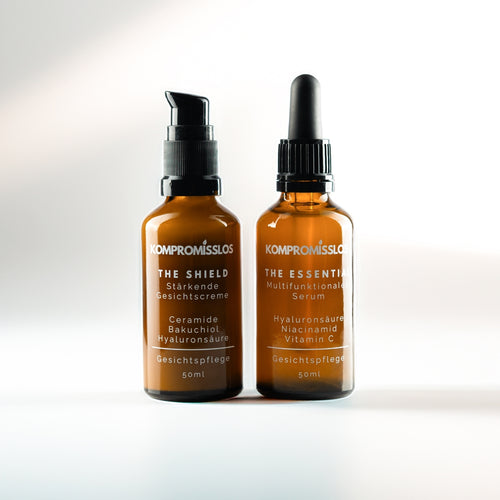
Squalane is unnecessary if your skincare already contains squalane and your skin is neither tight nor flaky. The most common mistake when combining ingredients is not the wrong pairing but a third layer of lipids on skin that doesn’t need one. For oily skin with plenty of its own sebum, extra squalane brings hardly any noticeable benefit; there, it is more worthwhile to look at your cleansing. And if a combination has caused redness or stinging three times in a row, squalane is rarely to blame, because the molecule is unreactive. Fragrance, preservatives or another oil in the same formula are much more likely causes. Persistent redness, weeping or itchy patches and skin changes that do not improve over several weeks should be checked by a dermatologist. Skincare looks after the appearance of the skin’s surface; it does not replace a diagnosis. How sparingly we use squalane in The Essential serum and The Shield cream follows the same logic.
I am regularly asked whether we also offer a pure squalane oil. We don’t, and the reason fits this topic exactly. Squalane is already in The Shield cream. A third product alongside it would lengthen the routine without giving your skin anything more. I also chose plant-derived squalane, even though the molecule from shark liver would be chemically identical. For a vegan brand, that is not a trade-off but a precondition. For me, combining starts with checking what is already there.
Frequently asked questions
Can squalane and vitamin E be used together?
Yes, with no gap and in the same step. Vitamin E is an oil-soluble antioxidant, squalane a saturated lipid. Both sit in the same phase of a formula and do not interfere with each other. In many creams they appear side by side anyway, because vitamin E protects the other lipids from oxidation.
Can you use squalane and retinol together?
Yes; it makes sense to apply retinol first on dry skin, followed by squalane or a cream containing squalane. Squalane does not weaken retinol, but it does slow down moisture loss while your skin adjusts. Applied the other way round, the lipid layer gets in the way before the retinol reaches the skin.
Can hyaluronic acid and squalane be used together?
Yes, this is the most obvious of all squalane combinations. Hyaluronic acid binds water, and squalane holds it in. Apply hyaluronic acid to slightly damp skin and layer squalane on top. Without the water-based step first, squalane simply seals a dry surface and the effect stays small.
Can you use vitamin C and squalane together?
Yes. Squalane does not shift the pH and does not react with ascorbic acid or its derivatives. Apply the vitamin C product first and let it absorb briefly, then follow with squalane. With stable forms such as 3-O-ethyl ascorbic acid, even this short gap can usually be skipped in practice.
Can niacinamide and squalane be used together?
Yes, without restriction and twice a day. Niacinamide is water-based and goes first, with squalane as a lipid afterwards. The two are not competing for anything: niacinamide targets the look of your skin, squalane the lipid layer. There is no need to separate them in time or to wait between them.
Can you use ceramides and squalane together?
Yes, and usually both are in the same cream anyway. Ceramides are incorporated into the skin barrier as building blocks, while squalane replaces missing oil on the surface. That is not duplication but a division of labour. You only need an extra squalane oil on top if your skin is very dry.
Can bakuchiol and squalane be used together?
Yes, this combination is considered particularly well tolerated. Bakuchiol is applied in the evening, and squalane can go straight on top. As bakuchiol is gentler than retinol, the buffering effect matters less, but it does no harm. In the Duo, 0.3% bakuchiol and squalane sit side by side for exactly this reason.
Sources
- Pham et al., Oxidization of squalene, a human skin lipid: a new and reliable marker of environmental pollution studies. International Journal of Cosmetic Science, 2015. Source
- Wolosik K, Chalecka M, Gasiewska G, Palka J, Surazynski A. Squalane as a Promising Agent Protecting UV-Induced Inhibition of Collagen Biosynthesis and Wound Healing in Human Dermal Fibroblast. Molecules, 2025. Source