What to mix with retinol: which ingredients work together and which don’t
INGREDIENT COMBINATION
When it comes to what to mix with retinol, barrier-supporting ingredients work best: niacinamide, hyaluronic acid, ceramides and panthenol all get on well with retinol. Use vitamin C in the morning and retinol in the evening. Exfoliating acids such as AHAs or BHAs do not belong in the same night. Retinol is applied only in the evening, and during the day it needs to be paired with consistent sun protection.
Can you use vitamin C and retinol together?
Yes, but at different times of day: vitamin C in the morning, retinol in the evening. For most skin types, this split carries the lowest risk of irritation. There are two considerations behind it. The first is a question of formulation: pure ascorbic acid is stable in a much more acidic environment than retinol, which is why people were long advised never to layer the two. With stabilised forms such as 3-O-ethyl ascorbic acid, this argument carries less weight, and the right vitamin C concentration has more influence on how well your skin tolerates it than the time of day anyway. The second consideration matters more in practice: each of the two can cause tightness, flaking or redness on its own. If you layer them in the same night, you add two irritants together and, if your skin reacts, you no longer know which one caused it. So the morning-evening split is not dogma but simply the cleaner routine. If your skin stays calm after months with both, there is little reason not to try them on the same evening.
Can you use niacinamide and retinol together?
Yes, niacinamide and retinol are one of the least problematic combinations and can go into the same evening routine. Niacinamide is a form of vitamin B3 that supports the skin barrier and reduces moisture loss through the skin’s surface. That is exactly where retinol creates a weak spot in the first few weeks: dry, slightly flaky, more sensitive skin. In an open-label clinical study in the Journal of Drugs in Dermatology, a cream containing 0.5 per cent retinol and 4.4 per cent niacinamide was used for ten weeks, and the initial irritation decreased over the course of the study. That does not prove niacinamide prevents irritation, but it does show that the two can coexist in one formula. In practice, this means niacinamide serum first and retinol on top, or niacinamide in the cream afterwards. More important than the order is not introducing both at the same time. An overview of compatible and tricky ingredient pairings covers the remaining combinations.
Can you use hyaluronic acid and retinol together?
Yes, hyaluronic acid and retinol go together without any restriction and complement each other well. Hyaluronic acid binds water in the upper layers of the skin and so counteracts the dry feeling that retinol can cause while your skin gets used to it. There is no chemical incompatibility between the two and no reason to use them at different times. In practice, you apply the hyaluronic serum to slightly damp skin, let it absorb briefly and apply retinol on top. The reverse also works: retinol first, then moisture and lipids. This version slightly softens the effect and is the calmer choice for sensitive skin. One point that often gets lost still matters: hyaluronic acid alone is not enough as a layer over retinol. Hyaluronic acid attracts water but does not hold on to it. For that, your skin needs lipids such as ceramides, squalane or plant oils. Why that is so is explained in our article on the skin barrier and how it is built.
Which ingredients don’t belong in the same night as retinol?
Exfoliating acids such as AHAs or BHAs, benzoyl peroxide and any active ingredient you are only just introducing do not belong in the same night as retinol. The reason is always the same: retinol speeds up cell renewal and makes the outermost layer of the skin more permeable in the first few weeks. If an acid exfoliant, which also works on that outer layer, is added in the same night, two stresses pile up on top of each other. The result is redness, stinging and flaking, which many people take for an intolerance when it was simply too much at once. Benzoyl peroxide is also considered able to oxidise retinol, so it still makes sense to use them on different evenings. And if you start two new products at the same time, you can no longer narrow down the cause if your skin reacts. One active ingredient per introduction phase, two to three weeks apart, then the next. The table sums up the most important pairings.
| Combining with retinol | In the same routine | What to watch |
|---|---|---|
| Niacinamide | Yes | Supports the barrier; works well in the cream afterwards. |
| Hyaluronic acid | Yes | Needs a cream with lipids on top. |
| Ceramides and squalane | Yes | Ideal as a caring layer after retinol. |
| Vitamin C | Better kept separate | Vitamin C in the morning, retinol in the evening. |
| AHAs and BHAs | No | Use on different evenings. |
| Benzoyl peroxide | No | Can oxidise retinol; use at different times. |
| Bakuchiol | Not necessary | Both target the same thing; one is enough. |
How do you introduce retinol without overwhelming your skin barrier?
Introduce retinol slowly: two evenings a week, a pea-sized amount, and only increase once your skin stays calm. Most problems are caused not by the wrong combination but by using it too often too soon. There is now a clear upper limit on concentration: under Regulation (EU) 2024/996, face products in the EU may contain no more than 0.3 per cent retinol equivalent, and body lotions 0.05 per cent. Since 1 November 2025, products that do not comply may no longer be newly placed on the market, and stock already supplied may be sold off until 1 May 2027. A higher dose does not mean better tolerated. The build-up in four steps:
- Two evenings a week, retinol on dry skin, followed by a rich cream.
- After two to three calm weeks, increase to three evenings.
- On your nights off, use only moisture and lipids, no acids.
- Consistent sun protection every morning, because your skin may react more sensitively to light.
Stinging that does not fade within a few minutes of applying is not a sign that it is working. Stop the product for a few days and use only moisture and lipids before you start again.
When retinol isn’t the right choice and when to see a professional
You don’t need retinol if your skin already reacts with irritation to several skincare products or if you don’t want to go through a build-up phase with flaking. There is a gentler route. In a randomised, double-blind study in the British Journal of Dermatology, researchers compared 0.5 per cent bakuchiol with 0.5 per cent retinol over twelve weeks in 44 people. Both groups showed a comparable improvement in wrinkle surface area and pigmentation, but the retinol group reported flaking and stinging more often. The evidence for bakuchiol is thinner than for retinol, and an honest assessment has to say so. For sensitive skin, the better tolerability is still a strong argument, and the whole question of the right combination becomes much less pressing, because a low-irritation base needs fewer rules. Our comparison of bakuchiol or retinol for sensitive skin goes into the differences in detail.
Skincare has its limits. Persistent redness, inflamed nodules, weeping or itchy patches and skin changes that keep changing belong with a dermatologist. The same applies if you use medication on your skin or are pregnant: whether retinoids suit your situation is for a professional to decide. Our overview of retinol serum tests also explains what test reports actually examine.
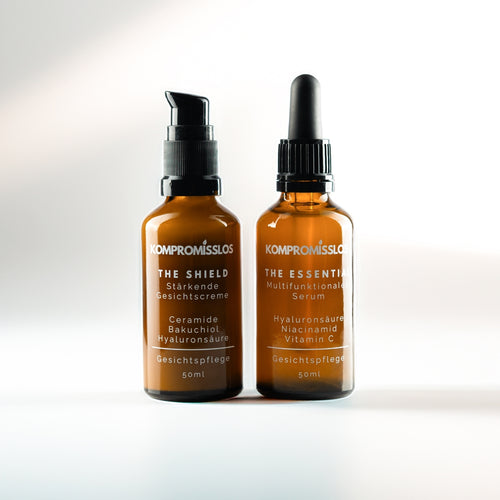
For Kompromisslos, I deliberately did not formulate with retinol and chose 0.3 per cent bakuchiol instead. The reason was not ideology but the feedback I hear most often: people who started with retinol and gave up again after three weeks of flaking. If you abandon a routine, you have gained nothing. All the percentages in the Duo of serum and cream apply to the combination as a whole, not to a single product. What is inside is listed openly under ingredients. Retinol is a good active ingredient. It just isn’t the only one.
Frequently asked questions
Can you use retinol and bakuchiol together?
Yes, nothing speaks against it, but it rarely makes sense. Both target the same signs of skin ageing, and two active ingredients pulling in a similar direction mainly increase the risk of irritation. Choose one of the two and give it twelve weeks before you switch.
Can you use retinol in the morning?
Better not. Retinol belongs in your evening routine, because your skin may be more sensitive to light afterwards and the ingredient is broken down by light and oxygen. If you want to apply something active in the morning, vitamin C is the better choice, combined with consistent sun protection at the end of your routine.
How long should you wait after retinol before applying cream?
One to two minutes is enough for the serum to absorb. Waiting longer has no proven benefit. If your skin is sensitive, you can reverse the order and apply the cream first. That softens the effect a little and makes the adjustment period calmer.
Can you use retinol and ceramides together?
Yes, and it is one of the most sensible combinations. Ceramides are components of the skin barrier and make up for the moisture loss that retinol encourages during the adjustment phase. Apply the ceramide cream after the retinol, every night of the build-up phase, including your nights off.
Can you combine retinol and vitamin E?
Yes, without restriction. Vitamin E is a fat-soluble antioxidant and is already part of the formula in many skincare products. It does not get in retinol’s way and supports the caring layer on top. There is no need to use them at different times, and usually no need for a separate vitamin E product either.
What should you do if your skin flakes after retinol?
Reduce how often you use it rather than stopping. Take a break of two to three nights, use only moisture and lipids during that time, and then start again with one application a week. If the flaking continues for more than two weeks, a professional is the right person to see.
Does The Duo contain retinol?
No. The Duo of The Essential serum and The Shield cream contains no retinol; instead it contains bakuchiol 0.3 per cent, niacinamide 5 per cent, hyaluronic acid 2 per cent and vitamin C as 3-O-ethyl ascorbic acid 2 per cent. All figures apply to The Duo as a whole. Details on how to use it are on the information page.
Sources
- European Commission, Commission Regulation (EU) 2024/996 amending Regulation (EC) No 1223/2009, 2024. Source
- Dhaliwal S et al., Prospective, randomized, double-blind assessment of topical bakuchiol and retinol for facial photoageing, British Journal of Dermatology, 2019. Source
- Journal of Drugs in Dermatology, Efficacy and Tolerability of a Skin Brightening/Anti-Aging Cosmeceutical Containing Retinol 0.5%, Niacinamide, Hexylresorcinol, and Resveratrol, 2016. Source