Layering multiple serums: what order to apply them in and when one is enough
COMBINING ACTIVE INGREDIENTS
You can use multiple serums on top of each other as long as you layer them by base and texture: watery, runny serums first, oily ones last, then your cream. An acidic vitamin C or acid serum goes on first, onto clean, dry skin. More than two serums at a time rarely add anything, because every extra layer can change how much of the one underneath actually reaches the skin. If two serums do different jobs, you are often better off splitting them between morning and evening.
Can you use multiple serums on top of each other?
Yes, you can layer multiple serums, but each extra layer is not a neutral addition – it changes the conditions for the layer underneath. A serum is a mixture of water or oil, humectants, thickeners and active ingredients. When a second product goes on, the two films mix on the skin, evaporating water concentrates what is left, and thickeners or oils create a new environment. A laboratory study in the Journal of Toxicological Sciences shows how much this can matter: on pig skin, less of a cosmetic active ingredient penetrated the skin when a lotion and a milk were applied on top of each other than when the same amount was applied in a single application. When the milk went on first, absorption dropped more sharply than in the reverse order. This is a model with a single active ingredient and cannot be applied one-to-one to every serum. But it does show that more layers do not automatically mean more effect.
For most routines, two serums at a time is the upper limit that can still be justified. How many active ingredients your skin can handle at once overall, and how to introduce new ones gradually, is covered in the guide to combining skincare ingredients. This article is about the practical side: how to layer two serums cleanly and when you are better off not doing so.
Water-based or oil serum: which goes first?
The water-based serum goes first and the oil serum second, because oil forms a film on the skin that a watery product struggles to get through. The general ‘thin before thick’ rule that applies to your whole routine is explained in the article on the right skincare order. When you layer two serums, what matters most is their base. A hyaluronic acid or niacinamide serum is usually a watery gel, while an oil serum with squalane, plant oils or oil-soluble active ingredients is lipid-based. If you apply the oil first, the gel tends to sit on top of it as a sticky layer instead of spreading. You do not need to count the minutes between layers. It is enough for the first layer to no longer feel wet before the second one goes on.
There are two exceptions. Some oil serums are designed as the final step and take over the role of a cream for normal to oily skin – in that case, they belong at the end. And emulsion serums, which look milky, sit somewhere between the two: here, the consistency on the back of your hand decides, and whichever is runnier goes first. If little balls of product start to form after the second serum, too much product or two textures that do not go together are usually to blame. What helps then is explained in the article on skincare pilling.
| Type of serum | Base | Position when layering | What to watch out for |
|---|---|---|---|
| Vitamin C serum with L-ascorbic acid | Watery, acidic | First, on dry skin | Not in the same routine as an acid serum |
| Acid serum with AHA or BHA | Watery, acidic | First, usually in the evening | No more than one exfoliant per routine |
| Niacinamide serum | Watery | After acidic serums, before oils | Not doubled up across several products |
| Hyaluronic acid serum | Watery gel | Early on, before oils and cream | Needs a layer on top that holds in moisture |
| Oil serum | Lipid-based | Last, before or instead of cream | Anything watery applied afterwards absorbs poorly |
How do you layer acidic serums such as vitamin C or AHA with other serums?
An acidic serum goes on first, onto clean, dry skin, and all other serums follow afterwards. The reason is pH. A study in Dermatologic Surgery showed that L-ascorbic acid, the classic form of vitamin C, must be formulated at a pH below 3.5 to enter the skin. The authors conclude that absorption depends critically on the formulation. Any serum you apply beforehand brings its own water, buffering agents and thickeners. How much this shifts the pH of an acidic layer on top has hardly been studied for combinations on the skin. But because the effect is so closely tied to the formulation, the safe choice is not to put an acidic serum on top of another layer. Vitamin C derivatives have a different chemical structure and are formulated differently from one manufacturer to the next. With these, you go by texture, as you would with any other serum.
The same principle applies to acid serums with AHA or BHA: apply them first, followed by a watery, soothing serum and your cream. Two acidic serums in the same routine, such as vitamin C and glycolic acid, are something you can do without. Whether two specific active ingredients are chemically compatible is a separate question, which the articles on individual ingredient pairs answer. When it comes to layering, something simpler matters: if your skin starts to sting in the first few minutes, that is a sign to move the acid to a different routine, not to cushion it with another serum.
Two serums, but not at the same time: when should you split them between morning and evening?
You split two serums between morning and evening when they do different jobs, when both are acidic or when your skin does not stay calm with both on at once. Splitting them is the simplest way to use two serums without layering them. Each one gets a clean starting point, and your skin only has to deal with one set of active ingredients at a time. Whether an ingredient is better suited to the morning or the evening depends on the ingredient itself; you will find how to split active ingredients by time of day in the guide to combining them. Four rules of thumb help you decide whether to split them at all:
- Both serums are acidic, for example vitamin C and an AHA serum: one in the morning, one in the evening.
- One of the serums is an exfoliant or a retinoid: it belongs in the evening, the other one in the morning.
- Your skin stings or turns red as soon as both are on: split them first before dropping one altogether.
- One serum only provides moisture: it can go under the other one, morning and evening.
A third option is alternating evenings: one serum one evening, the other the next. This is especially worthwhile for active ingredients you do not need every day anyway, such as an acid serum that is enough two to three times a week.
Which serum combinations are not worth it?
The combinations that add the least are those in which two serums do the same thing. The most common example is two hyaluronic acid serums on top of each other. Hyaluronic acid binds water at the skin’s surface. A second layer of it adds hardly any extra benefit; above all, it makes the film thicker and can feel sticky. More important than a second hyaluronic acid product is a layer on top that holds in the moisture. How the two work together is explained in the article on combining hyaluronic acid. It is a similar story with niacinamide: if it is already in your serum and your cream, a third niacinamide product is duplication, not an addition. Niacinamide and hyaluronic acid, on the other hand, work well together, as the guide to combining niacinamide and hyaluronic acid explains.
The second group are combinations that do not cancel each other out but get in each other’s way: two exfoliants in the same routine, a thick oil serum under a watery serum, or a serum whose active ingredients are already all in your cream. Before you buy a second serum, it is therefore worth checking the ingredient list of everything you already use. You will often find much of what the new product promises there already.
When is a second serum really worth it?
A second serum is worth it when it delivers an active ingredient that is missing from your routine and does a job the first one does not cover. One example is a retinoid in the evening alongside a hydrating serum in the morning; another is an acid serum that you use twice a week instead of a peel. A new ingredient trend that promises the same as the serum you already have is not a good reason. Instead of layering three single-ingredient serums, one serum with several active ingredients can do the job, with fewer layers and less friction between textures. One example of this approach is The Duo: a serum with niacinamide, vitamin C, zinc PCA and hyaluronic acid, followed by a cream.
A second reason to keep the number of serums low concerns sensitive skin. A meta-analysis in the Journal of the European Academy of Dermatology and Venereology identified cosmetics as the most important trigger of symptoms in sensitive skin, with an odds ratio of 7.12, the highest value of all the factors examined. That does not mean every additional serum will cause problems. But it does mean that the more products sit on your skin at the same time, the harder it is to work out which one is causing the stinging. In her review on Judge.me, Barbara F. writes about her previous routine: “I did that Korean 7-step routine for years. My skin was well looked after, but always a little overwhelmed” (review translated from German). How little you actually need is described in the article on the minimalist skincare routine.
Introduce a new serum on its own and change nothing else for two to three weeks. That way, you can tell whether it adds something or only irritates. If you add two new serums at the same time and your skin reacts, you will not know which one triggered it.
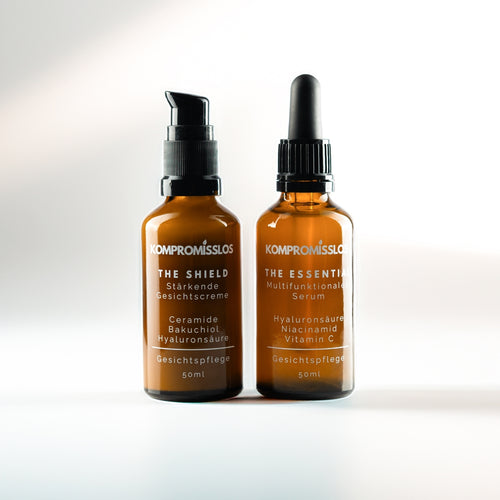
I deliberately decided against three separate serums, even though that would have let me sell more. Our serum, The Essential, combines niacinamide, vitamin C as stable 3-O-Ethyl Ascorbic Acid, zinc PCA and hyaluronic acid in three molecular sizes, and The Shield follows as a cream. Two products instead of eight. I disclose the concentrations, and they apply to The Duo as a whole: 5% niacinamide, 2% vitamin C as 3-O-Ethyl Ascorbic Acid and 1% zinc PCA. That way, you can check for yourself whether a second serum adds something for you or simply doubles up. What the serum cannot do: it is neither an exfoliant nor a retinoid. If you need either, you need a separate product for it. What each individual active ingredient in The Duo does is explained in detail on our active ingredients page.
Frequently asked questions
Can I layer niacinamide and hyaluronic acid serums?
Yes, that is one of the most straightforward combinations. Both are usually watery serums: the runnier one goes first, the more gel-like one second, then your cream. The only waiting you need to do in between is until the first layer no longer feels wet. If both are already in a single serum, you do not need a second product for them.
Can I put a hyaluronic acid serum under any other serum?
Almost always, with one exception: an acidic vitamin C or acid serum should remain the first layer, with hyaluronic acid going on straight afterwards. Hyaluronic acid works well under oil serums and creams, because the layer on top keeps the moisture it has bound on the skin.
Does a second serum dilute the first?
Not like water in a glass, but it does change the environment of the first one. In a laboratory study on pig skin, less of an active ingredient penetrated the skin with layered application than with a single application of the same amount. A second serum is therefore only worth it if it contributes something of its own.
Do multiple serums increase the risk of irritation?
Every additional product brings new ingredients that can irritate, and for sensitive skin, cosmetics are considered the most important trigger of symptoms such as stinging or tightness. It becomes critical above all when two acidic or exfoliating serums come together. If redness persists even after you have cut back your routine, that is a matter for a dermatologist.
Do I still need a cream after several serums?
In most cases, yes. Serums deliver water-binding active ingredients to the skin, but they hardly hold on to the moisture. Only a cream with lipids seals in the layers. Why the two belong together is explained in the article on whether you really need both serum and cream. For oily skin, an oil serum at the end can partly take on this role.
Can I mix two serums instead of layering them?
You can usually mix two straightforward, watery serums in the palm of your hand without any problem. With acidic serums containing L-ascorbic acid or AHA, it is best not to, because mixing can change the pH and therefore absorption. Only mix immediately before applying, and never make up a batch in a bottle.
Can I use another serum with The Duo?
Yes, if it delivers something that is not in The Duo, such as a retinoid or an acid serum in the evening. A second serum with niacinamide, vitamin C or hyaluronic acid, on the other hand, would be doubling up. An acidic serum goes on before The Essential, an oil serum after it, and the cream remains the last step. You can see exactly what is in The Duo on the product page.
Sources
- Arce FV, Asano N, Yamashita K, Oda A, Uchida T, Sano T, et al. Effect of layered application on the skin permeation of a cosmetic active component, rhododendrol. The Journal of Toxicological Sciences, 2019. Source
- Pinnell SR, Yang H, Omar M, Monteiro-Riviere N, DeBuys HV, Walker LC, et al. Topical L-ascorbic acid: percutaneous absorption studies. Dermatologic Surgery, 2001. Source
- Brenaut E, Barnetche T, Le Gall-Ianotto C, Roudot AC, Misery L, Ficheux AS. Triggering factors in sensitive skin from the worldwide patients’ point of view: a systematic literature review and meta-analysis. Journal of the European Academy of Dermatology and Venereology, 2020. Source