Skincare pilling: why your cream balls up and how to stop it
ROUTINE
Skincare pilling is, in most cases, product rather than skin: a film of humectants, gelling agents or silicones dries down and is pushed together into small balls as you keep rubbing. Typical triggers are too much product, too little time between layers, vigorous rubbing and sunscreen as the top layer. Using less, letting the layer underneath dry down and pressing the last layer in rather than rubbing it in often solves the problem without you having to swap a single product.
Why does cream pill on your face?
Cream pills on your face because a layer that has not yet absorbed forms a thin film on the surface, and friction breaks this film into pieces. Almost every skincare product consists largely of water. To keep it from being as runny as water, it contains thickeners, gelling agents and often film formers. As soon as the water evaporates, these substances stay behind on the skin as a delicate layer. If the layer is thin, you will not notice it. If it is thick, or the next layer goes on top with some pressure, the film comes away in places, rolls up and picks up sebum, tiny flakes of skin and traces of the next product along the way. The result is the grey or whitish bits you wipe off your cheeks and chin.
Surprisingly little of this has been studied scientifically. A 2024 study in Skin Research and Technology notes that until then there had been no peer-reviewed literature on its causes. The authors, some of whom work for a cosmetics group, had 528 women from Guangzhou aged 20 to 49 apply several products on top of one another. Around 41 per cent of the participants experienced pilling at least once. The authors’ explanation matches the mechanism above: certain products form a film that the friction of applying the next layer can break up.
Is it the amount, the waiting time or the ingredients?
Often all three play a part, but the amount is the factor you can change most quickly. The more product there is on your skin, the thicker the film left behind once the water has evaporated. How much cream you actually need per application is worked out in detail in the article on how long 50 ml of face cream lasts. The waiting time decides whether the next layer meets a surface that is still wet and shifts material around on it. The ingredients determine how prone a product is to forming a film in the first place.
When it comes to ingredients, many people think of silicones such as dimethicone first. They can encourage pilling, but they are not the only candidates. Polysaccharide gums such as xanthan gum, sclerotium gum or pullulan, fermented sugars such as Biosaccharide Gum-1, hyaluronic acid, synthetic gelling agents and powders such as silica also settle on the skin as a layer. This applies to conventional cosmetics just as much as to natural cosmetics. There is a separate article on what silicones in skincare do on your skin. Then there is your skin itself: in the study in Skin Research and Technology, women whose sunscreen already pilled on clean skin had drier, less oily and smoother skin with a slightly higher pH.
| Cause | How to recognise it | What to change |
|---|---|---|
| Too much product | Your skin still feels damp or sticky after several minutes | Start at the lower end of the recommended amount |
| Too little waiting time | Pilling only starts with the second or third product | Wait until the surface no longer looks wet |
| Vigorous rubbing | Little balls form exactly where you spread the product | Press the last layer in rather than rubbing it in |
| Several film formers layered on top of one another | Each product works on its own, but not in combination | Use fewer layers and test products one at a time |
| Sunscreen as the last layer | Pilling only happens in the morning | Use less skincare underneath and take your time applying sunscreen |
Why does cream pill after serum in particular?
Cream usually pills after serum because the serum was applied too thickly or had not yet dried down when the cream went on top. Serums are generally water-based and contain plenty of humectants and gelling agents. If there is too much of them on your skin, a slightly tacky layer remains. The cream then glides not over your skin but over this layer, and pushes it together as you spread it. The reverse also happens: the serum has dried down completely, and the cream is rubbed in with so much pressure that the film underneath breaks up.
That does not mean serum and cream do not go together. Whether you need both a serum and a cream at all is a different question from how you apply them. The rule of thumb of light before rich still applies; the article on skincare order explains the details. If you use two or three serums on top of each other, the chance of pilling rises because several films stack up. So it is worth checking at the same time whether you need to be layering multiple serums at all.
Why does sunscreen pill over your day cream?
Sunscreen pills over day cream particularly often because it deliberately forms a stable film of its own and ends up as the last layer on top of everything underneath. The figures from the study in Skin Research and Technology are clear: when the test sunscreen was applied over one of the base products, 12.4 per cent of these applications resulted in pilling. With a foundation over the same base products, it was 0.66 per cent. Overall, 80 per cent of all observed cases were down to sunscreen over a base product. Among other things, the authors suspect that mineral filters such as zinc oxide or titanium dioxide do not get on well with many water-based products, but they did not test the individual ingredients.
The wrong conclusion would be to skimp on sun protection. How much of it you need and why it comes last, after serum and cream, is covered in the article on sunscreen for your face. It makes more sense to use less of the skincare underneath and give it time. One side finding of the same study stands out: of 655 cases of pilling under sunscreen, 648 became less pronounced as soon as foundation went on top. What that means for your morning routine belongs in the article on skincare before make-up.
How do you stop pilling without changing your routine?
In most cases, you can stop pilling through technique alone, without changing a single product. Before you throw anything out, it is worth working through these steps in order:
- Use less: start each product with the smallest amount that just covers the area, and only increase it if your skin feels tight.
- Let it dry down: only apply the next layer once the surface no longer feels wet or slippery.
- Press rather than rub: in the study in Skin Research and Technology, most pilling occurred with rubbing movements, most often with linear rubbing. Spread the last layer with flat hands and press it in.
- Do not go over it again: once the layer is on, leave it alone. Smoothing over it again is the surest way to break up the film.
- Do not work the bits in: if pilling has already happened, gently lift the bits off rather than rubbing them in further.
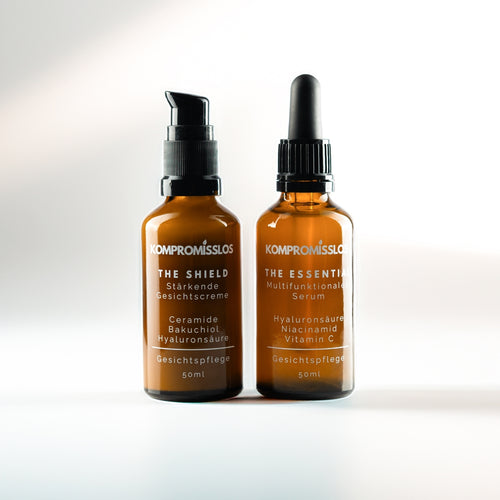
This applies to our own skincare too. The instructions for The Duo are 3 to 6 drops of serum followed by 3 to 6 pumps of cream, serum before cream. If you get pilling while using the upper end of that range, go down first. To be honest, the Duo also contains gelling agents such as xanthan gum, sclerotium gum and pullulan, which can roll up just like other film formers if the layer is too thick. In her review on Judge.me, Nicole B. writes: ‘At first I had pilling after applying my make-up. […] With the recommended adjustments, the Duo now works perfectly’ (review translated from German).
If you cannot find the trigger, do the single-product test: apply each product on its own to a small patch of clean skin and, once it has dried down, rub lightly over it. The product that pills on its own is your candidate for a smaller amount.
Is the pilling dead skin?
No, the bits that appear after applying cream are mostly product residue and only to a small extent skin. The outermost layer of skin renews itself constantly, but this process is normally invisible. A review in the International Journal of Molecular Medicine describes normal shedding as the inconspicuous detachment of individual skin cells. Another review in the Journal of Dermatological Science calls it a continuous, imperceptible process that only becomes noticeable when it is out of balance. You cannot see individual skin cells with the naked eye, and grey balls of this size do not form that way. It is quite possible, however, that a few tiny flakes of skin get caught up in them.
That is also why pilling is not a sign that your skin needs exfoliating. Whether you need to exfoliate your face at all depends on other signals. Things are different if your skin visibly flakes, feels tight or looks red without any product on it. That is dry or irritated skin, not a mistake in how you apply your skincare. If it lasts for weeks or itches, it is a matter for a dermatologist.
For The Duo, I did not want a vague indication of how much to use, but a clear number. That is why the instructions say: 3 to 6 drops of serum, then 3 to 6 pumps of cream, serum before cream. Too much product is an obvious cause of pilling, and you do not need more than this amount. But I will also tell you what the Duo cannot do: silicone-free does not mean pilling-free, because our gelling agents form a film too. And because the cream deliberately has no SPF, a separate sunscreen goes on top in the morning – precisely the layer that, according to the study, pills most often. So give the skincare underneath a few minutes first. The usage page explains step by step how the serum and cream are meant to be dosed.
Frequently asked questions
Does pilling mean a cream is bad?
No, a cream that pills is not bad or inferior because of it. Pilling is usually caused by the amount, the waiting time or the combination with other products. The same cream can work perfectly on its own and only start to pill under sunscreen. You should only doubt the cream itself if its smell, colour or texture has changed.
Does hyaluronic acid pill more often?
Hyaluronic acid can contribute to pilling because it leaves a fine film behind once the water has evaporated. This is especially true when a hyaluronic acid serum is applied generously and the cream goes straight on top. We are not aware of any studies that specifically compare hyaluronic acid with other ingredients. Using less serum and a little patience usually solves it.
Does patting help instead of rubbing?
Yes, patting or pressing is the gentler technique if your skincare tends to pill. In the study in Skin Research and Technology, most pilling occurred with linear rubbing, followed by circular rubbing finished off with linear strokes, while patting and pressing did better. For the first layer, spreading is fine; for the last, especially sunscreen, pressing it in is the better choice.
Does skincare pill under make-up?
It can happen, but it is less common than under sunscreen. In the study, foundation over a base product led to pilling in 0.66 per cent of applications. More often, the problem lies in the layer before, meaning too much skincare or the sunscreen. Let your skincare dry down before the foundation goes on.
Can an expired cream pill?
Yes, that is possible. When an emulsion ages or has been stored incorrectly, its texture can change: it becomes grainier or separates. Check the PAO symbol on the packaging, which shows how long a product should be used after opening. If a cream smells or looks different from when you first opened it, it no longer belongs on your face.
Are silicones to blame for pilling?
Not only. Silicones form a film and can encourage pilling, especially when several layers are stacked on top of one another. But polysaccharide gums such as xanthan gum or sclerotium gum, pullulan, hyaluronic acid and powders such as silica do the same. A silicone-free product is therefore not automatically pilling-free; amount, waiting time and technique remain what matters.
What should I do if The Duo pills on my skin?
First reduce the amount, going to the lower end of 3 to 6 drops of serum and 3 to 6 pumps of cream. Let the serum dry down before the cream follows, and massage the cream in gently from the centre of your face outwards, without rubbing over it again afterwards. If it only pills in the morning, give your skincare more time before sunscreen. If that does not help, get in touch with us – and The Duo comes with a 100-day return policy.
Sources
- Lua BL, Ruan L, Lyu Y, Liu S. Understanding the causes of skincare product pilling. Skin Research and Technology, 2024. Source
- Pierard GE, Goffin V, Hermanns-Le T, Pierard-Franchimont C. Corneocyte desquamation. International Journal of Molecular Medicine, 2000. Source
- Milstone LM. Epidermal desquamation. Journal of Dermatological Science, 2004. Source