Do you need to exfoliate your face at all?
ROUTINE
You do not have to exfoliate your face – an exfoliator is not an essential product. Healthy skin sheds dead skin cells by itself. Facial exfoliation only makes sense when your skin is visibly rough, dull or thickened, and even then rarely rather than often. On red, irritated or very dry skin it more often does harm than good. How often you should exfoliate depends on the condition of your skin, not on the calendar.
What does exfoliating your face actually do?
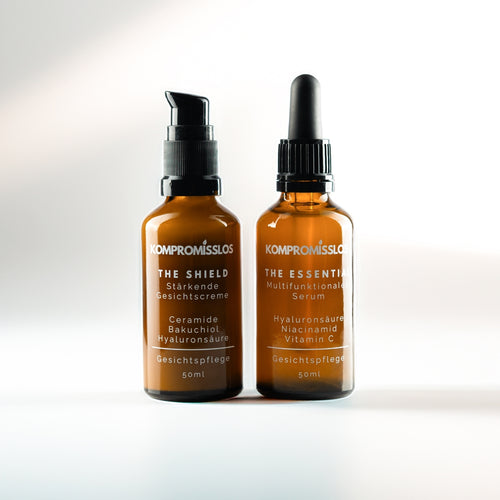
Exfoliating your face removes dead cells from the outermost layer of the skin and makes the surface smoother and more translucent for a while. Nothing more happens. There are two ways to get there: mechanically, through friction from particles or brushes, and chemically, through acids that loosen the bonds between skin cells and can be divided into the groups AHA, BHA and PHA. Both work on the outer layer of the skin, not deeper down. What an exfoliator cannot do is permanently shrink pores, fill in wrinkles or rebuild a weakened barrier. The smooth feel straight after use comes from material being removed, not from new substance in the skin. It is precisely this instant effect that tempts people to exfoliate more often than necessary. Putting moisture and lipids back afterwards is the job of another step – in our case The Duo, made up of The Essential serum and The Shield cream.
How often is too often to exfoliate your face?
For most skin types, exfoliating your face once a week at most is enough; for sensitive skin, considerably less often or not at all. There is no fixed number for everyone, because the condition of your skin determines the frequency. A good checkpoint is not the moment straight after use but the day after next: if your skin feels calm and soft then, the dose was right. If it feels tight, has an unusual shine or your usual skincare suddenly stings, it was too much. Chemical acids work more evenly than mechanical grains, because the pressure of your own hand is taken out of the equation. How strongly an acid works depends on its concentration and pH, not on its price. Salicylic acid, an oil-soluble acid, behaves differently from water-soluble fruit acids. The instructions on the pack are always a recommendation for everyone and never one for you personally. If you are unsure, start with the lowest sensible frequency and only increase it once your skin has stayed calm for several weeks.
| Skin condition | Realistic frequency | What to watch out for |
|---|---|---|
| Resilient skin that feels rough | Once a week at most | Evenings only, and no further acid afterwards |
| Uneven skin with rough, thickened areas | Every one to two weeks | Apply to specific areas rather than all over |
| Sensitive or reddened skin | No exfoliation | Reduce triggers rather than adding to them |
| Very dry skin with a feeling of tightness | Only after weeks of calm skincare | Moisture and lipids take priority |
Who should avoid exfoliating altogether?
Do not exfoliate your face while your skin is red, irritated, cracked or tight. In this state, what your skin lacks is not less of its outer layer but more protection. An exfoliator removes exactly what is in short supply. The same applies to broken skin, fresh sunburn and the days after a cosmetic treatment. If you tend towards sensitive skin anyway, you will do better in the long run by counting sources of irritation rather than active ingredients. Even if you are already using a retinoid or an acid from the pharmacy, an additional exfoliator usually amounts to doubling up. The reason is always the same: an intact skin barrier is the precondition for skincare to have any effect at all. If it is weakened, every additional active step becomes a risk rather than progress. In these cases, leaving something out is the more active decision than adding something, even if it feels like too little at first.
What can replace an exfoliator day to day?
A consistent basic routine achieves more than an exfoliator: gentle cleansing, moisture, lipids and daily sun protection. These four steps address the causes of dull skin, whereas an exfoliator only removes the symptom. The right facial cleanser already removes some of the loose skin cells, without any grains at all. Active ingredients such as niacinamide and bakuchiol work more slowly than an acid, but without removing anything: The Duo contains 5% niacinamide, 0.3% bakuchiol and 2% hyaluronic acid, each relative to the Duo as a whole. If you want to check, you will find the complete list of active ingredients on our ingredients page. Why we combine two products rather than one is explained in the article on how serum and cream work together. For everyday use, in the vast majority of cases that is exactly what is needed: our two-step routine, morning and evening. Visible changes take weeks rather than days, but they last longer than the smooth feel after exfoliating. If you want to combine the two, plan exfoliation as a rare exception rather than a fixed weekly appointment.
How can you tell you are overdoing it?
Over-exfoliation rarely shows up as a visible wound; it shows up as creeping hypersensitivity. Typical signs are an unusual shine without real moisture, stinging with products that were previously fine, fine redness on the cheeks and nose, and skin that feels tight yet still looks shiny. Often there is also the feeling that you need more and more cream. That is not a sign of dry skin but of a surface that holds water less well. The only reliable test is to leave things out: pause all acids and exfoliators, just cleanse, apply moisture and lipids, and watch. If your skin calms down within a few weeks, exfoliation was the trigger. If the reaction persists, something else is behind it. It is important to change only one thing at a time, otherwise it will be unclear in the end which step helped. Note down the day you started the break, so that you do not have to reconstruct the course of events from memory later.
A customer wrote to tell us that since switching to our routine her skin stung when she applied the serum, which had never happened before. In the course of our exchange it turned out that she was still using an enzyme exfoliator and a cleansing brush at the same time. Once she paused both, the stinging disappeared. The new product was not the problem – the total was.
After exfoliating, your skin is temporarily more sensitive to UV radiation. If you exfoliate, you need consistent sun protection the following day, whatever the season.
When is it a matter for a professional?
Cosmetic exfoliators may remove dead cells and the uppermost layers of the stratum corneum, as long as the skin’s normal physiology and barrier function are not significantly impaired. According to the Austrian Agency for Health and Food Safety, products that expose deeper layers or remove the stratum corneum completely no longer count as cosmetics and belong in professional hands. For home use, the position paper of the former EU scientific committee SCCNFP gives precautionary upper limits of 4% glycolic acid at a pH above 3.8 and 2.5% lactic acid at a pH above 5. Persistent redness, pustules, stinging with no obvious trigger, or skin changes that keep changing should be checked by a dermatologist, not met with a stronger exfoliator. The same applies to rosacea, where skincare has its own rules. Cosmetics care for the look of your skin; they do not provide a diagnosis. If in doubt, an appointment with a dermatologist is quicker than the next round of products.
I deliberately did not include an exfoliator in our range. When I was building Kompromisslos, the question came up of whether a third product belonged in it, and the honest answer was no. Exfoliators sell well because the effect can be felt immediately. But that is exactly what makes them the product most often overused. I did not want to build a routine in which two steps build something up and a third works against them. Two products, morning and evening, and then patience. If you still want to use an exfoliator, go ahead – just not as a substitute for the basics.
Frequently asked questions
How often should I exfoliate my face?
Once a week at most; less often or not at all for sensitive skin. What matters is the reaction the day after next: if your skin feels calm and soft, the frequency was right. If it feels tight or your usual skincare stings, cut back or pause entirely.
Is a physical or a chemical exfoliator better?
Chemical exfoliators work more evenly, because the pressure of your own hand is taken out of the equation. Physical exfoliators with grains or brushes are harder to dose and irritate sensitive skin more quickly. For most skin conditions, better in the sense of gentler means the chemical option at a low concentration.
Can I use an exfoliator and a vitamin C serum on the same day?
Better not on the same day. Both put strain on the surface of the skin, and the combination considerably increases the risk of stinging and redness. Use them on different days. On exfoliation days, cleansing, moisture and a rich cream are all you need.
Do I need sun protection after exfoliating?
Yes, consistently. After exfoliation your skin is temporarily more sensitive to UV radiation, because the protective outer layer is thinner. Sun protection is a basic requirement in the days that follow, including on overcast days and in winter. Without this step, exfoliating can do more harm than good.
Does exfoliating help with blackheads?
Exfoliating can soften the look of blackheads in the short term, because it smooths the surface. The cause, however, lies in sebum production and keratinisation in the follicle, and that remains. Frequent exfoliation often makes things worse, because irritated skin responds with more sebum.
Does The Duo contain an exfoliant?
No. The Essential serum and The Shield cream contain no exfoliating acids and no abrasive particles. The formula relies on active ingredients such as 5% niacinamide, 2% hyaluronic acid and 0.3% bakuchiol, each relative to The Duo as a whole. You do not need a separate exfoliator to use it.