Facial cleansing: what kind of cleanser your skin really needs
ROUTINE
Facial cleansing has exactly one job: to lift sebum, dirt, sunscreen and make-up without weakening the skin barrier. For most skin conditions, a mild, slightly acidic cleanser in the evening and lukewarm water in the morning are enough. The more a product foams and the more alkaline it is, the more likely your skin is to feel tight afterwards.
Why is facial cleansing the most underrated step?
Facial cleansing is the underrated step because it is the only one that takes something away from the skin, while every other step adds something. A serum cannot make up for an unsuitable cleanser, and the way serum and cream work together depends on skin that has not been stripped beforehand. If your skin feels tight, stings or stays red after washing, the cause is more often the product before than the skincare after. The top layer of the skin is slightly acidic, and it is precisely this environment that keeps the barrier working. Traditional soaps raise the pH considerably, dissolve the skin’s own lipids in the process and make the barrier more permeable. Because this effect builds up slowly, over weeks, it is rarely linked to cleansing and is blamed on the new serum instead. That makes cleansing your face the one step that can quietly sabotage an entire routine without anyone suspecting it.
How often a day should you cleanse your face?
Once a day with a cleansing product is enough for most skin conditions, and that means in the evening. Over the course of the day, the things that genuinely need removing build up on the skin: sunscreen, make-up, sebum, fine dust. By the morning, none of that is left on the skin apart from what it has produced itself overnight, and lukewarm water removes that reliably. Cleansing twice a day makes sense if your skin wakes up visibly oily or if you exercise in the evening and cannot get to a basin afterwards. Dry and sensitive skin almost always does better with just water in the morning. Cleansing more than twice a day brings no advantage for any skin condition, not even for very shiny skin. The real question is not how clean your skin can get, but how little cleansing is enough to keep it clean while the barrier stays intact.
| Starting point | Morning | Evening |
|---|---|---|
| Dry or sensitive skin | Lukewarm water | Mild cleanser |
| Oily or blemish-prone skin | Mild cleanser | Mild cleanser |
| Wearing sunscreen or make-up | Lukewarm water | Mild cleanser, twice if needed |
| Exercising in the evening | Lukewarm water | Mild cleanser after exercise |
How can you tell your cleanser is too harsh?
You can tell a cleanser is too harsh by the squeaky-clean feeling: after drying, your skin feels clean, taut and slightly rough, and that feeling stays until you apply something. Clean does not mean squeaky. Other signs are redness that only appears after washing, sudden sensitivity to products that were fine before, fine flakes around the sides of the nose and on the chin, and skin that becomes oilier over the course of the day than it used to. That last point is often misread. Oily skin after harsh cleansing is not proof that the cleansing was necessary; it is often a reaction to it. If several of these signs come together, the cleanser is the first candidate to drop, not the serum. A simple test for this needs no product at all: for one evening, wash your face with lukewarm water only and notice how your skin feels before you apply your skincare. A persistent feeling of tightness also points to a disrupted barrier rather than a lack of moisture.
One customer wrote to us because, since switching to a strongly foaming cleansing gel, her skin had felt tight after every wash. At first she suspected the serum and wanted to know whether she should stop using it. We advised her to do the opposite and drop the morning cleanse first. From then on, she washed with lukewarm water only in the morning and was able to keep using the gel in the evening without the tightness coming back. It was not the serum.
Is water alone enough to cleanse your face?
Water alone is enough in the morning for most skin conditions, but not in the evening once sunscreen, make-up or a lot of sebum is involved. Water removes water-soluble dirt and sweat, but not oily films – and those are exactly what sits on the skin in the evening. There is also a detail that is rarely mentioned: tap water in Europe often has a pH of around 8, while, according to a study in the International Journal of Cosmetic Science, the skin’s surface averages around 4.7. So even washing with plain water briefly raises the skin’s pH before it returns to its natural level. That is not an argument against water, but against the idea that cleansing is a neutral process. If you had nothing oily on your face during the day, you can easily stick to water on some evenings. Every cleanse has an effect, and your skin barrier remembers how strong it was.
What we recommend, even though we do not sell a cleanser
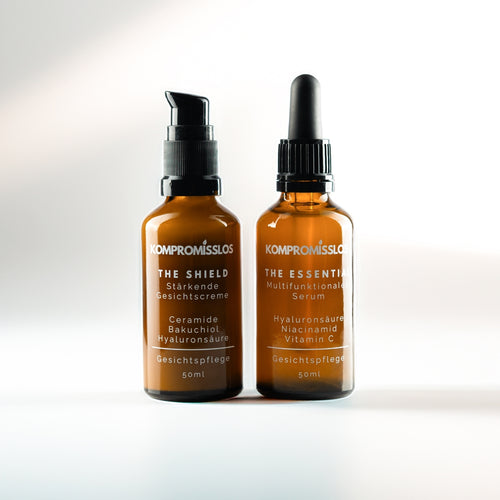
We recommend a mild, slightly acidic cleanser without traditional soap, fragrance or scrub particles – and we earn nothing from it. In concrete terms, that means a product that works with your skin’s environment rather than against it, rinses off completely with lukewarm water and does not leave your skin squeaky. Whether it is a gel, a milk or a balm depends more on your preference than on your skin. A review in the journal Molecules identifies traditional soaps as the product group that changes the barrier, skin lipids and pH the most, while synthetic surfactants can be formulated closer to the skin’s own environment. What comes afterwards also plays a part: the 5% niacinamide and 2% hyaluronic acid in The Duo work differently on an intact barrier than on a stripped one. All percentages apply to the Duo as a whole and are listed openly in the overview of ingredients.
According to a review of cleanser pH in the International Journal of Cosmetic Science, cleansing products on the market range from pH 3.8 to 11. The label pH-neutral on a pack means a value of 7, which is already higher than that of the skin’s surface.
When a professional is the better choice
As soon as redness, pustules, itching or flaking persist and do not respond to a milder cleanser, the issue belongs with a dermatologist rather than in a cosmetic routine. Cosmetics care for the skin’s surface and support the barrier, but they do not replace a diagnosis or treatment. This applies in particular if the symptoms always appear in the same places, if they spread despite gentle skincare, or if stinging and weeping are added to the picture. Skin that suddenly reacts to almost everything also deserves to be looked at properly rather than subjected to yet another product change. Until then, less really is more. A mild cleanser in the evening, followed by something soothing and hydrating, and nothing else. Put exfoliants, brushes and new active ingredients on hold until then. This break also helps the professional, because skin without constant product changes is much easier to assess. We have described separately what a pared-back routine for sensitive skin looks like.
I made a deliberate decision not to add a cleanser to our range. It would have been the easiest extra product to make, and it is the question we are asked about more than any other. I still left it out, because otherwise I would be selling two products designed to work together and a third alongside them that could undo their work the moment it was formulated too harshly. I would rather tell you what to look for in someone else’s cleanser than sell you one of my own that you do not need. How to use the serum and cream in the Duo afterwards is explained step by step in the instructions for use.
Frequently asked questions
Should I use a cleanser on my face in the morning?
In the morning, lukewarm water is enough for most skin conditions. Overnight, only sebum and a little sweat build up, and water removes both without any surfactant. A cleanser in the morning is mainly worthwhile if your skin wakes up visibly oily or if you use a very rich product at night.
Is a cleansing gel or a cleansing milk better?
Both work, as long as the formula is mild. Gels feel more pleasant on oily skin, while milks and balms are often better tolerated by dry and sensitive skin because they need less surfactant. What matters is not the texture but whether your skin stays calm afterwards or feels tight.
How warm should the water be when you cleanse your face?
Lukewarm, meaning just below body temperature. Hot water also dissolves the skin’s own lipids and intensifies the feeling of tightness after washing. Very cold water cleanses less well, because sebum stays solid. Afterwards, pat your face dry with a clean towel rather than rubbing.
Do I need to double cleanse?
Double cleansing only makes sense if you need to remove water-resistant sunscreen or full-coverage make-up. In that case, an oil or balm lifts the film, followed by a mild cleanser. Without that starting point, the second round is unnecessary and puts extra strain on the barrier.
What about cleansing brushes and flannels?
Both cleanse mechanically and therefore more strongly than most skin conditions need. If you use them, keep the pressure very light and use a fresh flannel every time. For red or sensitive skin, your fingers are the better choice, because they let you control the pressure most precisely.
Can I apply serum and cream straight after cleansing?
Yes, ideally on skin that is still slightly damp. After patting dry, apply 3 to 6 drops of serum first, then 3 to 6 pumps of cream. On damp skin the serum spreads more evenly, and the cream seals in the moisture that is still on the surface.
Sources
- Lambers H., Piessens S., Bloem A., Pronk H., Finkel P., Natural skin surface pH is on average below 5, which is beneficial for its resident flora, International Journal of Cosmetic Science, 2006. Source
- Mijaljica D., Spada F., Harrison I. P., Skin Cleansing without or with Compromise: Soaps and Syndets, Molecules, 2022. Source
- Hawkins S., Role of pH in skin cleansing, International Journal of Cosmetic Science, 2021. Source