Facial cleansing brushes: are they good for your skin, or are your hands enough?
ROUTINE
A facial cleansing brush is not necessary for healthy skin, and there is no evidence that it cleans more thoroughly than your hands. The few studies on it are small, short and often part-funded by device manufacturers. Used briefly and only now and then, a gentle silicone or sonic brush usually does resilient skin no harm. On thin, sensitive or reddened skin, however, it tends to be one more source of irritation. Your fingertips, a mild cleanser and lukewarm water are enough in the vast majority of cases.
Does a facial cleansing brush clean more thoroughly than your hands?
So far, nobody has properly shown that a facial cleansing brush cleans measurably more thoroughly than your hands. Advertising likes to talk about deep pore cleansing and removing several times more make-up. These are manufacturers’ claims, not independently confirmed findings. A publicly funded split-face study in the Journal of Cosmetic Dermatology tested exactly this question on a small scale: one half of the face was cleansed with a sonic device, the other by hand, both with the same mild cleanser. Afterwards, there was no significant difference in skin oil between the two sides. In other words, the brush did not remove any more sebum than the fingers did.
That fits with what cleansing actually has to do. Sunscreen, make-up, sebum and dust are loosened mainly by the surfactants in the product and by water, not by scrubbing. Your hands provide enough movement to spread the product and rinse off any residue. If your face still does not look clean after cleansing with your hands, the cause is usually the product or the technique, not the lack of a gadget. Which product suits you is covered in a separate article on what kind of cleanser your skin really needs. This article is only about the tool.
What do studies say about sonic brushes and the skin barrier, and who paid for them?
Studies on sonic brushes show no damage to the skin barrier with short-term use, but they are small, short and to a large extent supported by manufacturers. The split-face study in the Journal of Cosmetic Dermatology mentioned above involved 12 people and took measurements for up to 90 minutes after a single cleanse. Transepidermal water loss, a standard measure of barrier function, did not differ significantly between the two sides. On the side cleansed by hand, skin hydration fell by 17.19 per cent, while on the device side it stayed close to the baseline. The study was paid for by Brazilian public research funders, not by a device manufacturer.
With older studies, the funding looks different. A study in Cosmetic Dermatology involving 20 people with seborrhoeic dermatitis found no significant increase in water loss over two weeks. The lead author received research funding from an educational grant provided by the company behind the device, and the co-author is one of its co-founders. And a review in the Journal of Cosmetic Dermatology, written by an expert panel, concludes that the sonic brush may be a safe and effective option for various skin conditions. The panel’s meeting was supported by a brush manufacturer with an educational grant.
Read honestly, this means that a gentle sonic brush is probably not harmful when used for short periods. None of these studies shows that it gives healthy skin any benefit over months. Independent long-term data on daily use over years are lacking.
Silicone, bristles or sonic: how do facial brushes differ?
Facial brushes differ mainly in how much friction they create and how easy they are to keep clean. Silicone brushes have soft nubs instead of bristles; the surface is smooth and does not absorb water. Bristle brushes use lots of fine synthetic fibres, which create more contact area and therefore more abrasion. Cleanser residue and flakes of skin also get caught between the bristles more easily. ‘Sonic’, by contrast, describes not a material but the drive: the head vibrates or oscillates rapidly back and forth instead of rotating. Sonic devices are available with both silicone and bristle heads. With rotating and manual brushes, the amount of friction depends especially heavily on how hard you press.
| Method | Friction on the skin | Hygiene | Running costs | Best suited to |
|---|---|---|---|---|
| Fingertips | Low, easy to control | Wash your hands first, nothing else | None | All skin types, especially sensitive and mature skin |
| Silicone brush | Low to medium | Smooth surface, dries quickly, easy to rinse | The device; usually no replacement heads needed | Resilient skin that likes the feel |
| Bristle brush or sonic device with a bristle head | Medium to high, depending on pressure and bristles | Residue between the bristles; needs thorough rinsing and drying | The device plus replacement heads | Resilient, fairly oily skin without redness |
Which skin types are better off without a facial brush?
A facial brush is generally unsuitable for thin, mature, sensitive or reddened skin, and for skin that is already under strain for other reasons. Every brush works on the outermost layer of the skin, on top of what the cleansing itself does. On resilient skin this hardly matters, but on a barrier that is already stressed, it adds up. In its face-washing tips, the American Academy of Dermatology advises applying cleanser with your fingertips, because anything else can irritate the skin. So in the following situations, it is better to leave the brush out:
- Your skin feels tight, stings or reddens easily – typical signs of a damaged skin barrier.
- You have thin, mature or very dry skin on which any friction stays visible as redness.
- You have recently exfoliated, used an acid or are using a retinoid.
- Your skin is sunburnt, sore or broken.
- You have rosacea or inflammatory acne: in that case, put the brush away and take the question to a dermatologist. What cosmetics can and cannot do here is covered in the article on rosacea skincare.
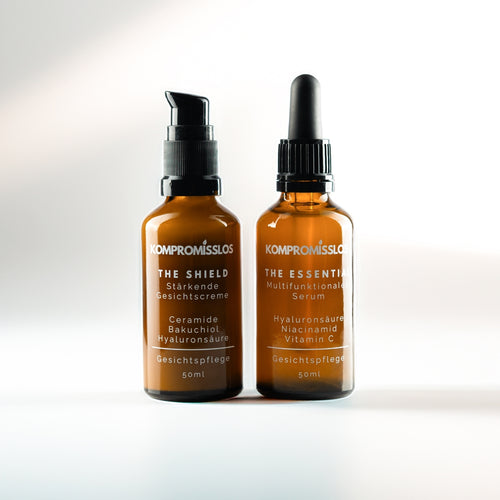
If several of these points sound familiar, the calmer alternative is not a gentler brush head but no brush head at all. You will find more on this in the article on caring for sensitive skin. After cleansing, what counts is what seals the skin again, not how thoroughly it was scrubbed. With The Duo, that looks like this: cleanse your face with water, then apply 3 to 6 drops of The Essential followed by 3 to 6 pumps of The Shield, each time working from the centre of your face outwards and down over your neck. The cream contains ceramide NP, squalane and jojoba oil, which support the skin barrier.
How often and for how long can you use a facial brush?
For resilient skin, using a facial brush on the odd evening each week for a short time is a sensible starting point – not twice a day. The studies above say little about daily use over months, so holding back is the more honest choice. Keep each session short, start with the shortest time given in your device’s instructions, and let the head glide over your skin rather than pressing it down. Leave out the eye area and the lip contour, where the skin is particularly thin.
Watch how your skin reacts over a few weeks. If it feels tight after cleansing, looks red or flaky, or seems more sensitive than before, use the brush less often or stop using it altogether. If you already exfoliate regularly, the brush counts as well: it is mechanical friction and part of your total exfoliation for the week. Whether you need an exfoliant on top of that at all is a separate question.
How do you keep a facial brush clean and hygienic?
A facial brush stays hygienic if you rinse it thoroughly after every use, let it dry completely and never share it. A damp head with traces of cleanser and flakes of skin, sitting in a closed container, is exactly the kind of environment in which germs thrive. Silicone has the edge here, because its smooth surface does not absorb water and dries more quickly. Bristles need more care.
- After every use, rinse the head under running water until no more foam comes out.
- Shake off excess water and leave the brush to dry upright in the open – do not put it in a box or pouch while it is still wet.
- Clean the head regularly with a little mild soap as well, as the instructions specify.
- Do not share the brush, not even within your family.
- Replace the brush head as soon as the bristles splay out or become discoloured, or if it smells unpleasant.
We do not sell cleansers, exfoliants or devices. Our application page simply says that you cleanse your face with water before the serum and cream go on. For me, two products instead of eight also means no extra gadget working on the outermost layer of your skin every day. That does not mean a brush is harmful. If you have one, enjoy using it and your skin tolerates it well, there is no need to throw it away. But I want to be honest: The Duo does not work any better because you brushed beforehand. Serum and cream need clean skin, not scrubbed skin. You can see how simple the routine is meant to be in our guide to applying the products.
Frequently asked questions
Does a facial brush make pores smaller?
No, there is no solid evidence for that. Pore size depends mainly on sebum production, genetics and skin elasticity, not on the cleansing tool. Right after brushing, pores can look less noticeable for a short while because there is no sebum on the surface. That is a snapshot, not a lasting effect.
Does a facial brush replace an exfoliant?
A facial brush is itself a form of mechanical exfoliation, so you should not use it on top of frequent exfoliating. As a deliberate replacement, it is of limited use, because the abrasion is hard to control. Before anything else, it is worth asking whether you need to exfoliate your face at all.
Can I remove make-up with a facial brush?
That is not a good idea, especially with eye make-up. Make-up and waterproof formulas are dissolved by the product, not by friction, and the skin around the eyes is too thin for a brush. Remove your make-up first, for example with micellar water as a make-up remover, and then cleanse with your hands or, at most, briefly with the brush.
Can I use a facial brush morning and evening?
Twice a day is more friction than most skin needs. In the morning, there is little on your skin that water and your hands cannot remove. If you use the brush at all, it belongs in your evening cleanse, and not every evening at that. If your skin feels tight or turns red, cut back further.
When should I replace the brush head?
Follow the guidance in your device’s instructions. Regardless of that, a bristle head should be replaced as soon as the bristles splay out or become discoloured, or if the head smells despite cleaning. Silicone heads usually last longer, but they should also be replaced once the surface becomes cracked or sticky.
Is a face cloth a good alternative to a facial brush?
Not really – a face cloth comes with similar problems: friction, and a fabric that stays damp and is rarely fresh. The American Academy of Dermatology advises applying cleanser with your fingertips rather than with a washcloth or sponge. If you do use a cloth, pat gently and use a fresh one every day.
Do I need a facial brush if I use The Duo?
No. For The Duo, cleansing your face with water beforehand is enough – that is what the application instructions say. Serum and cream follow, morning and evening. A brush does not improve how The Duo works on your skin. If you tolerate a brush well and like using it, you can carry on, but you do not need one.
Sources
- Aiello LM, Vergilio MM, Monteiro E Silva SA, Anselmo T, Leonardi GR. Skin effect of facial cleansing combined with an electric sonic device. Journal of Cosmetic Dermatology, 2021. Source
- Gold M, Ablon G, Andriessen A, Goldberg D, Hooper D, Mandy S. Facial cleansing with a sonic brush – A review of the literature and current recommendations. Journal of Cosmetic Dermatology, 2019. Source
- Draelos ZD, Akridge R. An efficacy assessment of a novel skin-cleansing device in seborrheic dermatitis. Cosmetic Dermatology, 2006. Source
- American Academy of Dermatology. Face washing 101. Source