Do you need to rinse off micellar water? How to use it and when it’s enough to cleanse your face
ROUTINE
To use micellar water, you soak a cotton pad and sweep away make-up, sunscreen and sebum without rubbing, because the surfactant micelles in the water bind anything oil-soluble. For an evening with light make-up, that is usually enough cleansing. According to most labels, you do not need to rinse off micellar water, but for sensitive or dry skin a quick rinse with water is still the better choice, because otherwise surfactants and preservatives stay on your skin as a film. In the morning, water is usually all you need.
What is micellar water and how does it work?
Micellar water is water containing a small amount of mild surfactants that cluster together into tiny spheres known as micelles. A surfactant has a water-loving head and an oil-loving tail. Above a certain concentration, the critical micelle concentration, the molecules arrange themselves so that the oil-loving ends point inwards. This core dissolves sebum, oily make-up ingredients and sunscreen filters that water alone cannot wash off; pigments are carried along with them. On the cotton pad, the micelles pick up these substances and lift them away from your skin. That is why micellar water feels like water but cleanses far more thoroughly than water alone. How well your skin tolerates it depends mainly on which surfactants it contains. A 2025 review in Colloids and Surfaces B: Biointerfaces concludes that a surfactant’s structure, especially the charge of its head group, determines how well the skin tolerates it: anionic surfactants such as sodium lauryl sulphate are strongly irritating, while amphoteric and non-ionic surfactants are better tolerated.
Micellar water mostly relies on milder, often non-ionic surfactants, which explains its reputation as a gentle cleanser. It does not foam and does not need a sink. So when you use it, technique matters more than the product itself:
- Soak the cotton pad so that it is properly damp but not dripping.
- Sweep outwards from the centre of your face with light pressure, one area at a time, instead of rubbing back and forth.
- Switch to a fresh pad as soon as the old one is discoloured.
- If your skin is sensitive, finish with a quick rinse of lukewarm water, then apply your skincare.
Do you need to rinse off micellar water?
You do not have to rinse off micellar water, but you should if your skin is sensitive, dry or quick to redden. What ends up on the cotton pad is only part of the product. The rest stays on your skin: surfactants, preservatives and, in some products, fragrance as well. A cleanser thus turns into something that sits on your skin for hours without having been designed for that. A study in the Journal of Investigative Dermatology shows that surfactant residue is not without consequences: the skin of 80 participants, healthy people as well as people with atopic dermatitis, was washed with the surfactant sodium lauryl sulphate and rinsed, and the residue left behind increased the skin’s water loss and caused irritation. Hard water left significantly more residue behind, which is explained in more detail in the article on hard water and what it does to your face. The study used a much harsher surfactant than is usual in micellar water. The principle still applies: whatever is meant to cleanse your skin does not need to sit on it all day.
Rinsing does not mean adding a second cleanse. A few splashes of lukewarm water or a damp flannel are enough. If your skin is resilient and you do not notice anything, you can also try going without. If your skin feels tight afterwards, tingles when you apply your skincare or gets drier over the weeks, rinsing is the first thing to change, even before switching products.
Is micellar water enough to cleanse your face?
For light make-up, tinted moisturiser and everyday sunscreen, micellar water is usually enough to cleanse your face; for waterproof products and full-coverage foundation, it often is not. The line is wherever you start rubbing. A study in the Journal of Cosmetic Dermatology involving 35 women with mild atopic skin symptoms on the face concluded that many people rub too hard when taking off make-up because their usual product does not dissolve enough. After four weeks with a cleansing oil that cleansed more thoroughly and required less rubbing, dryness, scaling, irritation, redness and itching decreased significantly. The study comes from the research department of a cosmetics manufacturer, which you should bear in mind when weighing it up. For micellar water, this means that if you are dragging pad after pad over the same spot, it is the wrong tool for your make-up. That is not down to your skin, but to the job you are asking the product to do.
As a rule of thumb, micellar water is enough if the following applies to you:
- You wear sunscreen, tinted moisturiser or light make-up, nothing waterproof.
- The pad comes away clean after a few sweeps without you having to press.
- Your skin does not feel tight after removing your make-up.
- You take off what is left with a quick rinse of water afterwards.
If any of these points does not apply, it is worth taking a step back and looking at what kind of cleanser your skin really needs before you buy your next micellar water.
With eye make-up, a small change in technique helps more than a new product: soak the pad well, hold it on your closed eye for a few seconds, then draw it gently downwards once instead of rubbing back and forth.
Is micellar water suitable for sensitive skin?
Micellar water is often well suited to sensitive skin, as long as it is fragrance-free, needs little rubbing and you rinse it off afterwards. Its advantage lies in what it leaves out: no foam, no hot water and, as a rule, mild surfactants. Its drawback lies in what it leaves behind. Besides the surfactants, that is mainly preservatives, because a water-based product without preservatives would quickly become contaminated with microbes. The journal Dermatitis published a piece entitled “Micellar Water Mayhem”, which describes micellar water as a new source of allergic contact dermatitis caused by biguanides, a group of preservatives and disinfectants. That is no reason to avoid micellar water altogether, but it is a good reason not to leave it on reactive skin all day. It is also worth checking the label for fragrance, essential oils and alcohol near the top of the ingredient list, because sensitive skin needs none of the three.
If your skin repeatedly burns, itches or flakes after the same product, that is a matter for a dermatologist. A patch test can show whether a contact allergy is behind it. Switching to a different cleansing water is no substitute for getting it checked.
Micellar water or cleansing milk: which suits you better?
Micellar water is the better match for normal, oily and combination skin with light make-up, while cleansing milk suits dry and mature skin that quickly feels tight after cleansing. The difference lies in the base: micellar water is an aqueous solution containing surfactants, whereas cleansing milk is an emulsion of water, oil and emulsifiers. The milk dissolves oily residue through its oil content and leaves some of that oil on the skin. Dry skin finds this pleasant; combination skin tends to find it heavy. Micellar water feels lighter but strips oil more noticeably with daily use. Both products are designed to be used with a pad or your hands, and with both, a quick rinse with water at the end does no harm. Neither is the first choice for waterproof make-up; cleansing oils or bi-phase products with an oil phase dissolve it with less rubbing. You do not need to buy both: choose the one that suits your skin and your make-up.
| Criterion | Micellar water | Cleansing milk |
|---|---|---|
| Base | Water with mild surfactants | Emulsion of water, oil and emulsifiers |
| How your skin feels afterwards | Light, rather matte | Soft, slightly greasy |
| Better suited to | Normal, oily and combination skin | Dry and mature skin |
| Waterproof make-up | Only bi-phase versions with an oil phase | Limited, needs time to work |
| Rinsing off | Recommended for sensitive skin | Recommended, otherwise a film remains |
| Typical mistake | Lots of pads, lots of rubbing | Too much product that never gets removed |
When can you skip micellar water altogether?
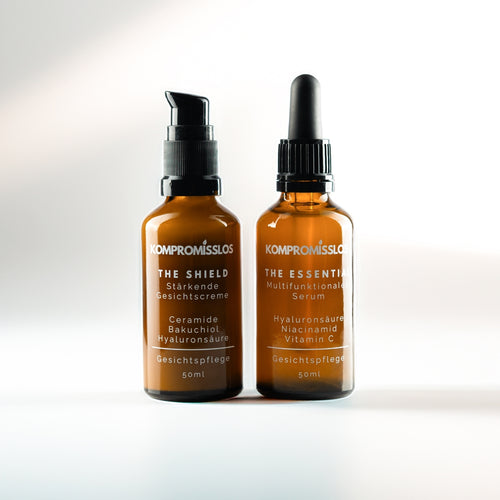
You can skip micellar water, and any other cleanser, in the morning and on evenings when you have worn neither make-up nor sunscreen. Overnight, what builds up on your skin is mainly sebum, sweat and leftover night-time skincare, and lukewarm water removes these well enough. Every extra surfactant, on the other hand, also strips away skin lipids that your barrier actually needs. A cleanser only becomes necessary when there is something oil-soluble on your skin that water cannot shift, in other words make-up or sunscreen. This is exactly how the routine for The Duo serum and cream begins: cleanse your face with water morning and evening, then apply 3 to 6 drops of serum, followed by 3 to 6 pumps of cream. How cleansing, serum, cream and sunscreen follow on from one another in a sensible order is explained in the article on skincare order in the morning and evening.
That does not mean cleansing is unimportant. In her review on Judge.me, Simone B. writes: “in future I would also like to see products for facial cleansing” (review translated from German). It is a fair point, and the answer stays matter-of-fact: on evenings with make-up or sunscreen, cleanse with a product of your choice, micellar water included. On all other days, water is enough. That saves you not just a product but also friction and surfactants on your skin. Why fewer steps often make for a calmer routine is covered in the article on how many products your skin really needs.
I do not sell a cleanser, and I am not going to talk you into one here either. Our routine starts with water morning and evening, followed by serum and cream. On most days, that is enough. But to be honest, not on every day: if you wear make-up or sunscreen in the evening, you still need a cleanser, and it does not have to come from us. Micellar water is a perfectly workable option for that, ideally fragrance-free and followed by a quick rinse with water. The fact that we offer two products instead of eight does not mean your routine will never need a third. It only means I will not sell you one that you do not even need on many days. What comes after cleansing is explained in how to apply the serum and cream.
Frequently asked questions
Can I use micellar water in the morning?
Yes, you can use micellar water in the morning, but it is rarely necessary. Overnight, what sits on your skin is mainly sebum and leftover skincare, and lukewarm water removes this well enough. If you still use micellar water in the morning, rinse it off briefly so that no film of surfactant is left under your skincare and sunscreen.
Does micellar water remove waterproof mascara?
Clear micellar water usually only removes waterproof mascara with a lot of rubbing, which is exactly what you want to avoid around the eyes. Bi-phase versions with an oil phase, which you shake before use, or a cleansing oil work better. Give the product time to work instead of pressing harder.
Does micellar water replace a toner?
No, micellar water and toner have different jobs: one cleanses, the other traditionally comes after cleansing. So micellar water does not make a toner redundant, but in most routines a toner is not an essential step anyway. When one is worth using is covered in the article on whether you need a toner.
Does micellar water leave a film on your skin?
Yes, if you do not rinse it off, surfactants and preservatives stay on your skin as a thin film. Some people notice it as a slightly sticky or soapy feeling, others not at all. For resilient skin, this is usually not a problem. If your skin is sensitive, it is better to remove the film with a little lukewarm water before applying your skincare.
Can micellar water dry out your skin?
Yes, micellar water can dry out your skin, especially with daily use, a lot of rubbing or versions that contain alcohol and fragrance. A feeling of tightness after removing your make-up is the typical sign. In that case, it helps to use micellar water only on evenings when you wear make-up, rinse afterwards and apply your skincare straight away.
How many cotton pads do I need?
You need enough cotton pads that you never have to rub, and each one should be well soaked. A fresh pad is gentler than a dry one that you drag across your skin for a long time. If the pad is still coloured after several sweeps, micellar water is too weak for your make-up. Washable pads work just as well.
Can I apply The Duo straight after micellar water?
Yes, but ideally after a quick rinse with water, so that no surfactant residue sits under the serum. Then apply 3 to 6 drops of serum and 3 to 6 pumps of cream, working outwards from the centre of your face and down over your neck. On evenings without make-up, you can leave out the micellar water and use The Duo straight after cleansing with water.
Sources
- Abdollahi H, Ghanbarlou S, Babapoor A, Yari Kalashgarani M, Valadez I, Zarrintaj P, et al. Surfactant-containing detergents: Impacts on dermal health. Colloids and Surfaces B: Biointerfaces, 2025. Source
- Danby SG, Brown K, Wigley AM, Chittock J, Pyae PK, Flohr C, et al. The Effect of Water Hardness on Surfactant Deposition after Washing and Subsequent Skin Irritation in Atopic Dermatitis Patients and Healthy Control Subjects. Journal of Investigative Dermatology, 2018. Source
- Hosokawa K, Taima H, Kikuchi M, Tsuda H, Numano K, Takagi Y. Rubbing the skin when removing makeup cosmetics is a major factor that worsens skin conditions in atopic dermatitis patients. Journal of Cosmetic Dermatology, 2021. Source
- Weber B, Karels S, Ophaug S. Micellar Water Mayhem: A New Source of Biguanide-Related Allergic Contact Dermatitis. Dermatitis, 2026. Source