Hard water and your skin: what Switzerland’s hard water does to your face
SKIN CONCERNS
Hard water is no cause for concern for most faces, but it can leave your skin feeling drier and more irritated after washing. The reason is not so much the limescale itself as the way it interacts with soap and surfactants: with hard water, more cleanser residue stays on your skin. The water you rinse with matters most. You can offset this well with a mild cleanser, thorough rinsing and a cream containing lipids – no need to buy a water softener straight away.
What does hard water do to the skin on your face?
Above all, hard water increases the residue a cleanser leaves on your skin, and with it the dryness and irritation you feel after washing. Hard water contains a lot of calcium and magnesium. These minerals combine with soaps and many surfactants to form compounds that dissolve poorly and do not rinse off completely. A study in the Journal of Investigative Dermatology tested this in 80 participants, including people with healthy skin. Their skin was washed with the surfactant sodium lauryl sulphate in water of different hardness and then rinsed. Significantly more surfactant residue remained on the areas washed with hard water. This residue increased water loss through the skin and caused irritation.
It is important to keep this in perspective: limescale is not poison for your skin, and plain tap water without any cleanser is unproblematic for most faces. Hard water becomes noticeable when washing products, soap or a strong cleansing gel come into play. That is why it is worth looking at the combination of water, product and rinsing, not at the water alone. Chlorine in indoor pools and salt water in the sea are a different matter: what your face needs after swimming is covered in our article on chlorine and salt water.
How hard is tap water in Switzerland?
Tap water in Switzerland ranges from very soft to hard, and it varies from one municipality to the next. The Swiss Gas and Water Industry Association (SVGW) describes water hardness as a measure of the calcium and magnesium in the water. In Switzerland, it is measured in French degrees of hardness, abbreviated to °fH. According to the SVGW, the scale runs from 0 °fH, meaning very soft, to around 50 °fH, meaning hard. How hard your water is depends on the rock it comes from, whether it comes from a spring, groundwater or a lake, and whether it is treated by your water supplier.
That is why your postcode tells you more about your water than any rule of thumb. Two places in the same canton can have very different values. If you move within Switzerland and suddenly notice that your skin feels different after showering, you may genuinely be reacting to different water. But it could just as easily be down to dry air from the heating, a different shower gel or the time of year. A single factor rarely explains everything.
Why does your skin feel tight after washing with hard water?
Your skin feels tight after washing with hard water because more surfactant residue stays on the outer layer of the skin and draws out oil and moisture. An older study in the journal Contact Dermatitis compared washing with fully demineralised water and with hard water. With the milder of the two washing methods, the skin areas treated with hard water were noticeably drier, redder and less hydrated. One detail is particularly useful for everyday life: the hardness of the rinse water mattered more than the hardness of the wash water. With a very intensive washing method, however, the link disappeared, probably because the cleansing itself was already so harsh that water hardness barely made a difference.
Then there is pH. A review in Dermatologic Therapy describes how strongly alkaline solutions of around pH 10 make the outer layer of the skin swell and alter its lipids, even without a surfactant. Cleansers with a neutral or slightly acidic pH close to 5.5 may put less strain on the skin. Traditional alkaline soap combined with hard water is therefore an unfortunate pairing. Our guide to tight skin after washing explains how it differs from other causes. Whether your skin is short of water or of oil is explained in the article on dehydrated skin and how it differs from dry skin.
How should you cleanse your face if you have hard water?
If you have hard water, the best way to cleanse your face is with a small amount of a mild product, lukewarm water and a particularly thorough final rinse. You do not need to overhaul your entire bathroom for this. The levers are the amount, the product and the rinsing. Which type of cleanser suits your skin in general is a separate question, answered in detail in our guide to what kind of cleanser your skin really needs. With hard water, these points matter most:
- Avoid bar soap: traditional soap is alkaline and, together with limescale, forms the same deposits you know from your washbasin and shower screen.
- Use less product: a pea-sized amount is enough for your face. Whatever you do not put on does not have to come off again.
- Rinse for longer: rinse with several handfuls of lukewarm water until your skin no longer feels slippery.
- Often just water in the morning: if you cleansed in the evening, lukewarm water without any product is usually enough in the morning.
- Dry gently: pat rather than rub, using a clean towel.
Hot water dries the skin out even more. Lukewarm is the gentler choice for your face, even if a hot shower is tempting in winter.
Is a shower filter or water softener worth it for your skin?
For most people, a shower filter or water softener is not worth buying for the sake of their facial skin alone, because cleansing and skincare make the bigger difference. In the Journal of Investigative Dermatology study mentioned above, water softened by ion exchange reduced the negative effects of hard water. However, this was a controlled experiment with one specific surfactant, not an everyday test over several months. In the same study, the researchers found no clear effect of chlorine.
If you are thinking of buying one, read the product description carefully. According to their descriptions, many shower filters are designed to remove chlorine or suspended particles. Whether a filter reduces hardness should be stated explicitly. A water softening system for the whole house, on the other hand, is a bigger investment that you are more likely to consider for the sake of your boiler, pipes and appliances than for your face. Before you spend money on equipment, try the simple steps in this article for two to three weeks. If the way your skin feels does not change, the cause probably lies elsewhere anyway.
| Measure | What it does | Effort | Makes sense if |
|---|---|---|---|
| A mild product instead of soap | Less residue and less alkaline strain | Low | Always the first step |
| Rinsing more thoroughly | Less surfactant residue on the skin | Minimal | Your skin feels slippery or dull after washing |
| A cream with lipids afterwards | Replaces lost oil, skin feels suppler | Low | Your skin feels tight after washing |
| Shower filter | Depending on the filter, chlorine or suspended particles; hardness only if stated | Medium | The filter explicitly softens the water |
| Whole-house water softener | Lowers hardness throughout the household | High | You are planning one anyway for your appliances and pipes |
Which skincare offsets the effects of hard water?
The best way to offset the effects of hard water is with skincare that binds moisture and replaces lost lipids. After washing, the outer layer of the skin is mainly short of the lipids that keep water in the skin. A cream with skin-identical lipids such as ceramides, squalane or jojoba oil goes exactly where they are needed. A serum with humectants such as hyaluronic acid, applied beforehand, brings water into the upper layers of the skin. Why this combination matters so much for the skin barrier is explained in our in-depth article on the topic.
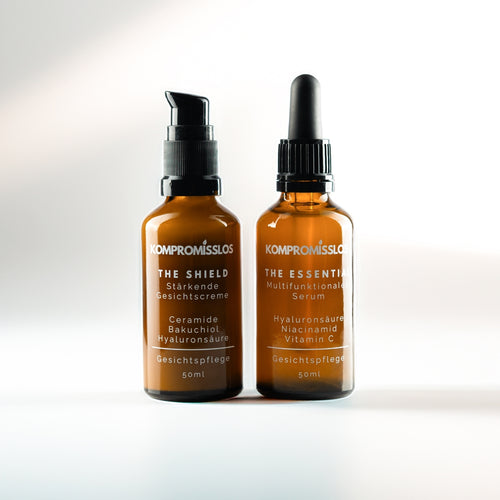
You do not need an extra product specifically for limescale. Neither a toner nor a mineral water spray is essential if your skincare after washing is well put together. For us, that means quite specifically: serum and cream after cleansing, morning and evening. The Duo combines a serum with hyaluronic acid, niacinamide and zinc PCA with a cream containing Ceramide NP, squalane and jojoba oil. The cream offsets the dryness after washing without the need for a third step. It does not change the limescale in your water; it makes up for what the limescale takes from your skin when you wash.
A simple test to try at home: for one week, wash your face in the evening with your usual product, but rinse for twice as long as usual. If your skin feels noticeably less tight afterwards, residue was probably part of the problem.
The Duo is developed and made in Switzerland, and our instructions begin with a sentence that suddenly matters when it comes to limescale: cleanse your face with water. So water is part of the routine, whether I like it or not. I cannot make it softer, and I sell neither a cleanser nor a filter. What I can influence is the step that follows. That is why the cream contains a combination of Ceramide NP, squalane and jojoba oil that replenishes the skin after washing, instead of adding a special anti-limescale product to the routine. It is also fragrance-free, so that after cleansing with hard water, no fragrance lands on skin that is already irritated. You can see what the two steps after washing look like in our instructions for use.
Frequently asked questions
Does hard water cause spots?
There is no evidence that hard water directly causes spots. Hard water can leave your skin drier and more irritated after washing, and irritated skin sometimes reacts more sensitively. Blemishes, however, usually have other causes, such as sebum, hormones or overly rich products. If spots persist or become inflamed, have them checked by a dermatologist.
Is micellar water better if you have hard water?
Micellar water can be an option if you would rather not cleanse your face with tap water. But you cannot always do without water entirely, because micelles are surfactants too, and they stay on the skin. Whether you should rinse it off and when it is enough on its own is explained in the article on micellar water and whether to rinse it off.
Does boiled water help your face?
Boiled water is hardly practical for cleansing your face every day. Heating it does make some of the limescale settle out, as you know from your kettle, but it does not make the water completely soft. Any benefit for the skin has not been studied. In everyday life, thorough rinsing and a mild product do more than a pan on the hob.
How can I tell how hard my water is?
The most reliable way to find out your water hardness is to ask your municipality or your water supplier. Water suppliers must inform their customers about the quality of their drinking water at least once a year, and many publish the figures on the SVGW’s trinkwasser.ch platform. Everyday clues are limescale build-up on taps and a kettle that furs up quickly.
Is hard water a problem for sensitive skin?
Hard water tends to matter more for sensitive skin, because residue and dryness lead more quickly to redness and stinging. Even so, the water is rarely the only trigger. Cutting back on cleansing and on the number of products usually helps more. What else sensitive skin needs, and what you can leave out, is covered in our guide on the subject.
Do I need to moisturise straight after washing?
There is no fixed rule in minutes, but you should not wait too long if your skin feels tight after washing. The tight feeling shows that the outer layer of your skin is short of moisture and oil at that moment. Skincare applied soon after drying your face makes up for this before the skin dries out further. If your skin is not sensitive, the timing is less critical.
Can I use The Duo after washing with hard water?
Yes. Using The Duo starts with cleansing your face with water anyway, however hard it is. Serum and cream follow, morning and evening, as described on our page on how to use it. The cream with Ceramide NP, squalane and jojoba oil offsets dryness after washing. The Duo does not need an extra anti-limescale step.
Sources
- Danby SG, Brown K, Wigley AM, Chittock J, Pyae PK, Flohr C, et al. The Effect of Water Hardness on Surfactant Deposition after Washing and Subsequent Skin Irritation in Atopic Dermatitis Patients and Healthy Control Subjects. Journal of Investigative Dermatology, 2018. Source
- Warren R, Ertel KD, Bartolo RG, Levine MJ, Bryant PB, Wong LF. The influence of hard water (calcium) and surfactants on irritant contact dermatitis. Contact Dermatitis, 1996. Source
- Ananthapadmanabhan KP, Moore DJ, Subramanyan K, Misra M, Meyer F. Cleansing without compromise: the impact of cleansers on the skin barrier and the technology of mild cleansing. Dermatologic Therapy, 2004. Source
- Schweizerischer Verein des Gas- und Wasserfaches SVGW. FAQ Trinkwasser: Wasserhärte und Kalk. Source
- SVGW. Über trinkwasser.ch: Informationspflicht der Wasserversorger nach TBDV. Source