Skincare after swimming in chlorine: what your face needs after the pool and the sea
ROUTINE
Chlorine draws moisture out of the top layer of your skin, which is why your face feels tight or dry after a swim at the indoor pool. Healthy skin usually takes this in its stride, and skincare after swimming in chlorine comes down to three things: rinse your face with clean, lukewarm water straight after swimming, pat it dry gently and apply your usual skincare within a few minutes. The same applies after the sea, except that you are rinsing off salt instead of chlorine. You do not need special after-swim skincare for this.
What does chlorinated water do to the skin on your face?
Chlorinated water temporarily loosens the way the outer layer of skin holds on to water, so your skin loses moisture faster after swimming. In the pool, your skin comes into contact not only with free chlorine but also with by-products that form when chlorine reacts with sweat, skin flakes and other organic matter. How much of the dryness comes from which substance has barely been studied. A study in the International Journal of Environmental Research and Public Health measured transepidermal water loss – in other words, how much water evaporates through the skin – in young elite swimmers. On the forearm, it rose from 10.7 to 19.3 g/m²/h after two hours of training in an indoor pool and was still at 14.4 thirty minutes later, after showering. In a comparison group of footballers, the value at the same spot did not rise significantly after a training session of the same length. The measurements were taken on the arm and hand, not the face, but the direction is clear: training in the pool put more strain on the barrier than sport without water.
How sensitively people react varies a great deal. A study in the Journal of Dermatology immersed forearms for ten minutes in water at 40 °C with different levels of residual chlorine. In healthy skin, the water-holding capacity of the outer skin layer only dropped noticeably at 2 mg/L, while in people with atopic eczema it dropped from as little as 0.5 mg/L. Incidentally, this has little to do with the tap water at home – what Switzerland’s hard water does to your face is a separate topic.
Is salt water from the sea better or worse for your face than chlorine?
Salt water is neither clearly better nor clearly worse for your face than chlorinated water – it simply puts strain on your skin in a different way. The sea has no disinfectant, but salt stays on your skin after swimming. When the water dries in the air, it leaves fine salt crystals behind that can draw moisture from the surface and make your skin look rough and feel tight. On top of that, a day by the sea almost always means sun, wind and long hours outdoors, and this combination usually puts more strain on your face than the salt alone. There are hardly any studies directly comparing sea water and pool water for facial skin, so any ranking is more opinion than evidence. A Swiss lake is a third case: fresh water with no chlorine and no salt, but with issues of its own such as algae or swimmer’s itch. Brine and thermal water at a spa are something else again, different from the water in a sports pool, and do not belong in this comparison.
| Where you swim | What strains your skin | What is enough afterwards |
|---|---|---|
| Indoor pool | Chlorine and chlorine by-products, often long periods in warm water | Rinse, pat dry, serum and cream |
| Outdoor pool | Chlorine plus sun and wind | Rinse, apply skincare, reapply sunscreen |
| Sea | Salt residue, sun, wind | Rinse off the salt with fresh water, apply skincare, reapply sunscreen |
| Lake | Sun, occasionally swimmer’s itch | Rinse, apply skincare, get any rash checked |
Should you wash your face after swimming or just rinse it?
In most cases, thoroughly rinsing your face with clean, lukewarm water is all you need after swimming. This washes off chlorinated water or salt without stripping even more oil from an outer skin layer that is already under strain. You only need a cleanser if you still have sunscreen or make-up on your skin, and even then a mild facial cleanser rather than the shower gel from your swim bag. Body washes are often more stripping and unnecessarily harsh on the face. Which kind of product works here is covered in the guide on what kind of cleanser your skin really needs. Also watch the temperature: long, hot showers after swimming feel good, but they dry your skin out even more. Afterwards, pat your face dry with a clean towel rather than rubbing it. If you swim twice a day, you do not need to cleanse twice: rinsing after the pool and your normal cleanse in the evening are enough.
When and with what should you moisturise your face after swimming?
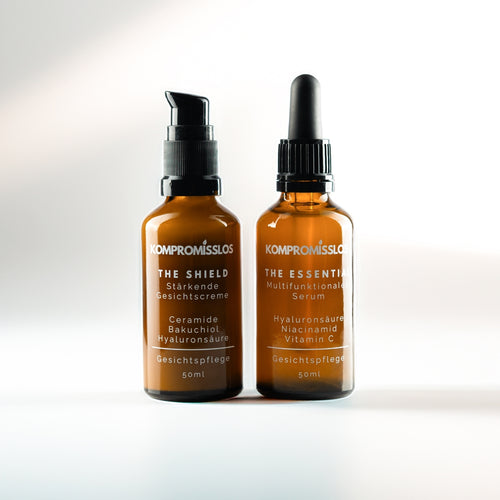
Ideally, moisturise your face shortly after drying off, using the same skincare you always use. In the study with the swimmers, water loss was highest straight after training, so it is worth applying your skincare in the changing room rather than waiting until you get home. If you swim in the morning or evening, simply do your usual routine straight afterwards. The principle is simple: moisture first, then lipids that keep that moisture in the skin. In The Duo of serum and cream, the serum The Essential takes care of the first part with hyaluronic acid in three molecular sizes, plus panthenol in the Duo. The cream The Shield adds the layer on top with ceramide NP, squalane and jojoba oil, which supports the skin barrier. Neither is a protective film against chlorine or a sunscreen – they are simply your normal skincare at the right moment. If your skin feels tight after swimming but still looks shiny, it is short of water rather than oil, which is typical of dehydrated skin.
- Rinse your face with clean, lukewarm water.
- Pat it dry with a clean towel – do not rub.
- Massage 3 to 6 drops of serum from the centre of your face outwards and down over your neck.
- Apply 3 to 6 pumps of cream on top, a little more if your skin is dry.
- Outdoors, finish with sunscreen.
If you swim regularly, you do not need a second skincare line for your swim bag. Take the products you already use, so that your skincare does not have to wait an hour until you get home.
Is it worth putting cream on your face before swimming?
Before the indoor pool, a thick protective layer is not worth it; outdoors, a water-resistant sunscreen is. The idea that a rich cream keeps chlorine away from your skin sounds plausible, but there is no evidence for it on the face. Water, movement and the friction of your goggles remove some of it anyway, and many pools ask you to shower before swimming. It makes more sense not to skip your usual skincare in the morning, so your skin does not go into the pool already dry. At an outdoor pool, a lake or the sea, something else matters: UV radiation, which the water reflects back at you, and long hours in the sun. Here, your face needs a water-resistant sunscreen as a separate product that you apply as the last step after your skincare. Which SPF is right is a separate question and does not depend on swimming.
Why does your skin feel tight or itchy after the pool, and when is it more than dryness?
Tightness and mild itching after the indoor pool are usually a sign of moisture loss and tend to ease soon after you moisturise. The outer skin layer has lost water, which makes your skin feel taut and less supple. If you want to know more about where that tight feeling comes from, you will find the general causes there. If the feeling lasts for days after every swim, or if you also notice stinging from skincare you normally tolerate well or flaky patches, it is worth looking at how to recognise a damaged skin barrier.
It is more than dryness if you get hives, a red rash, blisters or an eczema flare-up. After swimming in lakes, swimmer’s itch can also be the cause: in a study in Epidemiology and Infection, 153 of 555 bathers at Lake Geneva reported probable cercarial dermatitis in the days afterwards. In all these cases, the right place to get it checked is your GP or a dermatologist, not your skincare routine.
I deliberately did not put an SPF into The Shield. For the indoor pool, that makes no difference; for the outdoor pool, a lake or the sea, it does. There, you need a separate, water-resistant sunscreen, and I would rather say so openly than sell a cream that does both jobs by halves. You will not find a special after-swim product from us either. After swimming, your skin needs the same two steps as after any shower, just without the delay. And because both products are fragrance-free, they spare skin that is already irritated after the pool any added fragrance. How to use the serum and cream together is explained in the instructions for use.
Frequently asked questions
Is chlorine bad for your skin if you swim several times a week?
Healthy skin usually copes well with regular swimming in chlorinated water, as long as you rinse and moisturise afterwards. Frequent training can make your skin drier, though, especially in winter and if your skin is sensitive anyway. If you are prone to atopic eczema and regularly notice flare-ups after swimming, talk to a dermatologist about it.
Can chlorine give you spots?
There is no evidence that chlorine in pool water directly causes spots. Other factors are more likely: friction and pressure from goggles or a swimming cap, make-up residue under your goggles, or skin that is overloaded with very rich skincare after drying out. If spots keep appearing after swimming and become inflamed, getting them checked by your GP or a dermatologist makes more sense than buying another product.
Do you need different skincare after the sea than after the pool?
No, your skincare stays the same – only the focus shifts. After the sea, the main thing is to rinse the salt off thoroughly with fresh water and remember to reapply your sunscreen. After the indoor pool, it is more about rinsing off the chlorinated water. In both cases, moisture follows, then a cream that keeps it in your skin.
Does sunscreen stay on in the water, and do you need to reapply it after swimming?
Only to a limited extent, which is why you reapply it after swimming and drying off: in a study in JMIR Dermatology, the SPF of two SPF 30 products, measured on the back, fell to a median of 12.3 and 9.9 respectively after 1.5 hours of swimming. How to choose one is covered in the guide to sunscreen for your face when your skincare has no SPF.
Should you use a toner after swimming?
No, you do not need a toner after swimming. Rinsing with clean water already removes chlorine and salt, and a product containing alcohol can dry your skin out even more. It is more important that serum and cream follow promptly than to add another in-between step.
Can you just let salt water dry on your face?
Better not. When sea water evaporates on your skin, it leaves salt crystals behind that feel rough and can make tightness worse, especially in the sun. So rinse your face with fresh water after swimming, at the beach shower or with a water bottle, and then apply your skincare and sunscreen.
When should you apply The Duo after swimming?
The easiest way is to do your morning or evening routine straight after rinsing and patting dry, ideally while you are still in the changing room. Rinsing then replaces cleansing with water. First 3 to 6 drops of serum, then 3 to 6 pumps of cream, a little more if your skin is dry. Outdoors, a separate sunscreen goes on top of The Duo.
Sources
- Paciência I, Rodolfo A, Leão L, Silva D, Cavaleiro Rufo J, Mendes F, et al. Effects of Exercise on the Skin Epithelial Barrier of Young Elite Athletes-Swimming Comparatively to Non-Water Sports Training Session. International Journal of Environmental Research and Public Health, 2021. Source
- Seki T, Morimatsu S, Nagahori H, Morohashi M. Free residual chlorine in bathing water reduces the water-holding capacity of the stratum corneum in atopic skin. Journal of Dermatology, 2003. Source
- Chamot E, Toscani L, Rougemont A. Public health importance and risk factors for cercarial dermatitis associated with swimming in Lake Leman at Geneva, Switzerland. Epidemiology and Infection, 1998. Source
- Rachmani K, Yusharyahya SN, Sampurna A, Ranakusuma RW, Widaty S. The Comparison of Sun Protection Factor 30 Persistence Between Inorganic and Organic Sunscreen in Swimmers: Double-blind Randomized Clinical Trial. JMIR Dermatology, 2023. Source