Sunscreen for your face: what you need if your skincare has no SPF
ROUTINE
If your skincare does not contain an SPF, sunscreen for your face belongs at the very end of your morning routine. For uncovered skin, the Swiss Federal Office of Public Health (FOPH) recommends at least SPF 30 together with the UVA logo, applied generously and reapplied after a few hours. Serum and moisturiser do not replace this step; they prepare the skin for it.
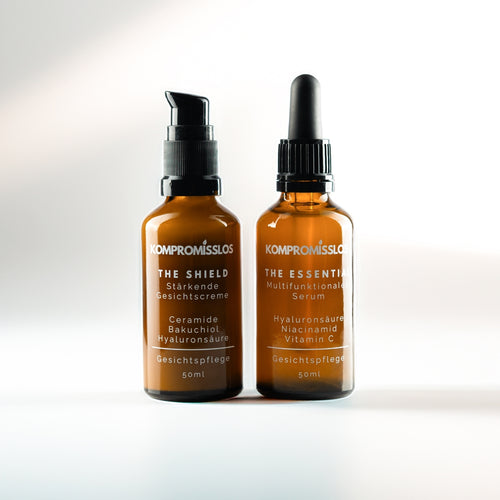
The base underneath, deliberately without its own SPF: The Duo – serum & face cream, developed and made in Switzerland.
How much SPF does your face need day to day?
For everyday life in Switzerland, a sunscreen for your face with SPF 30 and the UVA logo is enough, as long as you spend most of your time indoors and avoid the midday sun. The FOPH names SPF 30 as the minimum for uncovered skin and points out that the sun is strongest between 11:00 and 15:00. Go higher as soon as you spend longer outdoors, head into the mountains or are near snow and water, because reflection further intensifies the radiation. A high number on the tube does not replace sensible behaviour: shade, a hat and clothing work more reliably than any cream. Which measures actually slow down visible skin ageing is set out under what has been shown to slow skin ageing. UV protection is at the top of that list for good reason. If you work in an office and only spend your commute outdoors, SPF 30 on your face covers you well.
The evidence here is unusually clear. A randomised trial from Australia, published in the Annals of Internal Medicine, compared daily with occasional use of a broad-spectrum sunscreen over four and a half years and found less measurable skin ageing in the daily-use group.
How do you combine face sunscreen with serum and cream?
Sunscreen goes on last thing in the morning, after serum and moisturiser. The order follows the texture: first the light, water-based serum, then the cream, then sun protection as the outermost layer. It is worth waiting one to two minutes between steps so that the previous layer can be absorbed. In the evening, sun protection is dropped entirely and you stick to serum and cream working together. With our products, that means three to six drops of serum and three to six pumps of cream, followed by sunscreen in the amount stated on its pack. It is important not to mix the sunscreen into your cream to save a step. Diluting it lowers the protection without you noticing. How our Duo of serum and cream is designed to work together is explained step by step in the how-to-use guide.
A customer wrote to me that her sunscreen was forming small crumbs on top of her cream and would no longer spread evenly. In the vast majority of cases, this is because the layers go on too quickly one after the other. As soon as she let the cream absorb completely and then patted the sunscreen on instead of massaging it in, the problem disappeared.
Is a day cream with SPF enough as sun protection?
In most cases, a day cream with SPF is not enough as your only sun protection, because in everyday use it is applied too thinly. The stated factor is tested in the laboratory with a fixed amount, and when you use a moisturiser you typically apply only a fraction of that. Then there is the second weak point: a day cream is practically never reapplied during the day, whereas sun protection should be renewed after a few hours and after swimming. For an office day with a short commute, a day cream with SPF can still be a reasonable choice, because it is clearly better than no protection at all. As soon as you spend longer outdoors, a separate product belongs on top. The difference is less a question of quality than of application. Both products can contain the same filter and still protect very differently, because the amount on your skin is what counts. The table shows where the two options diverge and what each one is suitable for.
| Criterion | Day cream with SPF | Separate sunscreen |
|---|---|---|
| Amount applied | usually well below the tested amount | can be dosed deliberately |
| Reapplying during the day | practically never intended | intended and practical |
| Usual level of protection | often SPF 15 to 30 | SPF 30 to 50 and higher |
| Suitable for | short trips, mostly indoors | long periods outdoors, mountains, water |
How much sunscreen is enough for your face?
For your face and neck together, you need about two finger lengths of sunscreen – one line each along your index and middle finger, from the base to the tip. The SPF on the packaging is determined with an application amount of 2 milligrams per square centimetre of skin. A review in Photodermatology, Photoimmunology and Photomedicine notes that under real conditions only about 0.39 to 1.0 milligrams per square centimetre are applied, which significantly lowers the actual protection. In practice, this means that if you apply it sparingly, you do not have SPF 50 but a value far below it. Ears, the nape of the neck, the temples and the area above the upper lip are also regularly forgotten. If you use a pea-sized amount, as many people are used to from their skincare, you stay well below the tested amount. This gap is rarely noticed, because sunburn usually does not happen in everyday life. Applying generously and reapplying after a few hours will therefore do more for you than a more expensive product.
When you can skip sunscreen on your face
On days with low UV levels and no extended time outdoors, you do not need sunscreen on your face. In winter, the radiation in the lowlands is considerably weaker than in summer, and if you travel to the office in the morning and back in the evening, you build up hardly any relevant dose. In the evening, sun protection is unnecessary anyway. To be honest, the step is worth it where radiation actually reaches you, not as a daily ritual for its own sake. More important than whether you apply it every single day is whether you stay consistent on days of high exposure. A day’s skiing or a summer hike can expose your skin to more UV than several weeks in the office put together, because snow reflects a considerable share of the radiation. For us, this context is part of the picture, even if it sells less well than the line that everyone needs sunscreen every day. How accumulated radiation shows up years later is explained in age spots and their causes.
When skincare is no longer enough
As soon as a mole changes, a spot does not heal or redness persists, it is a matter for a dermatologist, not for a skincare routine. The FOPH advises having skin changes assessed by a professional and, depending on your history, having a dermatological check-up every one to two years. Cosmetics may improve how your skin looks; they replace neither diagnosis nor treatment. That explicitly applies to us too: serum and cream are skincare products, not medicines. If you are unsure whether a pigmented spot will stay harmless, an appointment with a professional is quicker and, in the end, cheaper. The line runs between appearance and medical findings, and it is not negotiable. No serum and no cream can replace a professional looking at a spot that is changing. If your skin generally reacts quickly and unpredictably, it helps to read up first on recognising and caring for sensitive skin.
I am regularly asked why our skincare does not have an SPF built in. The answer is an uncomfortable one: a product with an SPF would have to be applied in the amount it was tested with, and it would have to be reapplied during the day. With a moisturiser, that is exactly what does not happen. I could have printed a number on the bottle that almost nobody reaches in everyday life. Instead, The Shield cream in the Duo concentrates on what it can do reliably. For the same reason, the Duo contains 2% vitamin C as 3-O-ethyl ascorbic acid rather than a cocktail of filters. Vitamin C works under your sun protection in the morning, not in place of it. All raw materials are listed openly in the overview of ingredients.
Frequently asked questions
Do you need sunscreen on your face when it is cloudy?
Yes. Clouds only partly hold back UV radiation, which is why the FOPH explicitly names cloudy skies as a situation in which particular protection is needed. A thick, dark cloud cover weakens the radiation considerably, whereas thin or broken cloud barely does. If in doubt, rely on the UV index rather than on how it feels.
Which SPF is right for your face?
For everyday life, at least SPF 30 with the UVA logo, according to the recommendation of the FOPH. For longer periods outdoors, in the mountains, on snow or by the water, SPF 50 and higher is the better choice. What matters more than the number, though, is whether you apply enough product and reapply it.
Is there a best face sunscreen in product tests?
Tests by consumer magazines usually check protection, ingredients and labelling – that is, criteria, not a ranking for every skin type. A test winner tells you little about whether a texture suits your skin or whether you enjoy applying it every day. The more useful question is which product you will actually use in sufficient quantity.
Why does the Kompromisslos Duo not contain an SPF?
Because an SPF only protects if it is applied in the tested amount and renewed during the day. A moisturiser is neither. A number on the bottle would therefore promise a level of safety that does not materialise in everyday life. That is why, with us, sun protection deliberately remains a separate step.
Does sunscreen go on before or after make-up?
Sunscreen goes on after skincare and before make-up. Sun protection is the last skincare step and at the same time the first layer that foundation or powder sits on. Let it dry for one to two minutes before you continue, otherwise your make-up will slide or the sunscreen will form small crumbs.
Do you need to reapply sunscreen on your face?
Yes, if you are outdoors for longer. The FOPH recommends reapplying sunscreen after a certain time and after swimming. Sweating, wiping and rubbing also remove the layer. On a day indoors with a short commute, on the other hand, a single application in the morning is enough.
Sources
- Hughes MCB, Williams GM, Baker P, Green AC. Sunscreen and prevention of skin aging: a randomized trial. Annals of Internal Medicine, 2013. Source
- Petersen B, Wulf HC. Application of sunscreen: theory and reality. Photodermatology, Photoimmunology and Photomedicine, 2014. Source
- Federal Office of Public Health (FOPH/BAG). Sonne und UV-Strahlung, 2026. Source