Blue light from screens: is it bad for your skin and do you need blue light skincare?
SKIN OVER 30
Based on what we know today, blue light from screens is not bad for your skin – at least not to a degree that would justify a dedicated skincare product. Phones, tablets and laptops give off only very small amounts of blue light, measured at far below the doses that trigger pigmentation in studies. What matters is visible and blue light from the sun, and even then mainly for dark spots in darker skin types. So you can skip the blue light cream. Sun protection outdoors does far more.
Is blue light from phones and laptops bad for your skin?
In everyday life, blue light from your phone and laptop is very unlikely to harm your skin, because the amount is far too small. There is still a grain of truth to the topic: visible light, and especially its blue part, has a demonstrable effect on the skin. But the data on this come almost entirely from experiments with solar simulators and powerful LED lamps – in other words, with amounts of light that a screen does not come close to. Marketing has turned these laboratory findings into the message that a working day at your laptop ages your skin. That shortcut does not stand up to closer scrutiny. A measurement study in the journal Clinical, Cosmetic and Investigational Dermatology examined six screens in everyday use and concluded that the dose of visible and blue light they give off is small and unlikely to harm the skin with daily use.
What actually affects your skin on a day spent at the screen is usually something else: dry, heated indoor air, too little sleep or your commute on a sunny day. The effect of blue light on your eyes and your sleep rhythm is a separate question that has nothing to do with your skin.
What is blue light, and how much of it comes from screens and how much from the sun?
Blue light is the short-wave, higher-energy end of the visible spectrum, and by far its largest source is the sun, not your screen. Studies usually define visible light as the range from 400 to 700 nanometres – a paper in the Journal of Investigative Dermatology is one example. The blue range sits at the lower end of this scale, right next to UVA light. In the scientific literature it is often called HEV light, short for ‘high-energy visible’. Screens create their image partly with blue light, hence the concern. What matters for your skin, though, is not whether blue is present, but how much of it reaches your skin over a given time. In the measurement study mentioned above, the highest dose of visible light – from a tablet at full brightness and a distance of 25 centimetres – was 0.0420 J/cm² per hour, with the blue part alone at 0.0260 J/cm². The authors give 40 to 80 J/cm² as the threshold for immediate pigment darkening caused by visible light. By that calculation, even in the least favourable measurement it would take around 950 to 1,900 hours of uninterrupted screen time to reach this threshold. Sunlight outdoors delivers the same kind of light on an entirely different scale, together with UV radiation.
What do studies show about blue light, dark spots and skin ageing?
Studies show fairly clearly that strong visible and blue light can trigger pigmentation, whereas there are no robust data on skin ageing caused by blue light in everyday life. The most important older paper comes from the Journal of Investigative Dermatology: 20 volunteers with skin types IV to VI were exposed to UVA1 and to visible light. Both triggered pigmentation, but the pigmentation caused by visible light was darker and lasted longer. In skin type II, meaning fair skin, no pigmentation appeared. A study in the International Journal of Cosmetic Science exposed the forearms of 33 women with skin types III and IV to blue LED light at 450 nanometres and found measurably darker and redder skin 24 hours later.
| Study | Light source | Who | Result |
|---|---|---|---|
| Journal of Investigative Dermatology, 2010 | Visible light in the laboratory | 20 people with skin types IV to VI, plus skin type II | Darker, longer-lasting pigmentation than with UVA1; none in skin type II |
| International Journal of Cosmetic Science, 2020 | Blue LED light, 4 × 60 J/cm² | 33 women with skin types III and IV | Measurably darker and redder skin after 24 hours |
| Journal of the American Academy of Dermatology, 2020 | Blue light like that from screens, short-term | Small group with melasma | No worsening of melasma |
| Clinical, Cosmetic and Investigational Dermatology, 2025 | Six screens, measurements | No participants | Small dose, hardly harmful with daily use |
The table shows the pattern: where effects occur, the amount of light is high and the skin tends to be darker. Where screens were studied, there was no effect. How dark spots develop in the first place and what helps is covered in the article on dark spots on the face. For skin ageing, the UV part of sunlight remains the big lever – more on that in how to slow down skin ageing.
Who is more affected by visible light?
Visible light matters most for people with medium to dark skin and for anyone prone to pigmentation disorders – and specifically as part of sunlight. The studies show this clearly: in skin type II, no pigmentation appeared, while in skin types IV to VI it was pronounced. A review in the Journal of the American Academy of Dermatology concludes that visible light tends to cause redness in fair skin and pigmentation in darker skin. So if you have fair skin that reddens quickly and you rarely get dark spots, the topic barely affects you. If, on the other hand, you tan easily, are left with dark marks after breakouts or already have dark spots on your face, it is worth paying attention to visible light outdoors.
Melasma is a special case: a patchy pigmentation on the face, often partly hormonal, in which visible light is discussed as an aggravating factor. Whether what you have is melasma, and how it should be treated, is a matter for a dermatologist.
What can blue light creams and serums really do?
When it comes to screen light, blue light creams and serums offer nothing you actually need, because the problem does not exist on that scale. With visible sunlight things are slightly different, but the evidence there is thin too. Most blue light products rely on antioxidants or plant extracts. They are typically tested in cell cultures or in short-term studies with powerful lamps, not in real everyday life over several months. One example is the study in the International Journal of Cosmetic Science mentioned above: there, both a formulation with 3% niacinamide and one with a microalgae extract softened the darkening and redness after LED exposure. The study was funded by the company that markets both raw materials, and it worked with a light dose that no screen delivers.
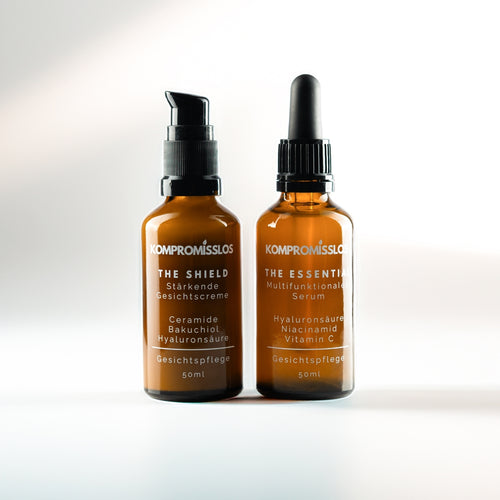
The honest conclusion: antioxidants belong in a good basic routine because they support the skin in general, not because of your laptop. For a realistic look at vitamin C, read what vitamin C can realistically achieve for your skin. The Duo, made up of The Essential serum and The Shield cream, contains 5% niacinamide, vitamin C as stable 3-O-Ethyl Ascorbic Acid, vitamin E and, in the cream, Ceramide NP. It deliberately makes no blue light protection claim, and it has no sun protection factor either. You do not need an extra blue light product alongside it.
What is more important to protect your skin from than screens?
In everyday life, protecting your skin from sunlight outdoors is far more worthwhile than any protection against your screen, because that is where UV radiation and visible light come together in meaningful amounts. Conventional sunscreens mainly filter UV. According to the review in the Journal of the American Academy of Dermatology, only products that are visible on the skin protect against visible light – in other words, tinted sunscreens with iron oxides and pigmentary titanium dioxide. How to choose filters and texture is covered in the article mineral or chemical sunscreen. For where it goes in your morning routine, see the guide to sunscreen for your face if your skincare has no SPF.
When it comes to everyday priorities, a short list is enough:
- Outdoors in daylight: sun protection for your face, in winter and in the mountains too.
- If you are prone to dark spots or have darker skin: consider a tinted version with iron oxides.
- Indoors at your screen: nothing extra – your usual skincare is enough.
- For new, changing or widespread patches: have them checked rather than switching products.
For everything else skincare in your 30s should do, see what a face cream in your 30s needs to do.
If your desk is right next to a window and a lot of sun falls on your face during the day, sunlight is the relevant factor, not the screen in front of you. In that case, sunscreen in the morning makes more sense than any blue light add-on.
There is deliberately no mention of blue light protection on The Duo. The reason is simple: the everyday effect of screens on the skin is not backed by evidence, and I do not want to print a promise I cannot keep. Our routine consists of two products instead of eight, and adding a third one just to solve a marketing problem would not make it any better. I deliberately use vitamin C in the stable form of 3-O-Ethyl Ascorbic Acid, with 2% vitamin C and 5% niacinamide for The Duo as a whole. I am just as open about where the limits are: the cream has no sun protection factor. That is why you need separate sun protection outdoors. You can find every concentration in our active ingredients with disclosed concentrations.
Frequently asked questions
Does working at a screen cause wrinkles?
No, there is no evidence that screen light causes wrinkles. The amounts of light measured from phones, tablets and laptops are very small. Wrinkles are mainly caused by UV radiation, smoking and the natural ageing process. If anything at your screen takes a toll on your skin, it is more likely to be frequent frowning, dry indoor air or too little sleep.
Does night mode on your phone help your skin?
Night mode makes practically no difference to your skin. In one measurement study, it reduced the blue light dose by 18.2 to 62.7 per cent, depending on the smartphone or tablet, at full brightness and a distance of 25 centimetres. Because the dose is already far below the levels that trigger pigmentation even without night mode, this changes little for your skin.
Does sunscreen also protect against blue light?
Conventional sunscreen mainly protects against UV and barely against visible light. Tinted sunscreens with iron oxides work against visible and blue light, because they are visible on the skin and shield it from light. You need neither for screens, but for sun exposure on skin prone to dark spots, the tinted version can make sense.
Do I need sunscreen indoors when I’m at my screen?
You do not need sunscreen indoors because of your screen. It is a different matter if you sit right next to a window with a lot of sun on your face, or if you pop outside briefly at lunchtime. Then it is about daylight, not the device. A morning routine that includes sun protection covers both.
Do antioxidants like vitamin C protect against blue light?
That has not been sufficiently proven. Antioxidants such as vitamin C, vitamin E or niacinamide are tested against light-induced stress in laboratory and short-term studies, often with very high doses of light. Long-term data for everyday life are lacking. They make sense as part of a basic routine, not as a substitute for sun protection.
Can blue light make melasma worse?
Visible light from the sun is discussed as an aggravating factor in melasma. For screens, a small study in the Journal of the American Academy of Dermatology found no worsening after short-term exposure. Melasma is a medical condition, and diagnosis and treatment are a matter for a dermatologist.
Do I need blue light skincare if I use The Duo?
No. You do not need special skincare against screen light, and with niacinamide, vitamin C and vitamin E, The Duo already contains antioxidants for a solid basic routine. The Duo does not promise blue light protection, and it has no sun protection factor. That is why separate sun protection belongs in your routine whenever you are outdoors.
Sources
- Charoenpipatsin N, Yothachai P, Nuntawisuttiwong N, Wongpraparut O, Choosri P, Silpa-Archa N. Dosimetry Assessment of Potential Hazard from Visible Light, Especially Blue Light, Emitted by Screen of Devices in Daily Use. Clinical, Cosmetic and Investigational Dermatology, 2025. Source
- Mahmoud BH, Ruvolo E, Hexsel CL, Liu Y, Owen MR, Kollias N et al. Impact of long-wavelength UVA and visible light on melanocompetent skin. Journal of Investigative Dermatology, 2010. Source
- Campiche R, Curpen SJ, Lutchmanen-Kolanthan V, Gougeon S, Cherel M, Laurent G et al. Pigmentation effects of blue light irradiation on skin and how to protect against them. International Journal of Cosmetic Science, 2020. Source
- Duteil L, Queille-Roussel C, Lacour JP, Montaudié H, Passeron T. Short-term exposure to blue light emitted by electronic devices does not worsen melasma. Journal of the American Academy of Dermatology, 2020. Source
- Lyons AB, Trullas C, Kohli I, Hamzavi IH, Lim HW. Photoprotection beyond ultraviolet radiation: A review of tinted sunscreens. Journal of the American Academy of Dermatology, 2021. Source