Dark spots on the face: what skincare can soften and what it can’t
SKIN CONDITION
Dark spots on the face develop when melanocytes permanently release too much pigment into the epidermis after UV exposure, inflammation or hormonal triggers. Skincare can soften the look of these spots and slow down further darkening. It will not make existing spots disappear. What matters is consistent sun protection, a stable form of vitamin C and patience over several months.
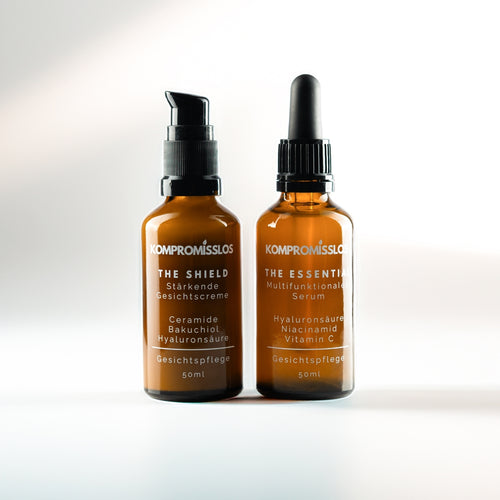
A stable vitamin C derivative (3-O-Ethyl Ascorbic Acid) plus niacinamide is in the serum of The Duo – Serum & Face Cream, made in Switzerland.
What causes dark spots on the face?
Dark spots on the face are caused by locally overactive pigment production. In the lowest layer of the epidermis sit melanocytes, which produce melanin and pass it on in small packages, called melanosomes, to the surrounding skin cells. When UV radiation hits the skin, signalling substances step up this production, because melanin shields the cells’ DNA. If the stimulus persists for years, individual clusters of melanocytes permanently work faster than their neighbours, and that is exactly where a visibly darker spot forms. Besides UV radiation, inflammation can also act as a trigger, for example after a squeezed spot, as can hormonal changes during pregnancy or menopause. Visible light and heat play an additional role. That is why spots tend to appear where the face gets the most sun: the cheekbones, forehead, bridge of the nose and temples. Once you understand this, you can also see why daily sun protection for your face is the foundation of any skincare for dark spots.
What types of dark spots appear on the face?
Four forms of hyperpigmentation are particularly common on the face, and they behave differently. Sun spots and age spots are sharply defined, light to medium brown and remain permanently without treatment. Melasma shows up as large, poorly defined patches of discolouration, usually symmetrical on the cheeks, forehead or upper lip, and reacts strongly to hormones and light. Post-inflammatory hyperpigmentation develops after inflammation, for example after acne or an injury, and in many people fades on its own over months. Freckles are genetic, become more pronounced in summer and are not a sign of skin damage. The distinction matters in practice, because it determines what skincare can achieve at all and when a dermatological assessment makes more sense than the next serum. Incidentally, age itself does not cause spots; it simply adds up hours in the sun. That is why discolouration often only becomes noticeable from the mid-thirties, even though the trigger lies decades back.
| Type | Typical trigger | Appearance | What skincare can do cosmetically |
|---|---|---|---|
| Sun spots and age spots | Cumulative UV radiation | Sharply defined, round, light brown | Soften their appearance, slow darkening |
| Melasma | Hormones plus light | Large, poorly defined, symmetrical | Little; without sun protection, practically nothing |
| Post-inflammatory discolouration | Healed inflammation | Flat, brown or reddish | Support fading, avoid irritation |
| Freckles | Genetic predisposition | Small, numerous, changing with the seasons | Nothing – and nothing is needed |
What can vitamin C realistically do for dark spots on the face?
Vitamin C can slow down the formation of new melanin and so, over months, soften the look of existing dark spots on the face. The mechanism is well studied: the substance inhibits tyrosinase, the key enzyme in pigment formation, and at the same time neutralises free radicals that form after UV exposure. A laboratory study in Free Radical Biology and Medicine showed that 3-O-Ethyl Ascorbic Acid interrupts pigment signalling pathways at several points in irradiated skin cells. These data come from cell culture and an animal model, not from a clinical study on the face, and that is exactly how they should be read. What follows from this is realistic and limited: a good vitamin C keeps new spots fainter and makes existing ones look less contrasting over time. It does not erase pigment that has been sitting in the epidermis for twenty years. The Duo of serum and cream contains 2% 3-O-Ethyl Ascorbic Acid, a stable form of vitamin C that, unlike pure ascorbic acid, does not oxidise within weeks.
What matters is the form, not the number on the pack. Pure ascorbic acid discolours as soon as air gets into the bottle. It is worth understanding why 3-O-Ethyl Ascorbic Acid is the more stable choice before your next purchase.
Which other active ingredients affect your complexion?
Alongside vitamin C, niacinamide is the second active ingredient with solid evidence for an uneven complexion. It works at a different point: instead of inhibiting pigment formation, niacinamide slows the transfer of finished melanosomes to the skin cells. In a study in the British Journal of Dermatology, 5% niacinamide significantly reduced this transfer in a cell model, and the accompanying clinical study showed measurable lightening after four weeks compared with the base without the active ingredient. Two active ingredients, two points of attack – which is why they complement each other well. Then there are ceramides and squalane, which have no effect on pigment but keep the barrier stable so that the skin can tolerate the active ingredients in the first place. What you can skip: aggressive weekly peels, lemon juice and anything that makes your skin red. Every irritation is a new inflammatory stimulus and can intensify existing discolouration rather than soften it. Here, less but every day beats any intensive treatment.
The Duo as a whole contains 5% niacinamide and 1% zinc alongside the vitamin C. All the concentrations are listed on the page covering the ingredients of both products, and how the active ingredient works in detail is explained in our article on the effects of niacinamide.
How long does it take for dark spots to change visibly?
Expect three to six months of daily use before anything noticeable happens to the appearance of dark spots. The reason is biological: in adults, the epidermis renews itself in about four to six weeks, and pigment does not only sit on the surface but is spread across several layers of cells. It takes several complete renewal cycles before slower new production becomes visible at all. If you look in the mirror after three weeks and see nothing, you have not picked a bad product – you have simply looked too soon. What happens alongside also matters. A prospective comparative study in the Journal of the American Academy of Dermatology showed that in melasma, consistent broad-spectrum sun protection significantly reduces relapses. Without this step, any skincare is working against a stimulus that is renewed every day, and the result fails to materialise. Three months with sun protection achieve more than a year with the most expensive serum but without it.
After her summer holiday, one customer wrote to me that the spots on her cheekbones had become darker than ever before, and asked whether the Duo would get rid of them. My answer was an uncomfortable one: get rid of them, no. What made sense for her was first to make sun protection a fixed habit, and then to assess the active-ingredient care of serum and cream with stable vitamin C as a second step. The same logic applies to age spots and how they develop.
Photograph your face every four weeks in the same daylight, from the same position and without make-up. A daily look in the mirror is no good for judging progress. A comparison over four months is.
When should dark spots on the face be seen by a professional?
Any spot that changes should be seen by a dermatologist. In concrete terms, this means a spot that grows, changes colour or becomes multicoloured, develops irregular or ragged edges, bleeds, itches persistently or does not heal in one place. A single spot that is clearly different from all the others should also be looked at. This is no longer a question of skincare, and no skincare in the world replaces this assessment. Large areas of discolouration that appear suddenly, and melasma that keeps getting worse despite skincare, should also be assessed by a specialist. Cosmetic products may and can influence appearance, but they do not diagnose anything and they do not treat skin disease. If you are unsure, get it checked first and look after your skin afterwards. That order costs you one appointment and, if in doubt, saves a great deal more.
For vitamin C, I deliberately decided against pure ascorbic acid. That form is the most potent, but it oxidises quickly, needs a low pH and irritates exactly the kind of skin that already tends to react sensitively when dark spots are an issue. 2% 3-O-Ethyl Ascorbic Acid is weaker on paper and more reliable in everyday use, because on day sixty the product still does the same as on day one. And I deliberately never write that the Duo removes dark spots. It does not. What it does is one contribution among several, and the biggest one is called sun protection.
Frequently asked questions
Can skincare really remove dark spots on the face?
No. Skincare can soften the look of dark spots and slow the formation of new melanin, but it cannot dissolve existing pigment. Products that promise removal cross the line into medical claims. A visibly more even complexion is realistic; spot-free skin after eight weeks is not.
What concentration of vitamin C makes sense for dark spots?
The form is more important than the percentage. Stable derivatives such as 3-O-Ethyl Ascorbic Acid work reliably in the range of around 2% to 5% and cause hardly any irritation. Pure ascorbic acid needs higher amounts and an acidic pH, but oxidises quickly. The Duo as a whole contains 2% 3-O-Ethyl Ascorbic Acid.
Do dark spots get lighter in winter?
Many spots do look paler in winter, because the surrounding skin loses its summer tan and the contrast decreases. The pigment in the spot itself largely remains. With the first stronger sunshine in spring, the same spot often becomes more noticeable again, unless daily sun protection has been used in between.
Do I need sunscreen on cloudy days too?
Yes. UVA radiation passes through clouds and window glass largely unhindered and is the more relevant part when it comes to dark spots. If you only protect your skin when the sun is shining, you expose it on every other day to the very stimulus that causes the spots in the first place. Daily protection clearly beats an occasional high sun protection factor.
Can peels or acids make dark spots worse?
Yes, that is possible if they are used too often or are too strong. Every bout of redness is an inflammatory stimulus, and inflammation is one of the triggers for new discolouration. A gentle exfoliation every one to two weeks is unproblematic for most skin conditions; daily acids on top of vitamin C are not.
What helps with discolouration after spots?
Time helps most. In many people, post-inflammatory discolouration fades on its own over months, provided no new inflammation develops in the same place. Do not squeeze, do not scratch, and protect your skin from the sun consistently. Niacinamide and vitamin C can support the process, but only speed it up to a limited extent.
Can I use vitamin C and niacinamide at the same time?
Yes. The widespread warning against this combination comes from experiments with pure ascorbic acid under heat, not from normal use on the skin. The two active ingredients work at different points in pigment formation and therefore complement each other. They are routinely combined in finished formulations.
Sources
- Chen S.-J. et al., The anti-melanogenic effects of 3-O-ethyl ascorbic acid via Nrf2-mediated alpha-MSH inhibition in UVA-irradiated keratinocytes and autophagy induction in melanocytes, Free Radical Biology and Medicine 173, 2021. Source
- Hakozaki T. et al., The effect of niacinamide on reducing cutaneous pigmentation and suppression of melanosome transfer, British Journal of Dermatology 147, 2002. Source
- Boukari F. et al., Prevention of melasma relapses with sunscreen combining protection against UV and short wavelengths of visible light, Journal of the American Academy of Dermatology 72, 2015. Source